FF Robotics debuts 6 robots and 5 use cases in Dubai
▼ Summary
– FF EAI Robotics Ecosystem Inc. showcased five robotics application scenarios at an industry event in Dubai to accelerate its business expansion in the Middle East.
– The company highlighted how intelligent robotics can transition from demonstrations to practical deployment through local integration, testing, and partnerships with regional entities.
– Application scenarios included entertainment using Master humanoid robots for live events and security patrols utilizing quadruped robots for facility monitoring.
– Educational demonstrations featured the Navi robotics learning platform for STEM curricula, while healthcare presentations illustrated automated smart pharmacy workflows.
– FFR aims to build a globally leading open ecosystem for Physical AI, focusing on scaled deployment across education, security, industrial logistics, and commercial services.
FF Robotics has significantly expanded its footprint in the Middle East by unveiling a suite of six new robots and demonstrating five distinct use cases during an industry event in Dubai. This strategic move underscores the company’s commitment to transitioning embodied AI robotics from theoretical demonstrations to practical, commercial applications across key regional sectors.
DUBAI, UAE (Nov. 23, 2026): FF EAI Robotics Ecosystem Inc. (NASDAQ: FFR), a U. S.-based leader in Embodied AI robotics, presented five application scenarios under the theme “FF EAI Robotics Middle East: From Innovation to Application.” By collaborating with regional partners, the company highlighted how intelligent robotics can be integrated into local workflows through rigorous testing and deployment. This initiative builds upon previously announced strategic cooperation agreements aimed at accelerating FFR’s business growth in the Middle East.
Expanding the Physical AI Ecosystem
FFR is dedicated to establishing a globally leading open ecosystem for Physical AI and robotics. Central to this strategy is the “Four-Core Full-Stack AI” framework, which includes the Physical AI Brain and Developer Platform, Physical AI Devices, Industry Productivity Solutions, and the Physical AI Data Factory. The company works alongside partners to advance real-world robot applications and scaled deployment across four primary industry ecosystems: Education and Research, Security and Inspection, Industrial and Logistics, and Commercial and Services. This Dubai event represents a critical milestone in that expansion.
The showcased scenarios illustrated the versatility of these technologies across diverse industries. In the entertainment sector, LEAP Interactive collaborated with FFR to demonstrate a coordinated performance by three Master humanoid robots. This display highlighted potential applications in exhibitions, live events, and audience engagement, showcasing the capacity for synchronized robotic movement in public-facing roles.
For security and inspection operations, a quadruped robot performed a simulated patrol workflow. The demonstration included incident identification, image capture, alert generation, and voice warnings. These capabilities point toward future uses in facility operations and site monitoring, although actual implementation will depend on practical testing, specific site conditions, and customer requirements.
In the education and research space, Mangobot presented a classroom interaction involving an instructor, students, and the Navi robotics learning platform. This scenario illustrated methods for combining robotics hardware with programming activities, practical learning exercises, and STEM-oriented curricula, offering a tangible glimpse into next-generation educational tools.
Healthcare and Sports Applications
The healthcare scenario featured a smart pharmacy workflow where a robot retrieved medication from a designated station upon instruction. This demonstration offered a possible approach to selected automated pharmacy processes, though it did not represent a completed commercial deployment or an autonomous clinical service. It served as a proof-of-concept for automation in controlled medical environments.
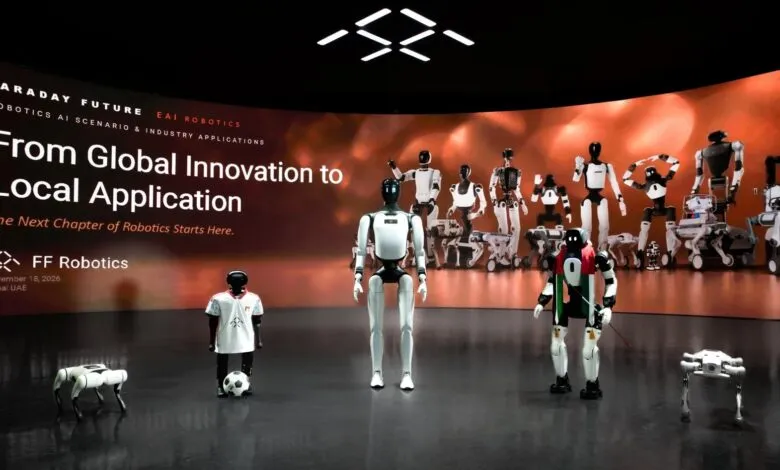
The fifth scenario focused on interactive sports. In collaboration with Booster, FFR presented a live robot soccer demonstration featuring the Master Mini. This event illustrated potential applications in sports education, interactive public events, and community engagement, emphasizing the role of robotics in recreational and educational settings.
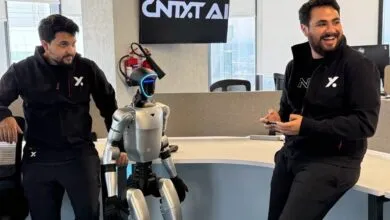
Separately, a Futurist humanoid acted as the event host with support from Action To Action, reflecting possibilities in reception duties and visitor interaction. FFR and its partners are actively exploring how these demonstrations can be adapted for real-world use. Potential applications will hinge on factors such as reliability, safety, integration with existing workflows, technical support availability, and overall commercial value. Progress may vary by scenario and specific customer needs.
New Product Portfolio and Pricing
FFR introduced six products to the Middle East market: Futurist, Master Mini, Nova, Nova Mini, Aegis Mega A, and Faber. Combined with existing models like Master, Aegis, and Navi, the regional lineup now comprises nine products spanning humanoid robots, quadruped robots, and mobile manipulators designed for a wide range of applications.
The company presented suggested regional prices ranging from AED 1,190 for the Nova Mini to AED 399,000–650,000 for the Faber model. Final pricing will be affected by configurations and applicable taxes. This product strategy reflects FFR’s “One Brain, All Robots, Diverse Capabilities” philosophy and its broader “Four-Core Full-Stack AI” ecosystem.
Local Partnerships Drive Commercial Deployment
FFR’s regional approach combines robotics devices and AI technology with local industry knowledge, system integration capabilities, service infrastructure, and customer access. Partners play a crucial role in identifying suitable scenarios, evaluating technical and operating requirements, and facilitating the progression from pilots and proof-of-concept projects to commercial adoption.
Origin Group’s cooperation supports the commercial side through direct sales, robot rental, and Robot-as-a-Service (RaaS) arrangements. These options may provide customers with alternatives to outright equipment ownership, supporting adoption across different industries. Specific commercial terms and deployments remain subject to further agreement.
This scenario-by-scenario model is designed to connect global Physical AI development with local deployment expertise. FFR and its partners aim to translate early customer discussions into clearly defined use cases, then assess technical feasibility through pilot programs before considering longer-term operating arrangements. Successful adoption will depend on customers, integration partners, and service providers working together through each stage.
“Bringing robots to the Middle East is only the first step. By working with local partners, we aim to identify meaningful applications and explore how these technologies can be used in real-world settings,” said Morris Gao, Head of UES, FF Middle East.
FFR believes the Middle East offers significant opportunities across education, retail, hospitality, security, public services, and industry. The next phase focuses on working with regional partners to assess customer requirements, develop industry-specific use cases, and evaluate commercially viable deployment opportunities. The pace and scope of each opportunity will depend on partner readiness, customer demand, and results from preliminary technical evaluations.
The event reinforced FFR’s central proposition: the future of Physical AI will be shaped not only by what robots can demonstrate, but by whether they can become reliable, useful, and economically viable components of everyday operations.
(Source: ME Tech Watch)