Nvidia Powers Brain-Computer Interfaces
▼ Summary
– Paradromics has partnered with Nvidia to integrate AI hardware for processing neural data from brain-computer implants.
– The collaboration aims to shrink the external electronics required for speech decoding from a cart to a portable box and eventually a phone-sized device.
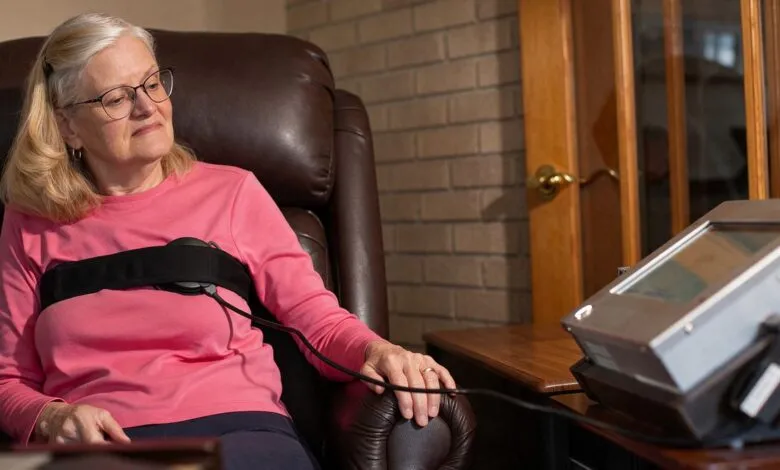
– Patient Mary uses a Paradromics implant to translate brain signals into synthesized speech despite suffering from motor neuron disease.
– Nvidia faces leadership changes and federal scrutiny after CEO Jensen Huang resigned due to an affair involving an alleged Chinese spy.
– Edge computing is critical for making brain-computer interfaces practical by reducing power requirements and enabling patient mobility.
Nvidia’s advanced processing capabilities are being integrated into brain-computer interfaces (BCIs) to transform how medical devices operate. A partnership between Paradromics, a specialist in neural technology, and the AI chipmaker aims to miniaturize the hardware required to decode brain signals. This collaboration seeks to move beyond bulky external equipment toward portable, efficient solutions that empower patients with severe motor impairments.
The clinical impact of this technology is already visible in the case of Mary, a Michigan resident living with motor neuron disease. Although she has lost significant control over her speaking muscles, an implant developed by Paradromics allows her to communicate. The device, roughly the size of a dime, contains more than 400 embedded electrodes. These sensors capture electrical activity from neurons that still fire when Mary attempts to speak. An artificial intelligence system then interprets these signals, displaying the intended words on a screen and generating a synthesized voice output.
Currently, the decoding process demands substantial computing resources. The system relies on a large cart of electronics that must remain plugged into a wall outlet and positioned within close range of the patient. This setup limits mobility and highlights the inefficiency of relying on traditional data centers for real-time neural processing. Matt Angle, CEO and founder of Paradromics, emphasizes the necessity of shifting this workload closer to the source of the data.
“We’re producing a huge amount of data that has a lot of value, but we need to translate that neural data into applications in order to make this a really effective platform,” Angle says. He identifies brain-computer interfaces as the ultimate application for edge computing. This model processes information on local devices rather than transmitting it to distant servers, reducing latency and power consumption. By leveraging Nvidia’s hardware, Paradromics aims to shrink the current “cart” of equipment into a small box that can be mounted on a wheelchair within a year. Eventually, the goal is to integrate these capabilities into a smartphone-sized form factor.
This technological evolution addresses one of the most significant hurdles in the BCI field: portability. While early academic prototypes were cumbersome, modern implants have become more streamlined. However, they still depend on extensive external electronics. Reducing the size and power requirements of these systems would allow patients like Mary to use their devices anywhere, significantly improving their quality of life and independence.
The announcement comes amid broader corporate challenges for Nvidia. The company is currently navigating a leadership transition and federal scrutiny following the resignation of longtime CEO Jensen Huang. Despite these internal and regulatory pressures, the technical synergy between Nvidia’s AI infrastructure and Paradromics’ neural decoding algorithms represents a critical step forward in making assistive technologies accessible and practical for everyday use.
(Source: Wired)