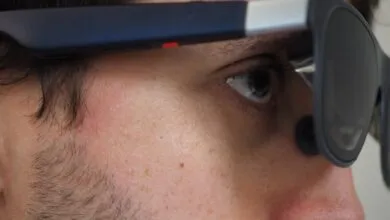
Unseen Reality XR Glasses Raises $1.2M on Kickstarter

▼ Summary
– Unseen Reality successfully concluded its Kickstarter campaign for the URXR One mixed reality glasses, raising over $1.2 million.
– The URXR One is a lightweight 93g headset that uses mini pancake optics and connects to external devices via USB-C rather than being standalone.
– Unlike birdbath-style AR glasses, this device functions as a slim display replacement for laptops, phones, and gaming handhelds.
– Early backers secured the device at $800 with shipping targeted for mid-October 2026, while the standard MSRP is set at $900.
– Technical specifications include dual micro-OLED displays, 6DOF tracking, and support for up to three virtual screens in app mode.
Unseen Reality has successfully closed its crowdfunding campaign for the URXR One, a pair of mixed reality glasses designed to replace traditional monitors. The project, which launched on Kickstarter last month, officially concluded with total contributions surpassing $1.2 million. Specifically, the company reported raising $1,288,712, far exceeding its initial target of $50,000 within minutes of going live on August 4th.
Unlike the “birdbath” style augmented reality glasses popularized by brands like Viture and Xreal, the URXR One functions more as a lightweight virtual reality headset with video passthrough capabilities. While it shares some aesthetic similarities with standalone devices like the Meta Quest, it is not an independent unit. Instead, it requires a physical tether to external hardware, such as a laptop, smartphone, tablet, or gaming handheld, to function. This design choice allows Unseen Reality to position the device as a portable, slim display solution that users can easily carry in a bag for viewing flatscreen content, including games, films, web browsing, and spreadsheets.
The device’s compact form factor is achieved through two primary engineering decisions: the use of ultra-thin pancake optics and the elimination of internal computing and battery components. Weighing just 93 grams, the headset shifts the bulk of processing power to the connected host device. It connects via USB-C DisplayPort Alt Mode, ensuring compatibility with a wide range of modern electronics. Despite lacking onboard compute, the glasses feature their own spatial processing unit dedicated to handling six degrees of freedom (6DOF) tracking.
Hardware Specifications and Visuals
At the core of the visual experience are dual 1.03-inch micro-OLED displays, one for each eye. These panels deliver a resolution of 2,448 x 2,064 pixels per eye, resulting in a pixel density of approximately 36 pixels per degree (PPD). The refresh rate sits at 90 Hz, providing smooth motion for both virtual and passthrough content. The optical system offers a diagonal field-of-view of 90 degrees, measuring roughly 80 degrees horizontally and 56 degrees vertically. In-eye brightness is rated between 120 and 140 nits, with a virtual image distance set at about 1.1 meters.
For those who backed the project during the Kickstarter phase, the early bird price was set at $800. These backers are targeted to receive their units starting in mid-October 2026. The standard manufacturer’s suggested retail price (MSRP) for general orders is listed at $900, though exact shipping timelines for non-backers remain undefined. Interested consumers can find further details regarding pricing and future availability on the official URXR One website.
Tracking, Connectivity, and Design Features
Beyond the visual components, the URXR One integrates a sophisticated array of sensors and cameras to facilitate interaction. It utilizes a dual-camera SLAM system combined with a 1000 Hz IMU for precise spatial tracking. Additionally, four forward-facing cameras handle video see-through (VST) functionality, delivering a passthrough resolution of 2,328 x 1,728 at 90 frames per second with latency under 10 milliseconds. Users can switch between native 3DOF and 6DOF modes directly on the glasses.
The headset includes a four-microphone array for audio input, though it notably lacks built-in speakers. Interaction is managed through physical buttons, hand tracking, gestures, and support for external keyboards and mice. A dedicated NPU works in tandem with the on-glasses SPU to manage these inputs efficiently.
Physically, the frame features hinged and flexible temples that fold inward and flex outward to accommodate various head widths. The IPD adjustment is manual, ranging from 58 to 68 mm. When unfolded, the dimensions are approximately 150.01 mm in width, 71.06 mm in height, and 170.83 mm in length. Folding reduces the depth significantly, making it highly portable. The cable exit is located on the right side, featuring a 1.35-meter cord. A notable accessory included in the ecosystem is the Cross-platform Bridge Power Hub, which not only powers the glasses but also charges connected phones and handheld gaming consoles, addressing potential battery drain issues on the host device.
(Source: Road to VR)