▼ Summary
– A new study in Frontiers in Psychology reveals that chimpanzees learn tool use through social learning, where adults model behaviors and transfer tools to offspring.
– Researchers Andreu Sánchez-Megías and colleagues suggest that food and tool transfers serve as a teaching method, with mothers acting as primary instructors for young chimps.
– Historically, tool use was considered unique to humans until Charles Darwin noted chimpanzees cracking nuts in 1871 and Jane Goodall observed termite fishing in 1960.
– Chimpanzees have been documented using various tools including leaf sponges, shaped sticks for algae, and sharpened spears for hunting, challenging previous definitions of humanity.
– Other species like dolphins and octopuses also exhibit tool-related behaviors such as throwing objects, which may serve purposes like communication or social bonding.
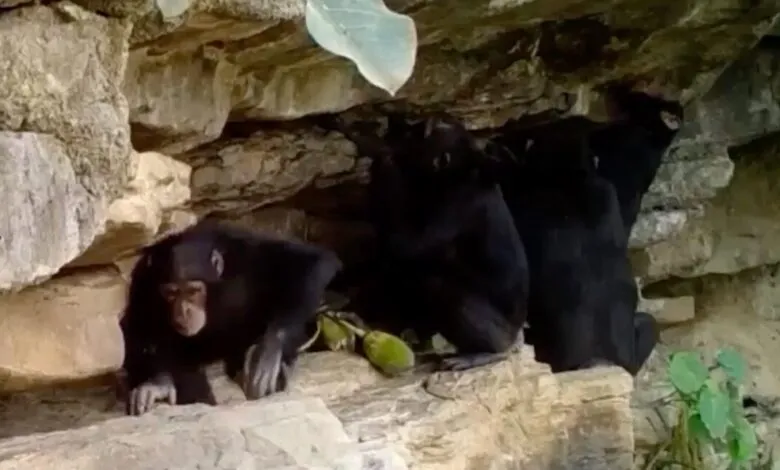
Recent research published in Frontiers in Psychology confirms that chimpanzees actively teach their young how to use tools, a skill previously understood as merely instinctual or individually discovered. The study highlights that this knowledge is transmitted through social learning, where adult chimps do not just perform tasks for juveniles to watch but engage in deliberate instruction. This process involves adults modeling the technique and then physically handing over the tools, allowing the offspring to replicate the exact motions required to access food.
Andreu Sánchez-Megías, a graduate student at the University of Barcelona and the Jane Goodall Institute Spain who conducted fieldwork in Senegal, emphasized the significance of these interactions. “Receiving food and tools from experienced individuals, which we call food or tool transfer, may help chimpanzees learn to use technology to extract foods that are difficult to access,” he stated. He further clarified the role of maternal figures in this educational dynamic: “Tool transfers thus appear to be a form of teaching, together with observation and supervised practice. It appears that mothers are the main models and teachers for young chimpanzees in this manner.”
The understanding of primate intelligence has evolved significantly since the mid-19th century. While Charles Darwin noted in 1871 that chimpanzees used stones to crack nuts, the behavior was long considered a unique hallmark of humanity. That perspective shifted dramatically in 1960 when primatologist Jane Goodall observed a chimp named David Greybeard bending a twig to strip leaves and spoon termites from a nest. The discovery was so profound that Goodall’s mentor, Louis Leakey, remarked, “Now we must redefine ‘tool,’ redefine ‘man,’ or accept chimpanzees as humans.” Since that pivotal moment, scientists have documented more complex behaviors, such as crafting leaf sponges to drink liquids, shaping sticks to harvest algae, and sharpening wooden spears for hunting.
While tool use is most prevalent among monkeys and apes, it is not exclusive to them. Other species demonstrate similar capabilities, though often in different contexts. For instance, dolphins have been seen tossing objects, a behavior some researchers classify as tool use, particularly when it involves other members of their pod. These actions may serve multiple functions, including communication, strengthening social bonds, or displaying aggression. Similar throwing behaviors have also been recorded in octopuses, suggesting that the manipulation of the environment for specific purposes may be a broader phenomenon across animal kingdoms.
(Source: Ars Technica)