▼ Summary
– Scientists have confirmed that the stones at Devil’s Arrows were transported by humans from a site 18 kilometers away, rather than by glacial movement.
– This finding highlights the significant effort Neolithic communities exerted to create sacred landscapes in understudied areas like Yorkshire.
– Recent chemical analyses of Stonehenge reveal its bluestones originated in western Wales while sarsen stones came from the nearby Marlborough Downs.
– A 2024 study identified the Stonehenge Altar Stone as originating from the Orkney region in northeast Scotland, challenging previous assumptions about its source.
– These discoveries contribute to ongoing debates regarding whether human labor or natural forces like glaciers were primarily responsible for moving these massive megaliths.
Uncovering the Origins of Yorkshire’s Megaliths
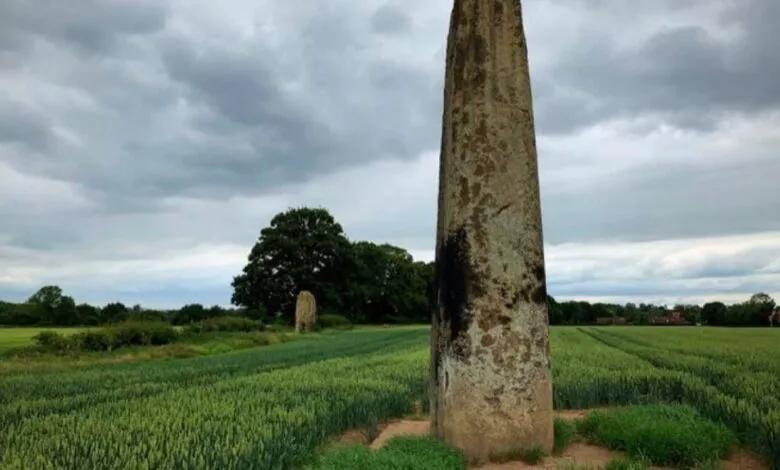
While Stonehenge dominates the public imagination as the premier example of megalithic engineering in Britain and Ireland, other monumental sites like Calanais, Newgrange, and Avebury hold significant historical weight. Among these, the Devil’s Arrows stand out as the tallest standing stone alignment in the country, yet their origins remained shrouded in mystery for centuries. Recent scientific analysis has finally resolved this enigma, confirming that the stones were not deposited by glacial activity but were deliberately transported by human hands from a source located 18 kilometers (11 miles) away. These findings, published in the Proceedings of the Royal Society A: Mathematical, Physical and Engineering Sciences, highlight the immense logistical capabilities of Neolithic communities.
“Sites in southern England and Scotland receive considerable attention but monuments like the Devil’s Arrows have remained comparatively understudied despite their significance,” said co-author Jim Leary of the University of York. “We have now proved that Neolithic communities moved several 25-ton stones across Yorkshire, transforming a familiar site into an epic quest to create a sacred landscape.”
This discovery places the Devil’s Arrows within a broader context of long-distance stone transport seen in other British monuments. Recent chemical analyses of Stonehenge have traced its components to distant quarries, revealing a complex network of material sourcing. For example, a 2019 study determined that the 42 bluestones forming the inner ring originated in western Wales, while the outer sarsen stones came from the Marlborough Downs, approximately 25 to 30 km north of the site. The Marlborough Downs contain the largest concentration of sarsen rock in the UK, making it a logical local source for the larger stones.
The narrative of Stonehenge’s construction continued to evolve in 2024 when Anthony Clarke, who also co-authored the new Devil’s Arrows study, led research identifying the origin of the Altar Stone. Contrary to previous assumptions that linked it to Wales, the team found evidence pointing to the Orkney region in northeast Scotland. This finding reignited debate regarding the methods used to move such massive weights over vast distances. While some theories suggest that glaciers carried bluestones partway from Wales to Salisbury Plain, others argue for human agency. The precise mechanics of how Neolithic people accomplished these feats remain a subject of ongoing investigation, with the Devil’s Arrows study providing crucial comparative data on human-led transport versus natural deposition.
(Source: Ars Technica)