How Cal AI’s Influencer Strategy Drove Viral Success
▼ Summary
– Zach Yadegari, a 19-year-old high school graduate, founded the AI calorie tracking app Cal AI which achieved viral success and $30 million in revenue within two years.
– The company’s rapid growth was driven by a strategy of paying influencers to promote the brand, leading to its acquisition by MyFitnessPal in March.
– Yadegari detailed his influencer marketing approach at TechCrunch Disrupt, emphasizing linear conversion rates and targeting tight-knit communities for better reach.
– He expressed skepticism about the value of higher education, suggesting college is primarily for social experiences rather than professional advancement.
– Yadegari recently launched Persona, a new AI agent startup that has raised $10 million with a mission to create a seamless hardware ecosystem for personal AI assistants.
Zach Yadegari, a 19-year-old high school graduate, has achieved remarkable commercial success with Cal AI, an artificial intelligence-powered calorie tracking application. The company, established in 2024, experienced explosive growth by leveraging a specific marketing approach centered on influencer partnerships. This strategy propelled the brand to viral status, resulting in more than $30 million in revenue within two years and leading to its acquisition by MyFitnessPal in March for undisclosed terms.
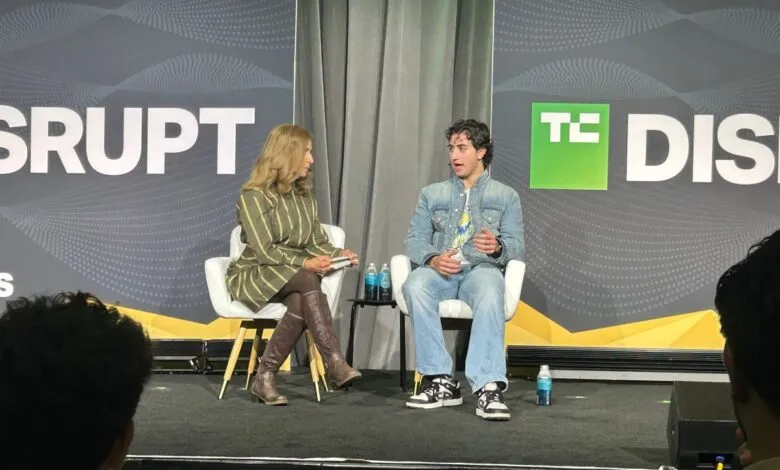
During a presentation at TechCrunch Disrupt, Yadegari detailed the mechanics behind this rapid ascent. He identified a pivotal moment when a single influencer post attracted approximately one thousand new users over a 48-hour period. This initial traction validated the potential of paid social promotion for the startup.
“From there, we figured out, okay, this can actually work for us, and so we started recruiting influencers as fast as we could , paying as many people as possible to start posting for us,” he said. “What we saw was that it was a clear formula. It was pretty linear, but it was extremely fast. I guess linear in the sense that every post they did would get a certain number of viewers that would convert.”
The core of Cal AI’s promotional model involved negotiating fixed payouts based on guaranteed reach metrics. Yadegari noted that many influencers were students seeking immediate income. The strategy required setting clear performance targets.
“A lot of influencers are ‘broke college kids’ who ‘just want cash,’ Yadegari added. ‘You just ask them, okay, we’ll pay you this, but we need to get us at least this amount of use and keep posting until you get there.’”
Success also depended on selecting creators with highly engaged audiences rather than just large follower counts. Yadegari emphasized the importance of community cohesion in driving conversions.
“The biggest thing for us was finding influencers that had very tight communities,” the founder said.
Yadegari acknowledged the support of his family, whose presence in the audience highlighted their role in enabling his entrepreneurial pursuits. When asked about the value of higher education in his journey, he offered a candid perspective that drew laughter from the crowd.
“I think the only real reason to go to college is if you want to have a fun social time as a kid and be with other people,” he said.
Beyond Cal AI, Yadegari recently expanded his portfolio with Persona, a new AI agent startup that has secured $10 million in funding. The venture aims to integrate artificial intelligence seamlessly into daily routines.
Yadegari stated that the “overarching mission” with Persona is to “make computing seamless with human life.” The personal AI assistant is designed to operate across various digital touchpoints, including iMessage, email, phone calls, and standalone applications. A key differentiator for the project involves developing a hardware ecosystem to complement the software experience.
(Source: TechCrunch)