GM: Apple CarPlay Was Never Removed, So It Can’t Be ‘Brought Back’
▼ Summary
– GM announced new software updates for the Chevy Silverado and GMC Sierra that enhance Apple CarPlay and Android Auto with picture-in-picture features.
– This announcement has caused public confusion regarding whether GM is reinstating phone mirroring in its electric vehicles, which have lacked these features since 2023.
– GM’s electric vehicle lineup, including the Equinox EV and Cadillac Lyriq, continues to use Google-based operating systems without native CarPlay or Android Auto support.
– GM CEO Mary Barra previously stated that the ban on phone projection might extend to gasoline vehicles, but the company later clarified that CarPlay and Android Auto would remain available in ICE models for the foreseeable future.
– The recent update signals that GM is adapting its strategy to co-exist with popular phone mirroring technologies in its traditional internal combustion engine trucks rather than removing them.
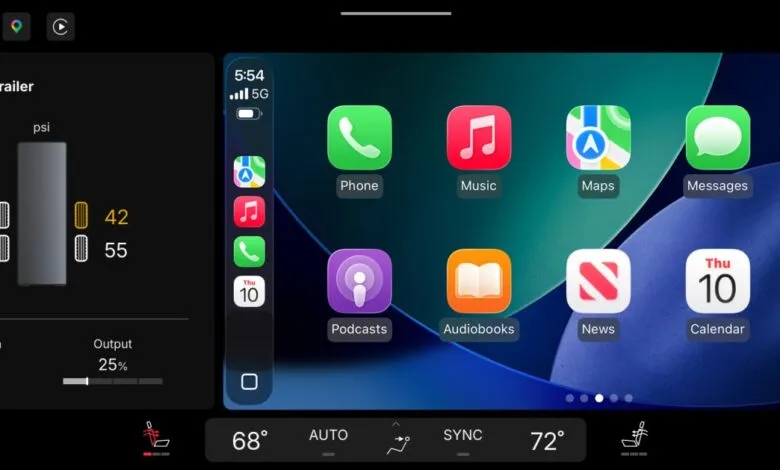
General Motors has clarified that Apple CarPlay was never actually removed from its vehicles, meaning the recent updates to the interface cannot be characterized as a “return” of the service. This distinction emerged following the automaker’s announcement of a new software experience for the upcoming Chevy Silverado and GMC Sierra trucks, which features an updated look for both Apple CarPlay and Android Auto. These phone mirroring systems had been a focal point of controversy after GM excluded them from its electric vehicle lineup in 2023.
The announcement sparked immediate confusion across the automotive media landscape. Reports from Yahoo Finance described the move as an “about-face” by the company, while Apple Insider claimed GM had “caved” on its previous restrictions. Even tech commentators were left puzzled by the narrative shift. The misunderstanding stems from the fact that while GM stopped offering phone projection in its EVs three years ago, it never disabled the feature in its internal combustion engine (ICE) models. Consequently, tens of thousands of owners of gas-powered GM trucks and SUVs have continued using these interfaces without interruption.
The Electric Vehicle Disconnect
For three years, buyers of GM’s electric lineup have been unable to use phone projection. This restriction applies to a wide range of models, including the Chevy Equinox, Blazer, Bolt, and Silverado EV, as well as Cadillac’s Lyriq, Optiq, Vistiq, and Escalade IQ. It also affects the GMC Sierra and Hummer electric SUVs and trucks.
Instead of CarPlay or Android Auto, these vehicles rely on Google’s ecosystem. GM builds its operating system on top of Android Automotive, often referred to as Google Automotive Services (GAS) when bundled with native applications like Maps and Gemini. While this integration provides robust built-in navigation and assistant capabilities, it does not replicate the familiar app layout users expect when connecting their smartphones. Drivers hoping to mirror their phones wirelessly or via cable will find no such option in these electric models.
Clarifying the Strategy
The source of much of the public outcry can be traced back to statements made by GM CEO Mary Barra. During an October 2025 appearance on the Decoder podcast, Barra defended the decision to prohibit CarPlay in EVs and hinted that the policy might eventually extend to the gasoline-powered lineup. This comment alarmed many truck and SUV owners who feared losing access to the technology they relied on.
In response to the backlash, GM quickly walked back those implications. The company clarified to multiple outlets that Apple CarPlay and Android Auto would remain available in its gas-powered vehicles “for the foreseeable future.” The recent software update for the Silverado and Sierra appears to be part of that ongoing commitment, introducing picture-in-picture upgrades that enhance the user experience rather than replace it.
Navigating Two Systems
To understand the nuance behind this strategy, I spoke with Colin McCormick, group product manager for Google Built-in, projection, and profiles at GM. He explained that GM was an early adopter of these technologies and recognized the value customers place on them. However, the company faced a structural challenge: having two distinct, competing systems running simultaneously within the same vehicle.
> And so the way that I look at this is that we were one of the early adopters of CarPlay and Android Auto when it first came out. And we do have a small segment of EVs right now that don’t offer that, but there is a large majority of our vehicles that do offer that. And our big position on this is that it shouldn’t be two competing systems. So as we work together with Apple and Google to provide solutions that we think are best for the customer, this is what we’re representing in this new UI design. So I think we’re landing in a spot where … we don’t have a customer that has to decide, ‘Oh, I’m going to use projection,’ or, ‘Oh, I want to use the native system.’ That’s our sweet spot for us. And that’s where we want to live.
McCormick’s comments highlight GM’s attempt to find a middle ground where customers do not have to choose between the native infotainment system and phone projection. By integrating the two more seamlessly, GM aims to eliminate the friction caused by maintaining parallel software ecosystems.
The Reality of User Preference
Despite GM’s efforts to streamline the experience, the underlying reason for the controversy is simple: consumers prefer phone mirroring. CarPlay and Android Auto offer clean, familiar, and largely dependable interfaces that contrast sharply with many modern native car operating systems. Even highly-rated manufacturers like Rivian and Tesla face criticism for struggles with basic functions such as profile logins and message handling.
While CarPlay and Android Auto are not flawless,often plagued by connectivity issues,they remain superior to the majority of proprietary automotive software currently on the market. GM acknowledges that its native systems are improving, but removing choice is a risky proposition. The company likely realized that alienating customers over phone projection was unsustainable.
By introducing picture-in-picture functionality, GM is finding a way to coexist with these popular services. This approach allows the automaker to avoid further customer churn while addressing the technical redundancy of running two separate systems. Ultimately, this update helps GM escape the corner it backed itself into during its initial push to remove phone mirroring from its EVs, signaling a pragmatic shift toward satisfying customer demand rather than forcing a specific technological vision.
(Source: The Verge)