China Tells Tech Giants to End Price Wars, Focus on AI Investment

▼ Summary
– A top Communist Party journal, Qiushi, signaled a regulatory shift toward balancing support for growth with oversight, ending the crackdown era for China’s internet platforms.
– The commentary urges platforms like Alibaba and Meituan to stop “involution-style” price wars and compete on value instead of subsidies.
– It directs companies to increase investment in strategic technologies, specifically artificial intelligence and cloud computing, for higher-value growth.
– The policy follows years of scrutiny, including fines and antitrust actions, that wiped hundreds of billions from tech market capitalizations between 2021 and 2023.
– The new framework means higher compliance costs and tighter algorithm transparency, rewarding companies that redirect spending from price wars to AI.
A top Communist Party journal has issued a clear directive to China’s largest internet platforms: end the price wars and redirect capital toward artificial intelligence investment. The draft commentary, slated for publication in the Qiushi journal on Monday, signals a notable regulatory stabilization after years of intense scrutiny and crackdowns on the tech sector.
The guidance, directed at companies such as Alibaba, Meituan, and PDD Holdings, reiterates Beijing’s long-standing opposition to what it calls “involution-style” competition. This term refers to the aggressive subsidies and price wars that have dominated Chinese e-commerce. Platforms are now instructed to compete on value rather than on who can sustain the deepest losses. The commentary also calls for tighter oversight of algorithms, data usage, and consumer protection.
More significantly, the piece encourages platforms to boost investment in strategic technologies, particularly artificial intelligence and cloud computing. Beijing is steering its tech giants away from subsidy-fueled margin destruction and toward higher-value growth areas. “The healthy development of the sector depends on a sound governance system and effective regulatory measures,” the commentary states. “The irregularities seen in China’s platform economy are partly linked to the fact that regulatory and governance frameworks have yet to fully adapt to its characteristics.”
This policy shift follows years of heavy-handed regulation. In 2021, Alibaba was fined $2.8 billion. Didi was forced to delist from the New York Stock Exchange. Meituan faced antitrust investigations. PDD’s Temu has faced pressure over merchant fees and pricing. Between 2021 and 2023, these regulatory actions wiped hundreds of billions of dollars from Chinese tech market capitalizations.
The Qiushi commentary suggests Beijing is moving from a crackdown phase to a calibration phase. The regulatory environment is stabilizing, but compliance costs are rising and operational constraints are tightening. Platforms are being given permission to grow again, but with conditions.
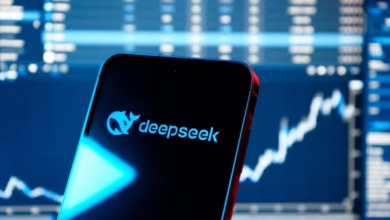
Chinese AI companies are already competing fiercely on price. This week, DeepSeek permanently cut its V4 Pro model pricing by 75%, undercutting every Western frontier model. The Qiushi commentary’s call for AI investment aligns with a broader national strategy to dominate the AI stack, from models to chips to applications.
China’s technology exports are expanding simultaneously across multiple fronts. BYD, Chery, and Geely are entering Canada. Xiaomi shipped 600,000 EVs in under two years. CXMT’s DRAM is appearing inside Corsair kits. The platform regulation signal is one piece of a larger industrial policy that encourages Chinese companies to invest in strategic technologies at home while competing globally.
For investors, the message is cautiously positive. The crackdown era appears to be over. Alibaba’s stock has recovered significantly from its 2022 lows. But the new framework means higher compliance costs, tighter algorithm transparency requirements, and an end to the subsidy-driven growth models that built Pinduoduo and Temu. Companies that redirect spending from price wars to AI will be rewarded. Those that do not will face regulatory pressure.
The Qiushi journal is the Communist Party’s premier theoretical publication. Commentary published in it reflects official policy direction rather than speculative opinion. When it tells China’s platforms to stop fighting on price and start investing in AI, the platforms listen. The question is whether the investment produces genuine innovation or compliance theatre. Beijing is betting on the former.
(Source: The Next Web)