Astronauts Return to Earth After Historic Moon Mission
▼ Summary
– NASA’s Orion spacecraft successfully returned to Earth, splashing down in the Pacific Ocean and completing the first crewed lunar mission in nearly 54 years.
– During re-entry, the capsule endured temperatures of about 5,000°F and a communications blackout as it was enveloped in a plasma sheath.
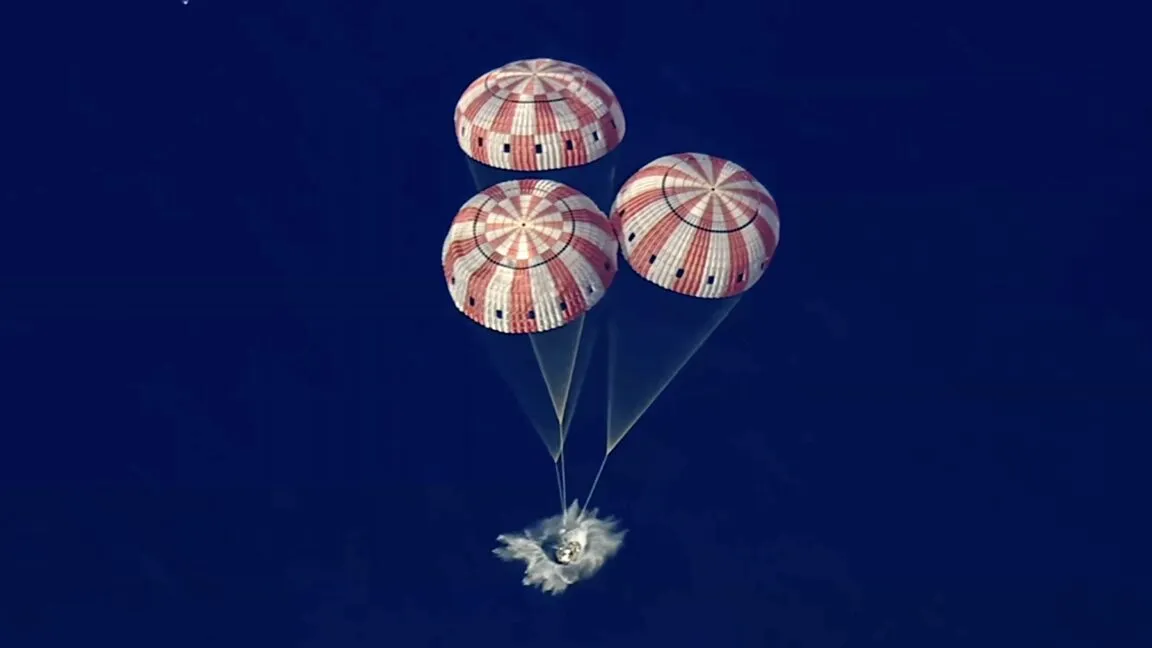
– The spacecraft used a series of parachutes, including three large main chutes, to slow from extreme speed for a gentle ocean landing.
– The four astronauts were confirmed to be in good health and were recovered by a U.S. Navy ship using small boats and helicopters.
– The crew, consisting of commander Reid Wiseman and astronauts Victor Glover, Christina Koch, and Jeremy Hansen, exited the capsule one by one for medical checks and transport.
A fiery streak across the Pacific sky marked the end of a monumental journey on Friday. NASA’s Orion spacecraft, carrying its four-person crew, endured a blistering atmospheric reentry at over 30 times the speed of sound, successfully concluding the first human mission to the Moon in over half a century. The capsule, named Integrity, was sheathed in plasma reaching approximately 5,000 degrees Fahrenheit during its descent, which temporarily severed communications with Mission Control in Houston. After a tense six-minute blackout, ground teams reestablished contact with commander Reid Wiseman as the vehicle steered toward its targeted splashdown zone.
The dramatic final moments were captured by airborne tracking planes. Video relayed to Houston showed the capsule jettisoning its parachute cover before deploying a sequence of stabilizing chutes. Three massive main parachutes, each spanning 10,500 square feet, then billowed open to gently lower the spacecraft into the Pacific Ocean at 8:07 p.m. EDT. In a mere 14 minutes, Orion shed nearly 25,000 miles per hour of velocity, with the crew experiencing two short periods of force around 3.9 times Earth’s gravity.
Waiting nearby was the recovery ship USS John P. Murtha. From the cockpit, Wiseman radioed the welcome news of “four green crew members,” indicating the entire Artemis II crew was in good health. Navy divers quickly assembled an inflatable raft alongside the bobbing capsule, a platform they call the “front porch.” Mission specialist Christina Koch was the first to emerge, followed by pilot Victor Glover and Canadian astronaut Jeremy Hansen. Commander Wiseman, as the captain of the ship, exited last.
Helicopters were poised to lift the astronauts from the water and transport them to the John P. Murtha for initial medical evaluations. Their return journey will continue with a trip to San Diego before a final flight to Houston for a long-awaited reunion with their families, capping an historic Moon mission that paves the way for future lunar exploration.
(Source: Ars Technica)