Generalist AI Achieves Production-Level Robotics Success
▼ Summary
– Generalist has released GEN-1, a physical AI system achieving high success rates on diverse manual tasks and capable of improvising to solve new problems.
– The system advances the GEN-0 model by applying scaling laws to robotics, though it lacks the vast, ready-made training data available to language models.
– To gather training data, the company uses wearable “data hands” that have collected over half a million hours of detailed human movement information.
– GEN-1 operates with high precision and speed, reportedly reaching 99% success on tasks like folding boxes and can adapt to a specific robot in about an hour.
– Unlike previous systems, GEN-1 can improvise and recover from unexpected disruptions using its accumulated experience, without being limited to a single pre-programmed task.
A new robotics model has achieved what many considered a major hurdle for artificial intelligence: performing complex, real-world physical tasks with a high degree of reliability and speed. Robotics firm Generalist has unveiled its GEN-1 physical AI system, announcing it now operates at production-level success rates across a diverse set of skills that traditionally demanded human dexterity. The company emphasizes the model’s novel capacity to improvise new moves and creatively solve unexpected problems when its environment changes.
This advancement builds directly upon the foundation of Generalist’s earlier GEN-0 model. That system, introduced last November, served as a proof of concept, demonstrating that the scaling laws proven in large language models could also apply to robotics. More data and computational power led to better performance. However, a fundamental challenge remained. While AI language models train on the vast text of the internet, robotics lacks an equivalent, high-quality dataset of physical interactions. There is no simple repository of how humans manipulate objects in the real world.
To bridge this data gap, Generalist developed a unique solution called data hands. These are wearable devices that capture intricate micro-movements and visual information as people perform manual tasks. The company now reports it has amassed a massive training library, consisting of over half a million hours and petabytes of physical interaction data. This reservoir of real-world experience is what powers the new model’s understanding of physical space and object manipulation.
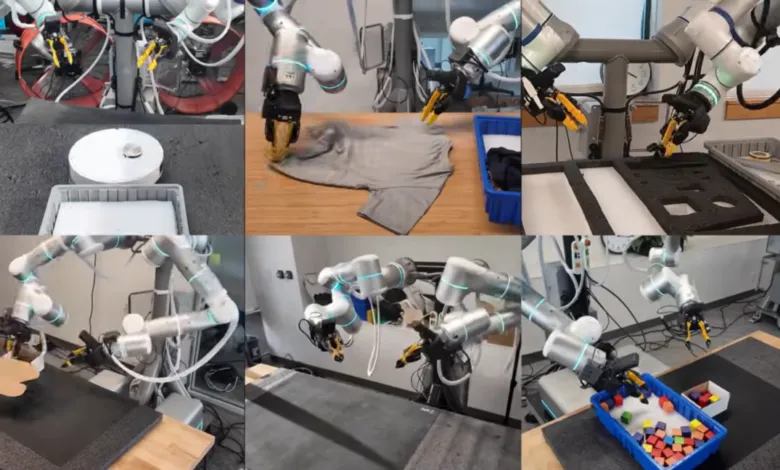
The practical outcomes are striking. The autonomous system demonstrates both precision and adaptability, capable of handling delicate electronics and folding laundry with equal competence. Generalist states that GEN-1 achieves a 99 percent success rate on repetitive but intricate tasks like folding boxes, packing phones, and servicing robot vacuums. It performs these operations at approximately three times the speed of its predecessor. Remarkably, the company notes that adapting the broadly pre-trained model to a specific robot’s hardware requires only about an hour of targeted training.
A key differentiator for this technology is its resilience. Historically, sophisticated robots depended on rigid, pre-programmed motions or were hyper-specialized for one task without room for error. GEN-1 represents a shift. Generalist highlights the model’s ability to recover from mistakes and respond to disruptions naturally. The system can draw on its accumulated experience to improvise solutions, even when confronted with scenarios that fall well outside its original training data. This capacity for adaptive problem-solving in unpredictable environments marks a significant step toward more versatile and useful robotic assistants.
(Source: Ars Technica)