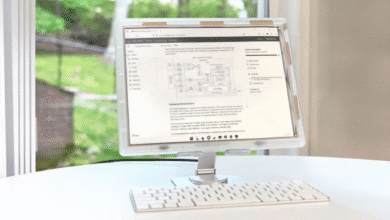
Modos Tech E-Paper Monitors: Dev Kit & Next-Gen Flow Hands-On

▼ Summary
– Modos Tech provided two e-paper monitor samples: a pre-built 13-inch Dev Kit model and the newer Flow model, which adds touch and stylus support.
– The company, founded in 2022, focuses on open-source hardware and software to promote e-paper displays for computing to reduce eye strain from traditional screens.
– E-paper technology is valued for sunlight readability and low energy use but is currently best for text-based tasks, not for media like video or gaming.
– The $599 Dev Kit is a configurable, open-source monitor with a USB-C connection, multiple display modes, and a 13.3-inch screen, though the reviewed sample had a 41Hz refresh rate.
– The upcoming Modos Flow is a more refined, consumer-ready 13.3-inch monitor with a 60Hz refresh rate, but the alpha sample had usability issues like a complex two-cable setup and inaccurate touch input.
Modos Tech recently provided an opportunity for an extended evaluation of two of its latest e-paper monitors. The first unit was a pre-assembled version of the Modos Paper Monitor Dev Kit, a 13-inch display currently available through Crowd Supply. The second was a prototype of the upcoming Modos Flow, a more advanced successor that introduces features like touch and stylus support. Both devices utilize modern color e-paper display technology, aiming to offer a more comfortable computing experience.
The company was founded in early 2022 by Alexander Soto and Wenting Zhang, who were motivated by the eye strain and fatigue associated with prolonged screen use during the pandemic. As an open-source hardware and software venture, Modos Tech seeks to expand the application of e-paper beyond e-readers and into general computing. While e-paper monitors have long held appeal for their sunlight readability and reduced eye strain, they have yet to achieve widespread adoption as computer displays. The technology excels with text-based tasks like reading, writing, and web browsing but remains less suited for dynamic content such as video, gaming, or photo editing. Innovators like Modos are working to improve the weaker aspects of the technology, including color reproduction, refresh rate, and overall responsiveness.
The Modos Paper Monitor Dev Kit arrived pre-assembled in a wooden frame for demonstration, though the kit itself does not include an enclosure. Priced at $599, this 13.3-inch kit connects via a single USB-C cable and includes a Mini HDMI port for compatibility. Key features include adjustable front lighting, a simple three-button interface, and support for refresh rates up to 75 Hz, though the provided sample used a 41 Hz panel. It does not currently support touch input. The core of the Dev Kit is its open-source Caster gateware, which runs on an FPGA and offers several unique display modes optimized for different tasks: Reading, Typing, Watching, and Browsing. These presets allow users to balance between image clarity and responsiveness. Developers can also access a C programming API for deeper customization.
In practical use, the Dev Kit integrated seamlessly as a secondary display. It proved responsive enough for text-oriented work, which is its primary intended function. The physical buttons allow quick cycling through display modes and control of the front light’s intensity and color temperature. While the monitor functions like a standard portable display, it does not retain settings like backlight level between sessions. The sample exhibited slightly uneven front lighting, and the glossy screen surface sometimes hampered its sunlight readability advantage in bright indoor environments. The Dev Kit is now shipping to backers, and a more compact 6-inch version is also available for $199.
The Modos Flow represents the company’s next step: a polished consumer product with a full-metal chassis and an integrated protective cover that doubles as a stand. This 13.3-inch monitor boasts a higher 60 Hz refresh rate, sub-100 ms latency, and adds touch and stylus support. It also features an on-screen menu system, accessible via a button combination, for more granular control over settings. The Flow is driven by a new next-generation controller designed to support larger and higher-resolution panels.
The build quality of the Flow prototype felt substantially more premium than the Dev Kit. However, the unit is relatively heavy, weighing 2.64 pounds with its cover attached. The current “alpha” firmware presented several usability challenges. A reliable connection requires a specific two-cable sequence, a process that must be repeated if the computer sleeps or restarts. Furthermore, in a multi-monitor Windows setup, the touch and stylus input was inaccurate, with interactions often registering on the primary display instead of the Flow.
Despite these software issues, the Flow’s display performance was superior, with faster response times and more even lighting. Modos has acknowledged these problems and indicated that ongoing firmware development aims to resolve them. Optimizations to the controller’s power draw may eventually enable a reliable single-cable connection. The company is also actively working on fixes for the touch input problems, particularly for Windows systems.
While both monitors show promise in addressing eye strain and promoting eye health, they are not yet perfect solutions. The Dev Kit has room for improvement in optical performance, and the Flow requires significant software refinement before it meets consumer expectations for plug-and-play reliability. The hands-on experience underscores both the potential of e-paper computing and the technical hurdles that remain as the technology evolves toward mainstream viability.
(Source: Tom’s Hardware UK)