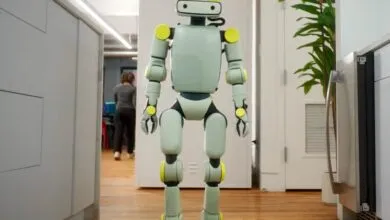
AI-Powered Humanoid Robots Are Evolving

▼ Summary
– The 2012 DARPA Robotics Challenge aimed to advance disaster robotics and led to developments like Boston Dynamics’ Atlas.
– Gill Pratt, the DRC architect, notes the current robotics shift is driven by AI advances in robot “brains,” not just humanoid bodies.
– A key bottleneck is training data, with a debate between patching pattern-matching AI and developing true reasoning “world models.”
– Current robots excel at fast, reactive “system one” tasks but lack the slow, imaginative “system two” reasoning for complex planning.
– Pratt warns the humanoid robotics field is nearing a hype peak and risks a disillusionment phase without managing expectations about these limitations.
A pivotal moment for robotics arrived in 2012 with the launch of the DARPA Robotics Challenge (DRC). This ambitious, multi-year competition aimed to accelerate the development of disaster-response robots, ultimately yielding iconic results like the Boston Dynamics Atlas platform and a legendary collection of robot bloopers. Gill Pratt, the program’s architect, envisioned the DRC as a catalyst, similar to earlier DARPA challenges that spurred the autonomous vehicle industry. He believed it would push the entire field toward practical, real-world capability.
Now, a decade after the challenge concluded, many believe the transformative moment for humanoid robots that Pratt predicted is imminent. However, the path has proven more complex than anticipated. Pratt, currently CEO of the Toyota Research Institute (TRI), observes that the fundamental shift is not in the robot’s body, but in its mind. For years, robotic mechanisms have been highly capable, but their utility was limited by computational constraints. The current AI revolution has changed that equation, providing the “brain” to finally harness the body’s potential.
While the DRC laid crucial groundwork, Pratt emphasizes humility in attributing today’s progress solely to that era. The challenge focused on a blend of teleoperation and semi-autonomy, a paradigm that preceded recent breakthroughs in artificial intelligence. The critical change is a new capacity for robot teaching through demonstration, rather than traditional coding. With enough data and modern AI methods, robots can achieve unprecedented performance levels.
This reliance on data introduces a significant bottleneck in robot learning. The debate mirrors discussions in large language models (LLMs). Some believe refining autoregressive predictors will lead to trustworthy AI, while others, like Yann LeCun, argue for the necessity of foundational world models that enable true reasoning and imagination. Current systems excel at fast, reflexive “system one” pattern matching but lack the slow, deliberate “system two” reasoning that involves planning and mental simulation.
At TRI, researchers have pursued advances in system one capabilities. Their work on diffusion policy and large behavior models (LBMs),where a single model learns multiple tasks that reinforce each other,represents significant progress. Applying diffusion to robot behavior created a powerful vision-to-action pipeline now widely adopted in robotics demonstrations. Yet, this remains sophisticated pattern matching; the robot reacts based on visual input without deep planning.
The limitations of system one are evident in challenges like autonomous driving, where unpredictable real-world scenarios cause breakdowns. Pratt notes that after a decade, the technical solutions are now sufficient, largely because they incorporate human backup for complex system-two decisions. This hybrid model, where a machine operates autonomously most of the time but requests human help when stuck, could be a template for other robotics applications.
Given the difficulty of perfecting autonomous cars, the intense focus on legged humanoid robots might seem surprising. Pratt explains that the human form offers inherent advantages: our world is built for bodies like ours, which aids imitation learning, and legs provide superior mobility in cluttered environments. However, he questions the practicality of legged robots in flat, structured settings like factories, where wheels are often more efficient.
The surge of investment into humanoids presents both opportunities and risks. While the influx of resources is energizing the field, Pratt cautions that the industry is likely approaching a peak of inflated expectations. The central issue is the conflation of impressive system-one pattern matching with genuine reasoning. This overpromising risks a subsequent trough of disillusionment if expectations are not managed.
To stabilize the field, Pratt suggests the need for damping the hype cycle. The press and academia can provide perspective by clearly communicating that current demonstrations do not equate to true reasoning. The autonomous vehicle industry offers a precedent, having endured its own bubble; the companies that survived did so through persistence and measured expectations. The same discipline is needed now.
Looking forward, Pratt highlights a profound application for this technology: addressing the challenges of an aging society. At TRI, they explore the concept of care-receiving robots that are taught by humans. This process taps into our innate desire to help and give, providing the teacher with a sense of purpose. The goal is to develop robots that improve quality of life psychologically and physically, helping to mitigate issues like loneliness and loss of purpose, which are exacerbated by worsening dependency ratios in nations like Japan and the U. S.
Ultimately, significant societal impact will require more than advanced pattern matching. Either a system-two breakthrough in AI reasoning must occur, or robots will need to operate within a framework of human supervisory control for complex decisions. This concept brings the discussion full circle, back to the hybrid human-robot collaboration paradigm explored in the DARPA Robotics Challenge. As Pratt recalls with a laugh, the approach that once defined a “Woodstock of Robots” may still hold the key to practical, helpful robots in our daily lives.
(Source: Ieee.org)