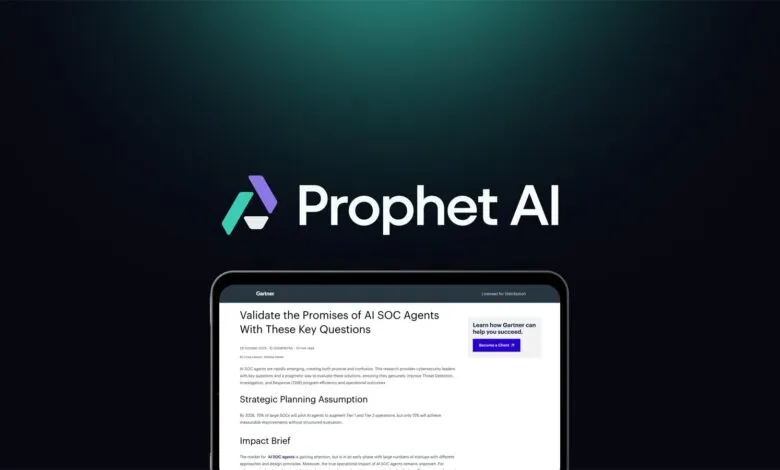
Gartner’s 7 Questions to Evaluate AI SOC Agents
▼ Summary
– AI SOC agents have the potential to reduce alert fatigue for security teams.
– Most security operations teams fail to measure the real-world outcomes of these AI tools.
– Prophet Security provides a framework based on Gartner’s questions to evaluate AI SOC agents.
– This evaluation aims to distinguish genuine operational impact from industry hype.
– The process involves analyzing specific metrics to assess an agent’s true effectiveness.
Security operations centers face a relentless stream of alerts, a challenge where AI SOC agents promise significant relief. Yet, many teams struggle to move beyond the initial promise to measure tangible security improvements. To separate genuine capability from marketing claims, Gartner has outlined a critical framework of seven questions for evaluation.
The first set of inquiries focuses on the agent’s core functionality. Teams must ask how the technology will reduce alert fatigue specifically. A vague promise is insufficient; the evaluation should demand concrete examples of how noise is filtered and high-fidelity alerts are prioritized. Furthermore, understanding the agent’s investigation scope is vital. Does it simply enrich data, or can it autonomously traverse different data sources to connect related events into a coherent narrative? This determines whether it acts as a basic assistant or a true investigative partner.
Another crucial line of questioning examines operational integration and transparency. It is essential to probe how the agent integrates with existing Security Information and Event Management (SIEM) systems and other tools in the stack. Clunky integrations create more work, defeating the purpose of automation. Equally important is explainability. Analysts need to understand the “why” behind an agent’s actions and conclusions to maintain oversight and trust. Can the system clearly articulate its reasoning?
Finally, evaluation must center on measurable outcomes and practical deployment. Organizations should define what success looks like in their specific context, whether it’s faster mean time to respond (MTTR) or a quantifiable reduction in tier-one alerts. Asking for proof of concept results or case studies from similar environments provides evidence beyond theoretical benefits. The ultimate question addresses scalability and adaptability; a solution must evolve with the threat landscape and the organization’s own growth without requiring constant, costly reconfiguration.
By applying this structured approach, security leaders can cut through the hype. The goal is to identify AI SOC agents that deliver not just automation, but intelligent augmentation that measurably strengthens the security posture and empowers human analysts.
(Source: BleepingComputer)