The 2026 European Deep Tech Report: Resilience, Growth, and the AI Revolution

▼ Summary
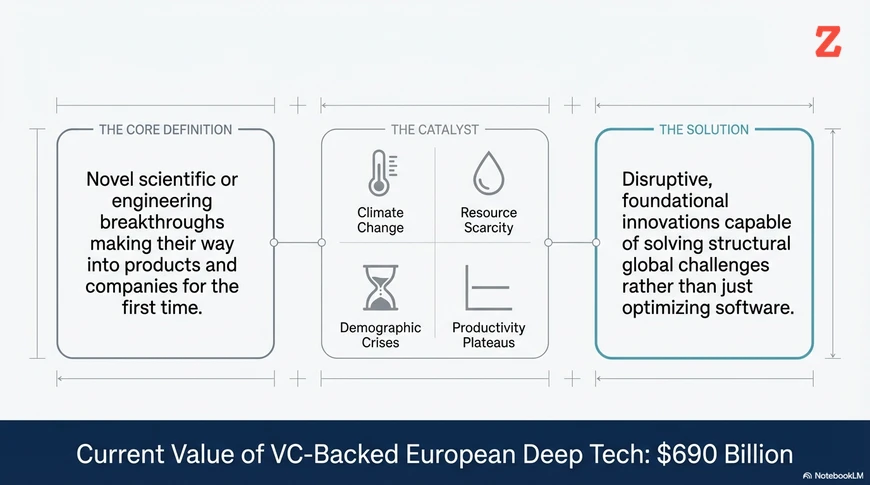
– The European deep tech sector is thriving, reaching a record $690 billion in total enterprise value and attracting 32% of all European VC investment in 2025.
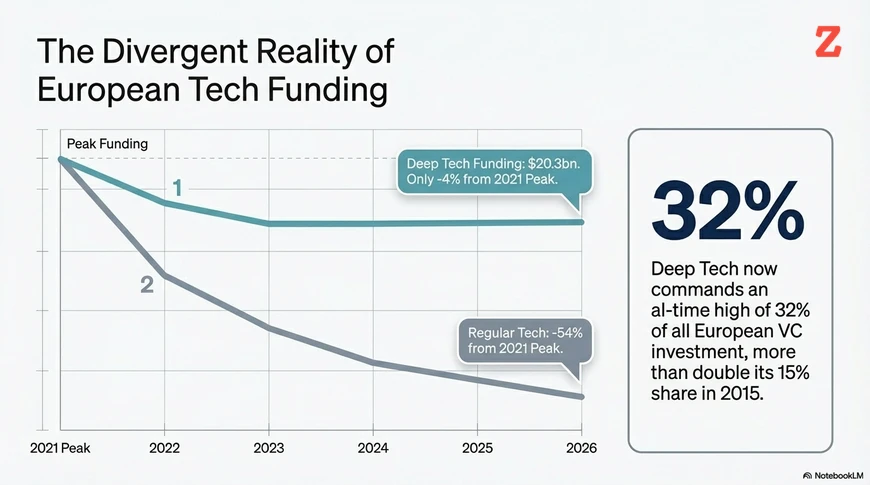
– Deep tech funding has shown remarkable resilience, remaining near its historical high while conventional tech investment has fallen sharply from its peak.
– Investment is concentrated in specific technologies, led by Novel AI and the Future of Compute segment, which saw 115% year-over-year growth.
– A significant structural challenge is a late-stage funding gap, with 70% of growth capital coming from non-European investors, creating a dependency risk.
– The UK, France, and Germany are the top funding countries, with Paris emerging as the leading European city for deep tech VC investment in 2025.
The tech landscape is shifting fundamentally from iterative software applications to physical and fundamental breakthroughs. The newly released 2026 European Deep Tech Report provides a comprehensive look at this transition, revealing that while conventional tech has faced significant headwinds, deep tech is thriving and reshaping the global innovation economy.
Here is a comprehensive summary of the key highlights, the most compelling segment trends, and the structural challenges Europe faces moving forward.
Key Highlights: Resilience in a Volatile Market
The most striking takeaway from the report is the sheer resilience of the deep tech sector.
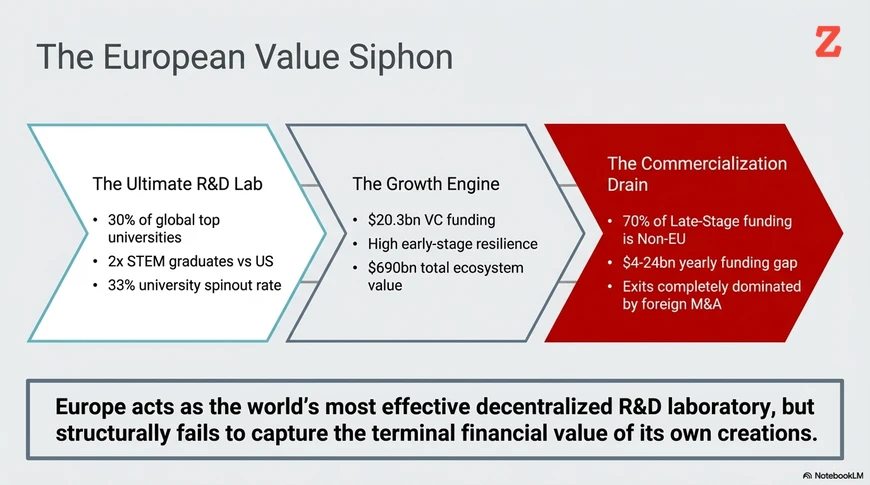
- Market Value at an All-Time High: The total enterprise value of VC-backed European deep tech has surged to a record $690 billion.
- Funding Defies Gravity: In 2025, VC funding for deep tech rose to $20.3 billion, representing an all-time high of 32% of all European VC investment. This is more than double the 15% share it held in 2015.
- Deep Tech vs. Regular Tech: While “Regular Tech” funding remains 54% below its 2021 peak, European Deep Tech is merely 4% shy of its historical high, proving that capital is aggressively chasing true defensibility and foundational breakthroughs.
The Geography of Innovation
The report highlights clear geographical concentrations of capital and talent:
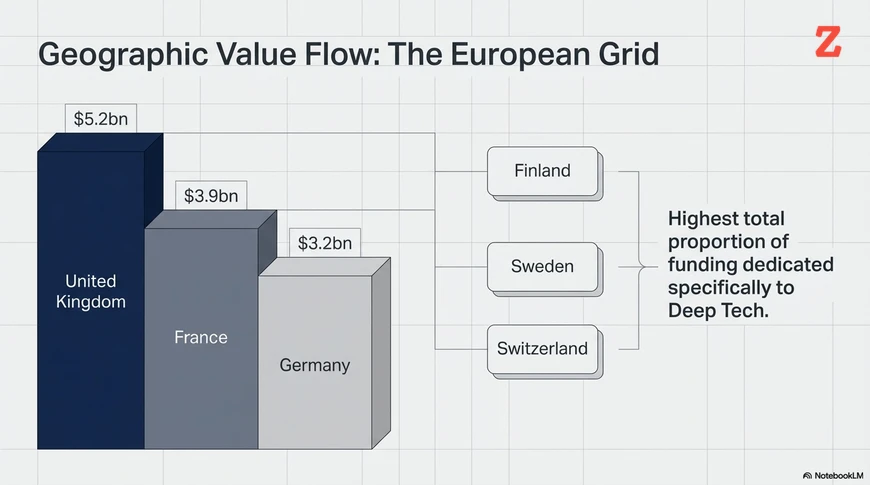
- Top Countries: The UK led the pack, attracting $5.2 billion in funding, followed closely by France ($3.9 billion) and Germany ($3.2 billion).
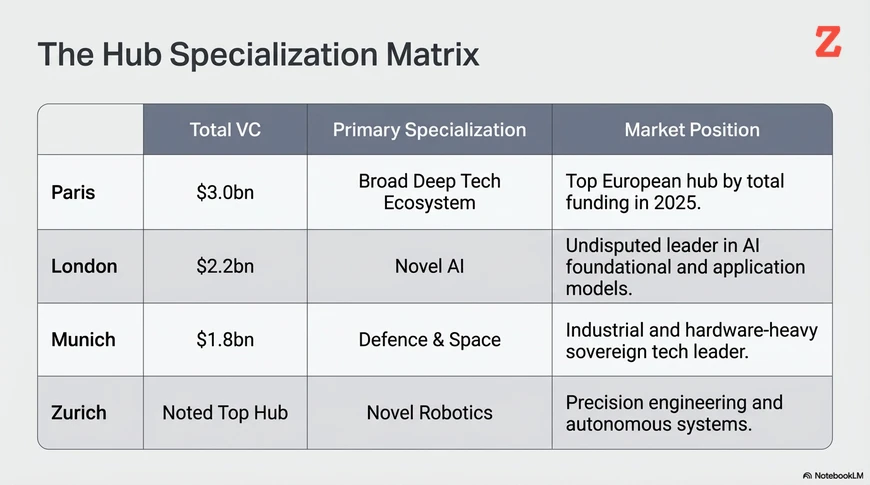
- Top Hubs: On a city level, Paris emerged as the premier European hub for Deep Tech VC funding in 2025 ($3.0 billion), overtaking London ($2.2 billion) and Munich ($1.8 billion).
Segment Deep Dives: Where the Capital is Flowing
A core focus for us here at DigitrendZ is the trajectory of artificial intelligence and compute power. The 2026 data shows massive acceleration in these foundational areas alongside defense and space capabilities.
| Technology Segment | 2025 VC Funding | YoY Growth | Key Growth Drivers & Notable Movements |
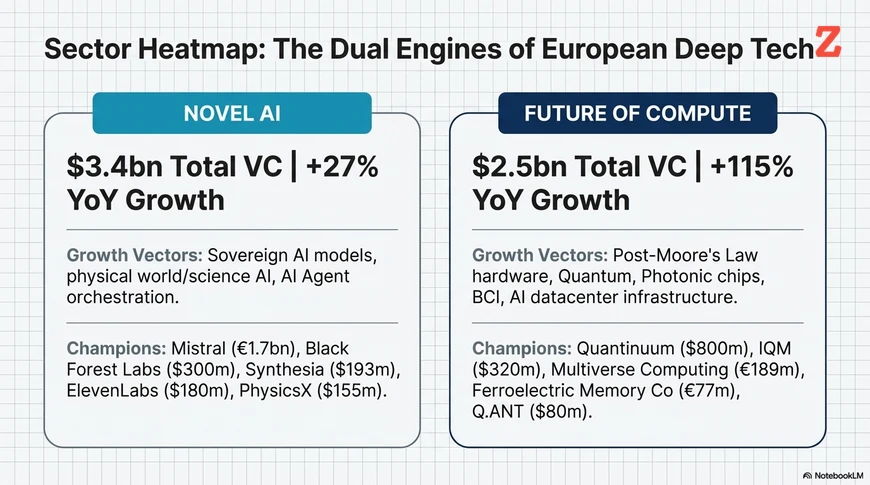
| Novel AI | $3.4bn | +27% | Foundational models (e.g., Mistral €1.7bn) and AI for vision/voice (e.g., Synthesia $193m). The focus is shifting to sovereign models and robust agentic workflows. |
| Future of Compute | $2.5bn | +115% | Quantum computing hardware (e.g., Quantinuum $800m), novel memory, and photonic chips tailored for post-Moore’s Law infrastructure. |
| Defence | $1.8bn | +125% | Driven by geopolitical conflicts, capital is pouring into sovereign solutions leveraging AI and drones, highlighted by Helsing’s €600m raise. |
| Space Tech | $1.3bn | +22% | Expansion in Earth observation, small satellite manufacturing, and launch vehicles to enable European sovereign launch capacity. |
| CompBio & Chemistry | $1.1bn | +88% | Heavy investments in AI-driven drug and material discovery, led by Isomorphic Labs ($600m). |
The AI and Compute Synergy
Novel AI remains the largest investment category, accounting for over half of all deployed capital when combined with the infrastructure required to run it. The industry is actively moving past the experimental phase of generative chat into reliable, agentic workflows designed for production environments. To support this massive computational overhead, the “Future of Compute” segment saw a staggering 115% growth, heavily driven by investments in quantum computing and more efficient data center infrastructure specifically engineered for AI workloads.
The Structural Challenge: The Late-Stage Funding Gap
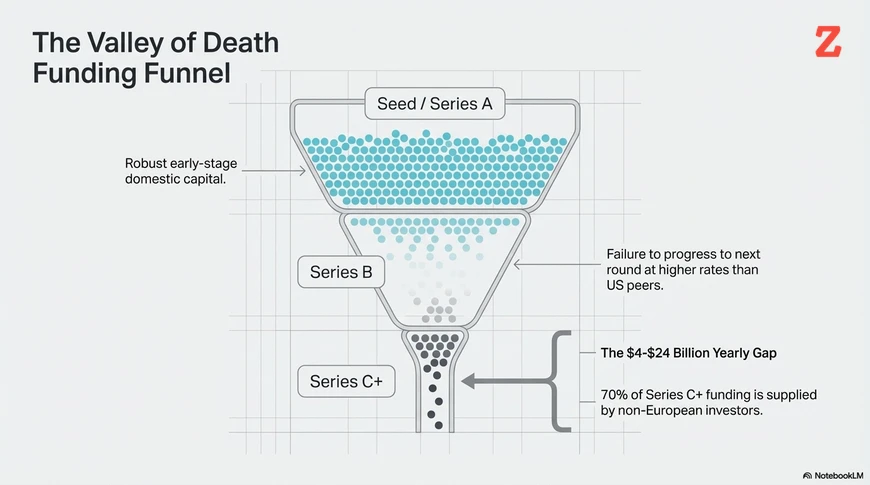
Despite the impressive top-line numbers, the report outlines a critical vulnerability in the European ecosystem: the growth-stage funding gap.
- The Foreign Capital Dependency: A concerning 70% of late-stage funding for European Deep Tech startups is sourced from non-European investors.
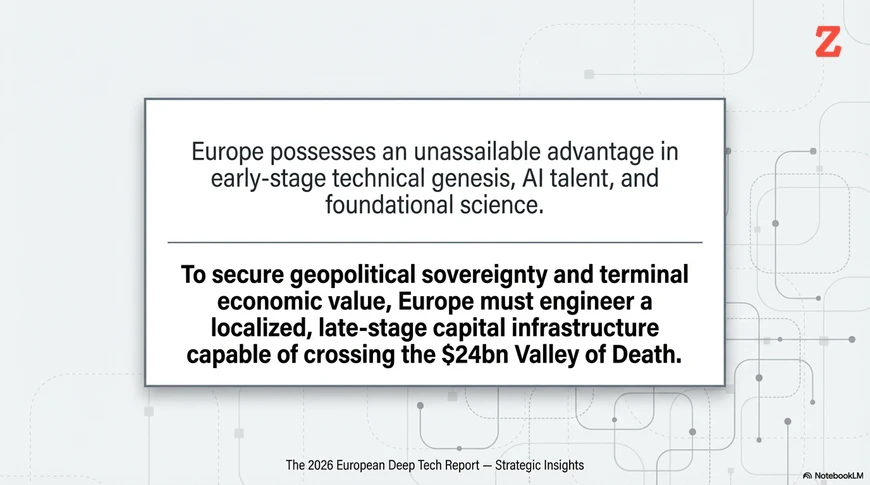
- The Quantifiable Deficit: There is a yearly funding gap of between $4 billion and $24.3 billion required just to match the domestic funding rates and conversion success seen in the US.
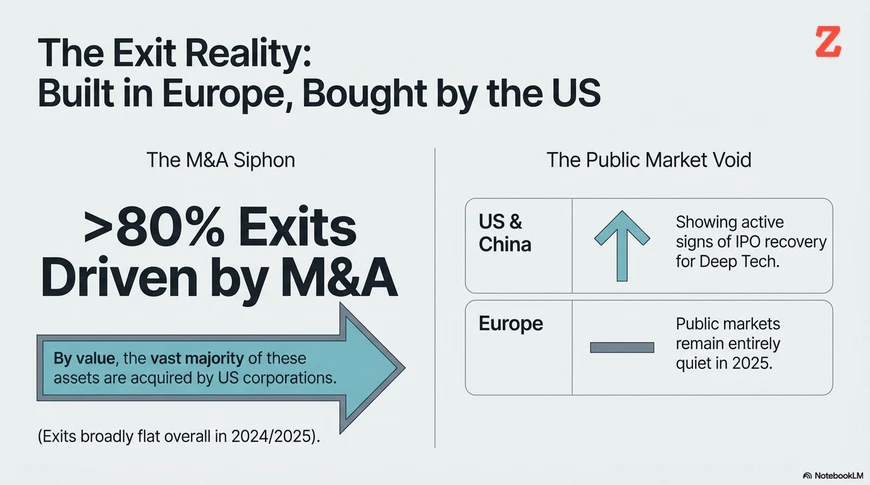
- The Exit Squeeze: Exits remain largely flat, predominantly driven by M&A (over 80%), with US companies acquiring the majority by value. Furthermore, European public markets remained incredibly quiet in 2025, contrasting sharply with recovery signs in the US and China.
Concluding Thoughts
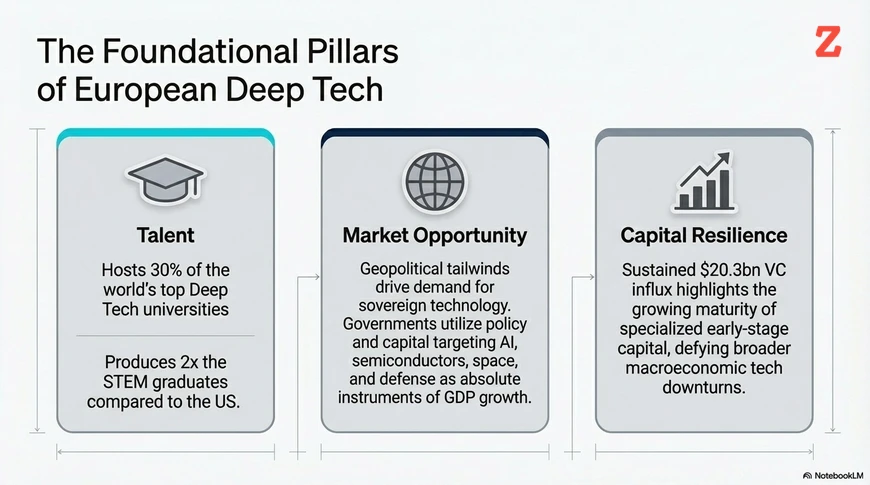
The 2026 European Deep Tech Report paints a picture of an ecosystem at a crucial inflection point. The scientific talent and early-stage capital are incredibly robust—evidenced by Europe producing twice as many STEM graduates as the US. However, to prevent value and intellectual property from leaking overseas, local late-stage capital must scale aggressively to meet the ambition of its founders.
The future of technology is physical, fundamental, and highly complex. Europe has the raw ingredients, but the next few years will dictate whether it can build and retain the generation-defining companies of tomorrow.