Study: Human Content 8x More Likely to Top Google Rankings
▼ Summary
– Human-written content holds the No. 1 Google ranking 80% of the time, compared to only 9% for purely AI-generated pages.
– Human content outperformed AI and mixed content across all top 10 search positions, with the largest gap at the top.
– AI detection tools used in the analysis are inconsistent, meaning some content classifications may be inaccurate.
– Despite 72% of SEO professionals believing AI content performs equally or better, ranking data shows a clear human advantage.
– Most content teams use AI in a hybrid, human-led workflow, primarily for tasks like research and drafting, not for high-judgment work.
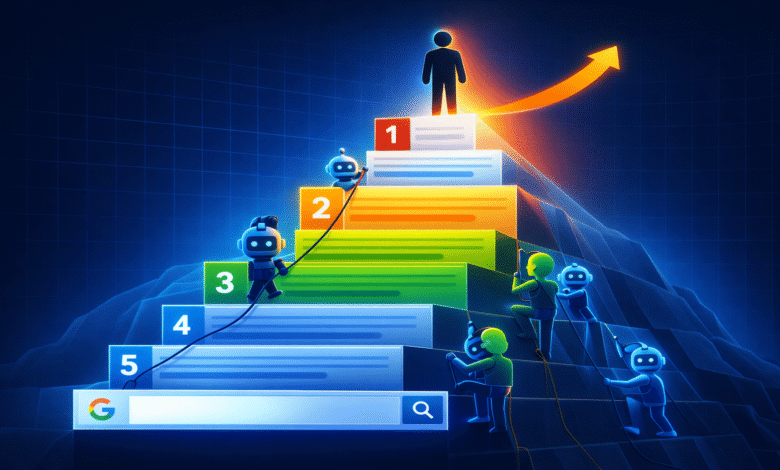
A recent analysis of search results reveals a significant performance gap between human and AI-generated content. The study found that human-written content secures the top position in Google search results 80% of the time, compared to a mere 9% for pages created solely by artificial intelligence. This data indicates that content crafted by people is roughly eight times more likely to rank at number one than purely automated material.
The research examined 42,000 blog posts ranking for 20,000 different keywords, classifying each piece with an AI detection tool. Across all ten positions on the first page of results, content identified as human-authored consistently outperformed both AI-generated and mixed-origin pages. The advantage was most pronounced at the very top of the page. While AI content does appear in search results, its prevalence nearly doubles from the first to the fourth position, suggesting it more frequently occupies spots lower on the page.
It is crucial to acknowledge a potential limitation in this data. AI detection tools are not infallible and can produce inconsistent results, sometimes mislabeling human writing as AI or vice versa. This introduces a degree of uncertainty into the classifications. Despite this caveat, the overarching trend is clear: for the most competitive search queries, human insight and editorial judgment provide a distinct advantage.
This finding presents an interesting contrast with industry perception. A survey of SEO professionals showed that 72% believe AI content performs equally well or better than human content. The actual ranking data, however, tells a different story, demonstrating a measurable human advantage in top rankings.
Within the industry, hybrid content creation is now the norm. The vast majority of teams, 87%, report keeping humans deeply involved in the content process. A common model is a human-led, AI-assisted workflow, employed by 64% of those surveyed. AI is most frequently utilized to accelerate tasks like initial research, drafting, and basic optimization. Its use declines sharply for more complex work requiring greater nuance, such as creating multimedia, localizing content, or making high-level editorial decisions.
The primary driver for adopting AI tools is speed, not necessarily quality. Seventy percent of professionals cite faster content production as the key benefit. Only 19% report that AI reliably improves the quality of the final output. This suggests that while AI can efficiently scale content creation, it does not yet replicate the originality and expertise that search engines appear to reward at the highest levels. For brands seeking to dominate search results, the strategic integration of human skill with AI efficiency remains the most effective path forward.
(Source: Search Engine Land)