NVIDIA’s Neural Texture Compression Reduces VRAM by 85%
▼ Summary
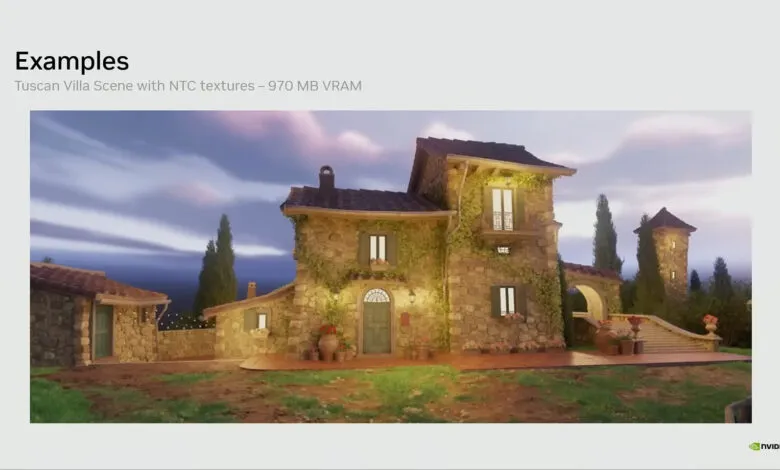
– NVIDIA’s Neural Texture Compression (NTC) is an AI-driven technology that can reduce GPU VRAM usage by up to seven times, as demonstrated by a scene’s usage dropping from 6.5 GB to 970 MB.
– The technology uses small, trained neural networks to emulate textures, maintaining high visual fidelity while drastically cutting memory consumption compared to traditional block-compressed formats like BCn.
– NTC allows game developers to either achieve much lower VRAM consumption or significantly enhance material appearance in games without a performance penalty.
– The system works by training neural networks to understand the appearance of a Texel (a texture’s base pixel) for nearly every game material, making it ready for real-world deployment.
– A key demonstration showed NTC providing better visual results than downscaled traditional textures while operating within the same reduced VRAM capacity.
A new AI-driven approach to texture compression promises to dramatically reduce the memory footprint of high-fidelity game assets. At the recent GTC 2026 conference, NVIDIA provided a detailed look at its Neural Texture Compression (NTC) technology, showcasing its potential to slash GPU VRAM usage by as much as 85 percent. In a compelling demonstration, a detailed scene of a Tuscan Villa that traditionally required 6.5 GB of video memory was rendered using just 970 MB with NTC enabled, all while maintaining virtually identical visual quality. This breakthrough suggests a path forward for enabling richer, more complex game worlds without necessitating a corresponding leap in hardware memory capacity.
The core innovation lies in replacing traditional block compression formats, like BC5, BC6, or BC7, with small, specialized neural networks. These AI models are trained to understand the appearance of a Texel, the fundamental pixel of a texture map, on specific materials. Instead of storing gigabytes of uncompressed texture data, the system stores these compact neural networks. When a texture is needed, the network generates the required pixel data on the fly. This process of AI-driven texture output means developers can choose to either drastically reduce memory consumption for a given level of detail or significantly enhance material appearance within the same VRAM budget.
NVIDIA’s demonstration highlighted two key scenarios. The exterior of the Tuscan Villa showed NTC matching the quality of traditional textures at a fraction of the memory cost. More impressively, an interior scene focusing on detailed tableware revealed that NTC could actually produce superior results compared to downscaled BCn textures, all while operating within that same constrained 970 MB limit. The company states it has trained networks for nearly every common game material, indicating the technology is prepared for real-world deployment. This refined process can either sit atop a game’s base texture layer for enhanced realism or replace it entirely for massive VRAM savings.
The implications for game development are substantial. High-quality complex materials could become standard without the performance penalty typically associated with massive texture data. Furthermore, this technology could lead to significantly smaller game install sizes, as the neural network weights are far smaller than the raw texture files they emulate. For the end user, the promise is more immersive environments and detailed objects without requiring a top-tier GPU with enormous video memory. While the technology is showcased in a controlled demo, its potential to reshape asset streaming and memory management in real-time graphics is considerable.
(Source: Techpowerup.com)