Pre-Cambrian Fossils Reveal Complex Animal Life
▼ Summary
– The origins of animal life are unclear, with most modern groups appearing during the rapid diversification of the Cambrian period.
– Fossils from the earlier Ediacaran period mostly show organisms with no clear relationship to modern life, suggesting they may have vanished in a mass extinction.
– New fossils from China reveal Cambrian-type groups coexisting with some Ediacaran species, indicating a possible gradual transition between these periods.
– These newly discovered fossils, called the Jiangchuan Biota, consist of over 700 small, carbon-rich impressions that preserve fine details like internal organs.
– The fossils were rapidly buried in a shallow marine environment similar to the one that preserved the famous Cambrian Burgess Shale fossils.
The origins of complex animal life have long been shrouded in mystery. The Cambrian explosion famously marks the period when most major animal groups burst onto the scene, yet the preceding Ediacaran period has typically yielded fossils of strange, soft-bodied organisms with no clear links to modern life. A prevailing theory suggests these enigmatic forms were wiped out in a mass extinction event, clearing the ecological stage for the rapid diversification of Cambrian fauna. However, a remarkable new fossil discovery in southern China challenges this narrative, revealing a gradual transition where early Cambrian groups coexisted with lingering Ediacaran species.
These exceptionally preserved fossils, analyzed by a team from Yunnan University and Oxford University, were unearthed near Fuxian Lake south of Kunming. The site is part of the Dengying Formation, with rock layers dating to the very end of the Ediacaran, approximately 547 million years ago. This places the find just seven million years before the first definitive Cambrian deposits, a critical window in evolutionary history.
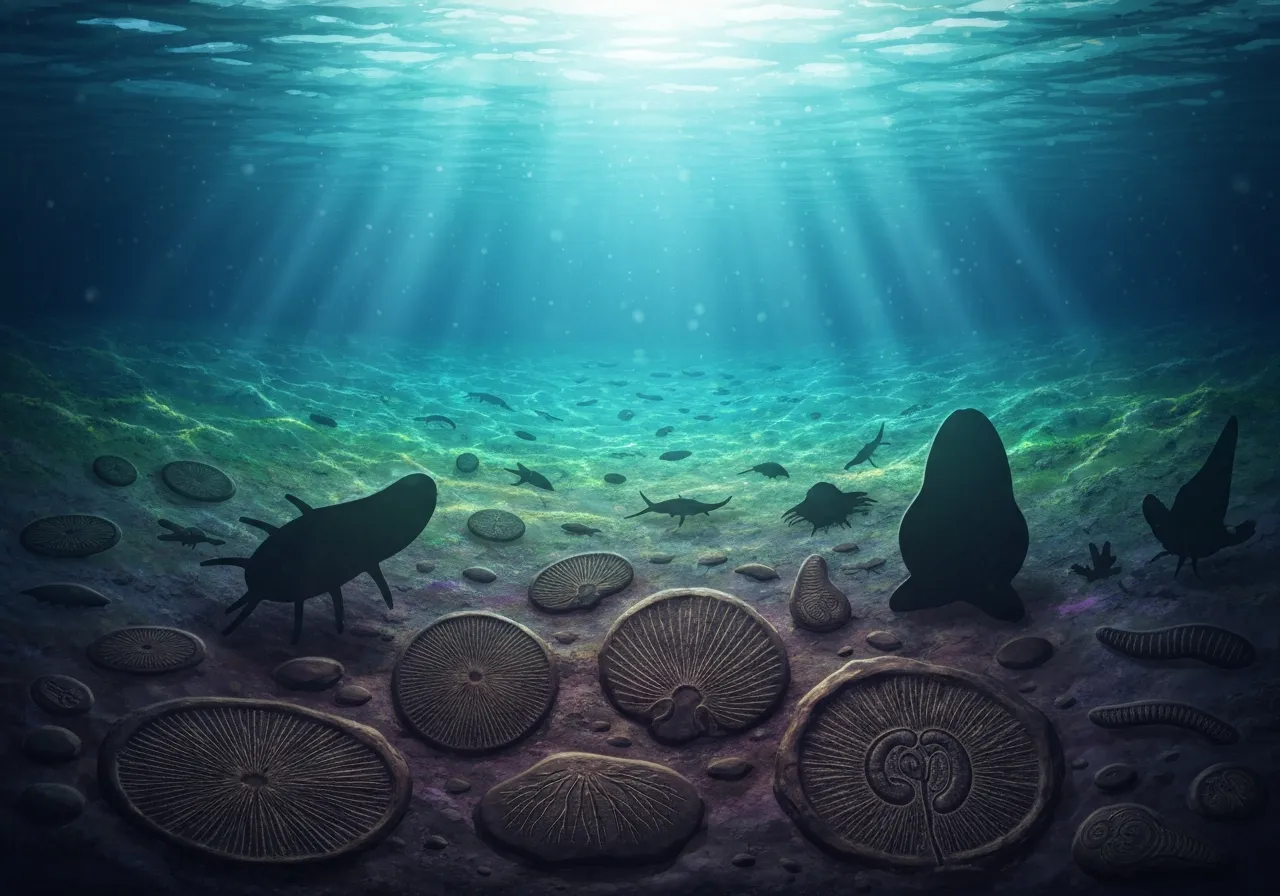
Previously recognized for its abundant algae, the location has now yielded a treasure trove dubbed the Jiangchuan Biota. This assemblage includes over 700 species, most preserved as small, one-to-two-centimeter impressions in a single carbon-rich rock layer. The high carbon content renders many specimens as stark black silhouettes, yet fine details remain visible, with some fossils even showing structures that resemble internal organs.
The research indicates these creatures were rapidly buried in sediment within a calm, shallow marine environment slightly deeper than the low-tide mark. This setting, analogous to the conditions that preserved the famous Burgess Shale fossils, was crucial for the exquisite preservation of these soft tissues. The coexistence of typical Cambrian groups with holdovers from the Ediacaran suggests the shift between these pivotal eras was not a stark, catastrophic break but a more nuanced ecological overlap, providing a clearer picture of life’s complex early narrative.
(Source: Ars Technica)