MSI MEG X870E Godlike X Review: Ultimate AM5 Motherboard?
▼ Summary
– The MSI MEG X870E Godlike X Edition is a limited-run, 1,000-unit motherboard that is nearly identical to the standard, more available X870E Godlike model.
– It is praised as an exceptionally stable and feature-rich board, offering extreme connectivity like 15 high-speed USB ports and support for up to 7 M.2 SSDs.
– However, its default performance in gaming and productivity benchmarks is conservative and on par with much cheaper motherboards, requiring manual UEFI tweaks for gains.
– The review notes specific compromises, such as shared PCIe lanes that can reduce speeds for some USB and M.2 slots when used simultaneously, which is a chipset limitation.
– Ultimately, the product is an excessive showcase of connectivity and expansion for enthusiasts, but its limited availability makes the standard Godlike model the practical alternative.
For those building an ultimate AMD Ryzen system, the MSI MEG X870E Godlike X Edition represents the absolute peak of AM5 motherboard design, offering an almost overwhelming array of high-speed connectivity and expansion features. This limited-run model celebrates a decade of MSI’s Godlike series, but its exclusivity raises questions about its real-world value for the vast majority of PC builders.
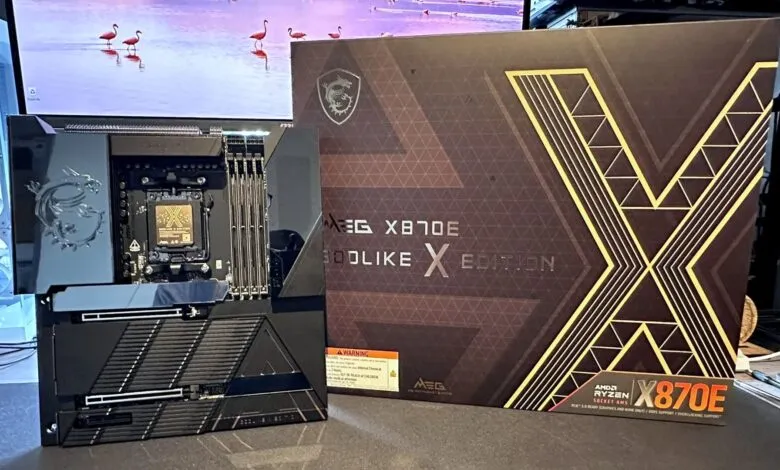
The core challenge in evaluating this board is its scarcity. MSI produced only one thousand units, making it more of a collector’s piece than a readily available component. For potential buyers, the critical detail is that the hardware and core functionality are virtually identical to the standard MEG X870E Godlike model. The “X Edition” primarily bundles unique aesthetic items: a numbered M.2 heatsink with a display, a special stand to showcase that heatsink, and a novelty keychain. The UEFI interface has minor visual tweaks, but you gain no meaningful performance or functional advantage over the non-limited version.
This motherboard is defined by extraordinary connectivity. The rear I/O panel is a USB powerhouse, featuring fifteen ports including two 40 Gbps USB4 connections and thirteen 10 Gbps USB 3.2 ports. Storage options are equally expansive, with five onboard M.2 slots and an included adapter card that adds two more hot-swappable Gen 5 SSD bays. This makes it a dream for users with extensive peripheral and storage arrays. However, this abundance highlights the inherent lane limitations of the AM5 platform; populating certain M.2 slots can reduce the speed of the USB4 ports or other PCIe slots, a compromise common to all high-end AMD boards.
Visually, the Godlike X is striking. It includes two displays: a polychromic panel on the rear shroud and the magnetically attached Dynamic Dashboard III. This secondary unit consolidates power buttons, a PCIe slot release, and a multitude of headers for fans, sensors, and RGB lighting into a clean, horizontal layout. While this modularity aids cable management, the sheer number of connections can be intimidating for newcomers.
When it comes to raw performance, the Godlike X Edition behaves like any other quality X870E board. Out-of-the-box gaming and application benchmarks align with far less expensive models. MSI prioritizes system stability with conservative default settings, so extracting maximum performance requires manual tuning in the UEFI. The board’s massive VRM heatsink proved highly capable under heavy loads, though the primary M.2 heatsink’s sleek, display-topped design hampered its thermal dissipation, allowing a Gen 5 SSD to reach a warm 76°C.
Ultimately, the MSI MEG X870E Godlike X Edition is a statement product. It delivers unparalleled expansion for an AM5 platform, wrapped in a flashy, feature-rich package. Yet, its limited nature and premium price tag make it an impractical purchase. For anyone craving this level of extreme connectivity, the standard Godlike model offers the same core experience without the collector’s markup and scarcity. This board is less about necessary performance gains and more about fulfilling a desire for the absolute most a desktop motherboard can provide.
(Source: PCGAMER)