Pompeii Reveals Secret to Roman Concrete’s Strength
▼ Summary
– MIT scientists have confirmed that ancient Romans used “hot mixing” with quicklime to create self-healing concrete, resolving a previous discrepancy with historical texts.
– Roman concrete was a mixture of mortar and aggregate, with the aggregate consisting of large pieces of stone or brick, unlike modern Portland cement.
– Historical instructions from Vitruvius describe building durable walls using materials like brick or volcanic rock bound with lime and volcanic tephra mortar.
– Researcher Admir Masic has applied advanced analytical techniques, such as Raman spectroscopy, to study Roman concrete samples from various archaeological sites.
– The self-healing property works because cracks interact with lime clasts, which react with water to form calcium carbonate or strengthen the material, sealing the cracks.
The remarkable durability of ancient Roman concrete, which has withstood millennia of environmental stress, has long fascinated scientists and engineers. A recent breakthrough from MIT researchers has finally unlocked a key secret behind its legendary strength, confirming a manufacturing technique that imbues the material with a unique self-healing property. This discovery centers on the use of hot mixing with quicklime, a process that creates reactive lime clasts within the concrete matrix. These clasts act as a built-in repair system, actively sealing cracks as they form and ensuring the material’s longevity far surpasses that of modern Portland cement.
For years, the precise methods used by Roman builders did not fully align with historical accounts. While texts like Vitruvius’s De architectura detailed recipes using volcanic ash and hydrated lime, physical evidence from sites like Privernum contained puzzling white inclusions. Many experts previously dismissed these lime clasts as mere flaws, the result of poor-quality materials or sloppy mixing practices. However, a dedicated team led by environmental engineer Admir Masic took a closer look using advanced analytical techniques.
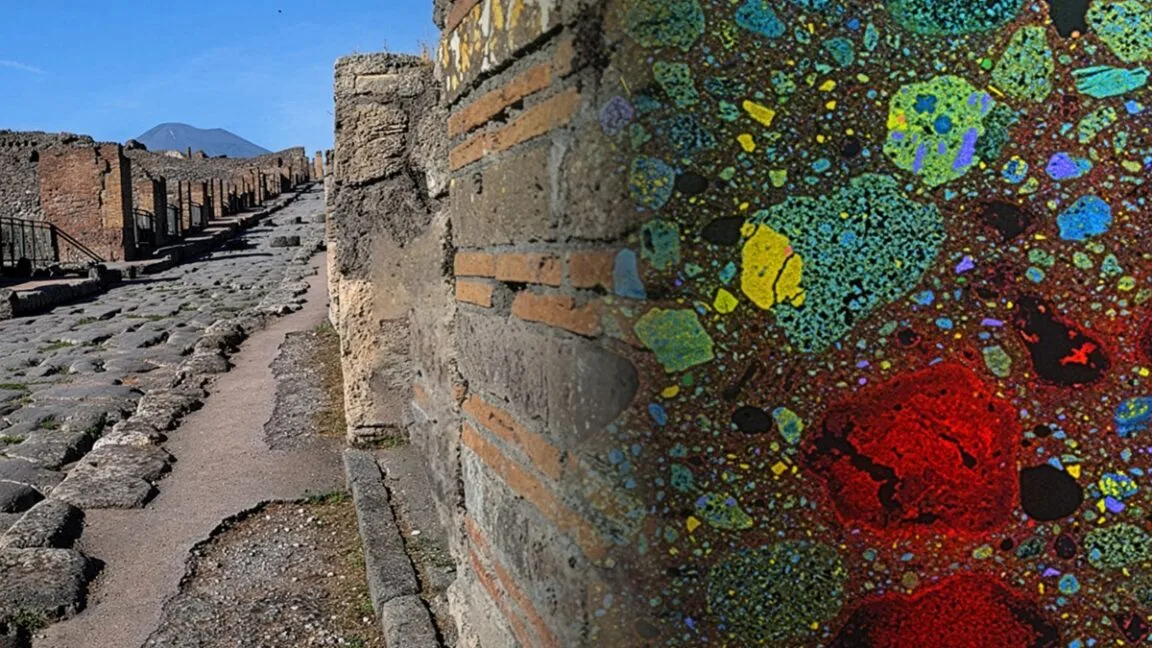
Their investigation employed tools such as Raman spectroscopy for chemical analysis and energy dispersive spectroscopy for detailed phase mapping. This rigorous approach revealed that the clasts were not mistakes at all, but intentional and functional components. The Romans, it seems, were using quicklime, a highly reactive form of lime produced by heating limestone, in a hot mixing process. When combined with water, quicklime generates significant heat, creating a more volatile and reactive mortar mix.
The genius of this method lies in the behavior of the resulting lime clasts. As microscopic cracks inevitably begin to form in the concrete over time, they preferentially travel through these white inclusions. When water seeps into these cracks, it reacts with the quicklime within the clasts. This reaction produces a calcium-saturated solution that can then recrystallize as calcium carbonate, effectively gluing the crack shut. Alternatively, the solution can further react with the volcanic ash (pozzolana) in the mortar, forming additional strengthening compounds.
This self-healing functionality is a form of ancient nanotechnology that modern concrete lacks. Our contemporary Portland cement structures are designed to be inert and static; once they crack, the damage typically worsens. Roman concrete, by contrast, possesses a dynamic, reactive chemistry that allows it to repair itself. The confirmation of hot mixing from a newly analyzed site solidifies this understanding, bridging the gap between the archaeological evidence and the historical record. It demonstrates that Roman engineers were not just skilled builders, but sophisticated materials scientists who optimized their recipes for resilience. This insight opens new avenues for developing more sustainable and durable construction materials today, inspired by a two-thousand-year-old technological marvel.
(Source: Ars Technica)