Supercharge ROM Emulation to 12MHz with Pico2 PIO
▼ Summary
– The Pico2ROMEmu is a new ROM emulator built using a Raspberry Pi Pico2 to solve the problem of scarce or expensive period-appropriate EPROMs and programmers for retrocomputers.
– It has been successfully tested at speeds of 10MHz with a Z80 processor and 12MHz with an MC68000, targeting slightly higher-performance retrocomputers.
– A key technical feature is that it performs all its work using the RP2350 chip’s PIO (Programmable I/O) rather than its main cores, enabling faster operation.
– This project differs from other emulators like the OneROM, which has focused on older, slower machines and may not have chased these higher speeds.
– The project’s code and design files (Gerbers) are available on GitHub under an MIT license for public use.
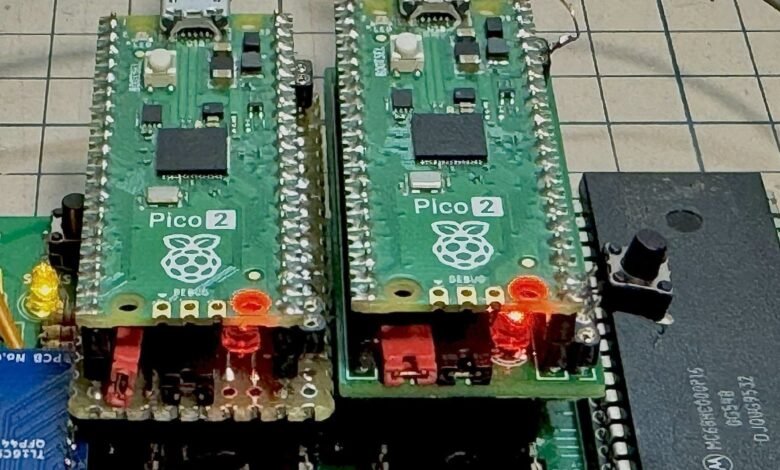
When retrocomputing enthusiasts need to replace aging or unavailable ROM chips, sourcing period-accurate EPROMs and programmers can be both costly and inconvenient. A new solution called Pico2ROMEmu leverages the Raspberry Pi Pico2 to emulate ROMs at impressive speeds, offering a practical alternative for custom firmware and system restoration. This device has been successfully tested running at 10MHz with a Z80 processor and achieving 12MHz with an MC68000, making it suitable for a range of classic computing projects.
The key to this performance lies in the RP2350 microcontroller’s Programmable I/O (PIO) blocks. Rather than relying on the main ARM or RISC-V cores, the design offloads the entire emulation task to these dedicated hardware state machines. This approach ensures minimal latency and consistent timing, which are critical for mimicking the behavior of original ROM chips. By using the PIO, the main processor remains free for other tasks, enabling a faster and more responsive emulation experience.
While other ROM emulators exist, such as the OneROM which also utilizes the RP2350’s PIO capabilities, the Pico2ROMEmu distinguishes itself by targeting higher-speed retro systems. Previous projects often focused on older, slower machines, but this new contender expands the possibilities for enthusiasts working with slightly more performance-oriented hardware. The availability of code and manufacturing files under an MIT license on GitHub encourages further development and customization.
For anyone building or repairing vintage computers, this tool provides a reliable method to load and test firmware without hunting for obsolete components. The design demonstrates how modern microcontroller features can breathe new life into classic technology, ensuring these systems remain operational for years to come.
(Source: Hack A Day)