SanDisk WD Blue SN5100 NVMe SSD: Performance Review
▼ Summary
– The Sandisk WD Blue SN5100 SSD is a significant improvement over its predecessor, featuring a new 218-layer QLC NAND flash and a refined controller for much better performance.
– It delivers exceptional speed for a PCIe 4.0 drive, with top-tier random 4K read performance that benefits gaming and makes it competitive with some early PCIe 5.0 drives.
– Despite being marketed as a creator drive for mass storage, the reviewer argues it is excellent for gamers due to its fast game load times and efficient operation.
– The drive’s value is highly dependent on its fluctuating price, which has increased significantly and can make comparable or better TLC drives a more sensible purchase.
– Its main limitation is being a QLC drive, meaning it can throttle during large, sustained file transfers, though it excels at typical tasks like loading games and running programs.
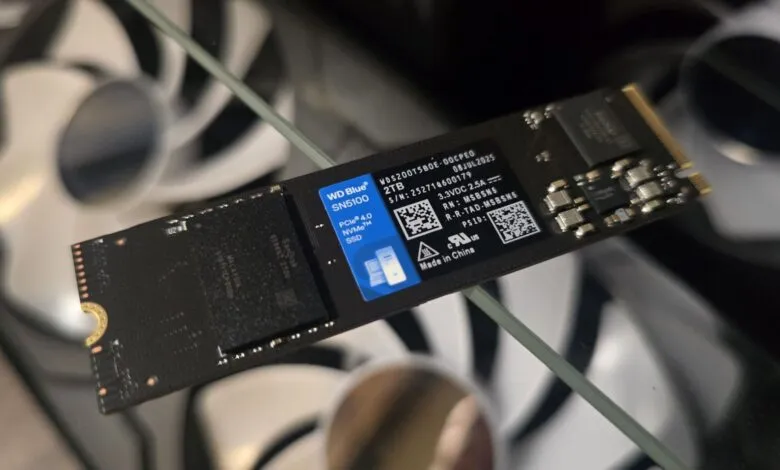
The SanDisk WD Blue SN5100 NVMe SSD delivers a remarkable performance leap over its predecessor, establishing itself as a compelling option for both creators and gamers. While marketed primarily for creative workloads like 4K video editing, its exceptional random read speeds translate into blistering game load times. Its performance is so strong that it competes with some first-generation PCIe 5.0 drives, making it a fascinating product in the current storage landscape. Potential buyers should be aware that SSD pricing remains volatile, so securing a good deal requires careful shopping.
This new drive addresses nearly every shortcoming found in the older SN5000 model. That earlier drive suffered from high temperatures, sluggish speeds, and was outperformed by more affordable competitors due to its aging QLC NAND. The SN5100 turns the tables completely. It incorporates a refined controller and a far more advanced 218-layer BiCS8 3D QLC NAND package. This architectural shift allows for higher density, improved power efficiency, reduced latency, and a significant overall speed boost, contributing to a 21% higher performance score.
The core upgrade is the move to 218-layer NAND flash, which dramatically shrinks the bit size through both vertical stacking and lateral scaling improvements. This is the same foundational technology used in the high-end WD Black SN8100, though that drive employs TLC memory. The new NAND enables SanDisk to pack 4TB of storage into a single package. The physical design remains familiar, using a single-sided M.2 2280 form factor for broad compatibility with PCs, laptops, and consoles, and it retains the Polaris 3 controller.
The performance results are outstanding for a drive in this category. Sequential read and write speeds max out the PCIe 4.0 interface at approximately 7.3 GB/s and 6.7 GB/s, respectively. In synthetic benchmarks, it posts impressive numbers, coming surprisingly close to the bandwidth of some current PCIe 5.0 models. Where it truly shines for gamers is in random 4K read performance, achieving a score that is among the highest ever tested, second only to the flagship SN8100. This directly benefits game load times, as evidenced by a swift 7.125-second result in the Final Fantasy XIV loading test, all while maintaining a cool peak temperature of 61°C.
Pricing, however, is where the situation becomes complicated. The drive launched at an aggressively low point but has since seen a substantial price increase, bringing it in line with TLC alternatives like the SN7100. While the SN5100 excels in random 4K reads and load times, a similarly priced TLC drive will generally offer better sustained performance for large file transfers once the drive’s cache is exhausted. This makes the value proposition highly dependent on current market prices.
For a modern QLC drive, the SN5100 is genuinely impressive. Its limitations are inherent to QLC technology, meaning prolonged, massive file transfers will eventually trigger throttling. Yet, for the core tasks of loading games and applications, it performs on par with the best TLC drives. The final verdict hinges entirely on the price you find. In a turbulent market, if you can locate a TLC drive for the same cost, it may be the more versatile buy. But if the SN5100 is available at or near its original launch price, it represents an exceptional storage solution.
(Source: PC Gamer)