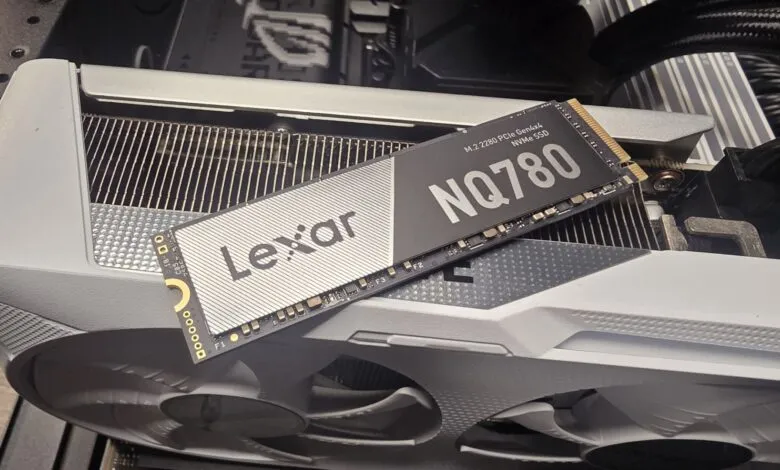
Lexar NQ780 4TB SSD Review: Speed & Value Tested
▼ Summary
– The Lexar NQ780 SSD is a budget, average-performing drive that uses older hardware, including a 2020 controller and QLC NAND, making it feel like a stock clearance rather than a new release.
– Its primary advantage is aggressive pricing, currently offering one of the lowest costs per gigabyte, though this may be its only saving grace in a volatile market.
– Performance is mediocre, with particularly poor random 4K read speeds that negatively impact game load times, placing it near the bottom compared to modern alternatives.
– The drive is suitable only for users prioritizing cheap, high capacity over speed, as it is outpaced by many other PCIe 4.0 drives that offer better performance for a slightly higher cost.
– The reviewer concludes that you can do much better, recommending alternatives like the WD Blue SN5100 for superior performance, and suggests the NQ780’s release is not competitive by current standards.
Finding a high-capacity solid-state drive that doesn’t break the bank can feel like a victory, but the Lexar NQ780 4TB SSD presents a complicated value proposition. While its aggressive pricing per gigabyte is undeniably attractive, this drive relies on hardware that feels several years behind the curve, resulting in performance that struggles to compete with even modestly more expensive modern alternatives.
The core issue is its dated internal components. At its heart is an Innogrit IG5236 controller, a design that first launched back in 2020. Paired with Intel’s 144-layer QLC NAND flash, this combination immediately signals that the NQ780 is not pushing any technological boundaries. It feels less like a new product and more like a strategic repackaging of existing, older parts. This architectural choice has direct consequences for real-world use, particularly for tasks that modern users care about.
On paper, the sequential read and write speeds look respectable, matching competitors like the WD Blue SN5100 in synthetic benchmarks. However, the drive’s significant weakness is revealed in random 4K read performance, a critical metric for gaming and general system responsiveness. Here, the NQ780’s results are disappointingly low, placing it near the bottom of the pack compared to other drives tested over the past year. This poor random performance translates directly to slower game load times, as evidenced by its slower result in the Final Fantasy XIV: Shadowbringers benchmark.
Once its pSLC cache is exhausted, write speeds also drop considerably. Furthermore, the older controller and NAND configuration tend to run slightly warmer and less efficiently than newer designs. For a user simply looking to add massive, affordable storage for a media library or backup, these shortcomings might be tolerable. For anyone who values snappy system performance and faster load times, they are a major drawback.
Lexar NQ780 4TB Key Specifications
- Capacity: 4 TB
- Interface: PCIe 4.0 x4
- Controller: Innogrit IG5236
- Flash Memory: Intel 144-layer 3D QLC NAND
- Rated Performance: 7,000 MB/s read, 6,000 MB/s write
- Endurance: 2400 TBW
- Warranty: Five years
The drive’s primary selling point is its cost. At roughly seven cents per gigabyte, it offers one of the lowest prices for this much capacity. In a market where SSD prices have been fluctuating upward, this aggressive pricing could be its main appeal. Yet, it creates a dilemma. Competitors like the WD Blue SN5100, which offer far superior all-around performance, have historically been available for only a small premium. While current pricing may vary, the performance gap is so substantial that the minor savings on the NQ780 become difficult to justify for a primary drive.
Performance Comparison: Lexar NQ780 4TB vs. WD Blue SN5100 2TB
| Test Metric | Lexar NQ780 4TB | WD Blue SN5100 2TB |
|---|---|---|
| 3DMark Storage Index | 2893 | 3915 |
| 3DMark Storage Bandwidth | 495.11 MB/s | 672.63 MB/s |
| CrystalDiskMark SEQ1M Read | 7446 MB/s | 7318 MB/s |
| CrystalDiskMark SEQ1M Write | 6601 MB/s | 6687 MB/s |
| Random 4K Read (IOPS) | 17,134 | 26,224 |
| Random 4K Write (IOPS) | 75,727 | 75,158 |
| FFXIV: Shadowbringers Load Time | 7.869 seconds | 7.125 seconds |
| Peak Temperature | 62°C | 61°C |
Ultimately, the Lexar NQ780 occupies a narrow niche. It makes sense if your absolute priority is maximizing cheap storage capacity and you are willing to accept noticeably slower random access performance. For everyone else, especially gamers and those using it as a primary drive, the experience will feel outdated. Investing a little more in a modern alternative typically yields a dramatically better performance return, making the NQ780 a hard drive to recommend despite its tempting price tag.
(Source: PC Gamer)