Intel Granite Rapids Leak Hints at Monstrous Workstation Upgrades
▼ Summary
– Intel’s upcoming W890 workstation platform supports dual-tier configurations with Expert-class systems offering 112 PCIe lanes for high-performance GPU and storage setups.
– Granite Rapids-WS processors will feature up to 86 cores, 172 threads, and support up to 2TB of memory per socket with DDR5 speeds reaching 5,200 MT/s.
– The platform uses a Socket E2 design with 4,710 LGA pins and supports CPUs with thermal design power up to 350 watts for demanding professional workloads.
– Connectivity includes USB ports, SATA III interfaces, SlimSAS connectors, and 2.5 Gigabit Ethernet, while power delivery uses standard 24-pin ATX and additional 8-pin CPU headers.
– These specifications represent Intel’s response to AMD’s Threadripper in premium HEDT workstations, with final adoption dependent on production CPUs to be revealed at CES 2026.
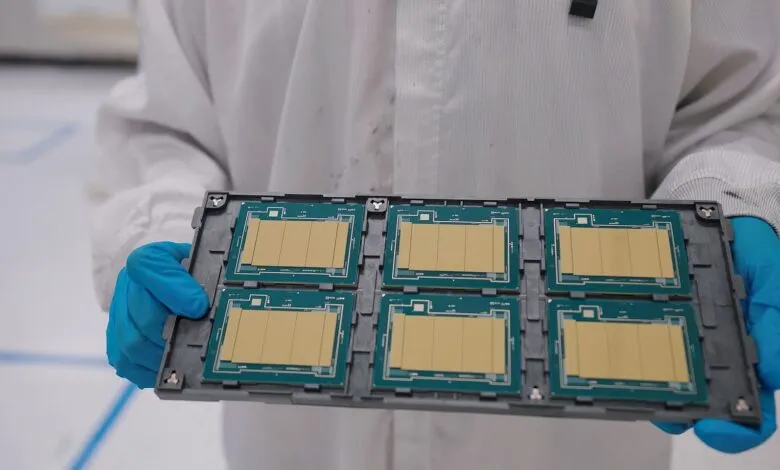
Recent leaks surrounding Intel’s forthcoming Granite Rapids-WS processors reveal a significant leap forward for high-end desktop workstations. Built on the new W890 platform, these chips are engineered to deliver exceptional performance for demanding professional applications, directly challenging competing solutions in the premium computing space.
The platform’s foundation is a Socket E2 design featuring 4,710 LGA pins, engineered to support processors with a thermal design power of up to 350 watts. This robust power envelope is necessary to fuel the impressive core counts, with the top-tier model reportedly packing 86 cores and 172 threads. Such a configuration is a clear indicator of Intel’s ambition to dominate in compute-heavy fields like 3D rendering, complex simulations, and intensive data analysis.
Memory capabilities receive a substantial upgrade. The platform accommodates both standard and registered DDR5 modules in a quad-channel configuration, supporting speeds of up to 5,200 MT/s. This setup allows for a massive memory capacity, with systems able to address up to 2 terabytes of RAM per processor socket. This enhancement is a critical advantage for professionals working with enormous datasets that require rapid access.
Connectivity and expansion are central to the W890 platform’s design, which is segmented into two tiers. The Expert-class configuration offers a total of 112 PCIe lanes, comprising 96 PCIe 5.0 and 16 PCIe 4.0 lanes. The Mainstream variant provides a still-impressive 80 PCIe 5.0 lanes. This extensive connectivity enables workstations to run multiple high-performance GPUs, numerous storage drives, and various expansion cards simultaneously without creating performance bottlenecks.
Beyond PCIe, the platform includes a comprehensive suite of ports, including USB 3.2 and USB 2.0, multiple SATA III interfaces, and dual SlimSAS connectors that provide PCIe 4.0 x4 bandwidth. A 2.5 Gigabit Ethernet controller is also integrated for fast networking. Power delivery is handled by a standard 24-pin ATX connector with support for up to four additional 8-pin CPU power headers, ensuring stable operation under heavy loads. For server-grade remote management, the platform relies on an ASPEED AST2600 BMC alongside a Nuvoton system supervisor.
The leaked specifications position the W890 platform as Intel’s strategic response to AMD’s established Threadripper ecosystem. While AMD may currently hold an edge in maximum core counts and cache size, Intel’s design philosophy with Granite Rapids-WS appears to prioritize memory speed and overall data throughput. The combination of a high-bandwidth memory subsystem and a flexible PCIe topology is tailored specifically for professional workloads where data movement is as critical as raw processing power.
It is important to note that the full potential of this platform is best realized in standard desktop workstation form factors. Mobile workstations and compact mini PC systems are unlikely to harness these capabilities due to inherent thermal and spatial constraints. For users who require maximum expandability and memory, traditional tower workstations will be the ideal environment.
These early details offer a compelling preview of Intel’s roadmap for reclaiming leadership in the high-end desktop workstation segment. The final performance and adoption rates will ultimately be determined by the production-ready CPUs and the official motherboard designs, which are anticipated to be showcased at CES 2026.
(Source: techradar)