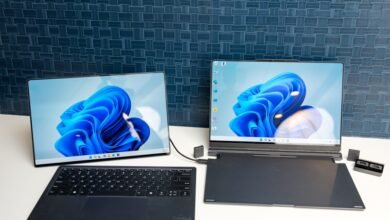
Framework Laptop Returns With Major Upgrades and Familiar Trade-Offs

▼ Summary
– The 2025 Framework Laptop 16 introduces a user-replaceable Nvidia RTX 5070 GPU, offering a significant graphics performance boost over the previous model.
– It maintains full modularity and upgradeability, allowing owners to purchase new components like the Ryzen AI CPU, Wi-Fi 7, and redesigned cooling separately.
– The laptop still suffers from build quality issues, including a creaky, flex-prone design and uneven spacers that detract from its premium feel.
– Reviewers experienced frequent crashes and stability problems, though some improvements were noted after BIOS updates.
– Customization remains a key strength, with flexible port options, keyboard/trackpad placement, and expansion cards enhancing user personalization.
The Framework Laptop 16 returns with substantial hardware improvements for 2025, reinforcing its unique position as a fully modular and user-upgradeable gaming laptop. This latest iteration introduces new AMD Ryzen AI processors, Wi-Fi 7 connectivity, a more robust cooling system, and a significantly more powerful user-replaceable graphics module featuring the Nvidia GeForce RTX 5070. While these upgrades deliver impressive performance gains, the laptop continues to grapple with build quality issues and software instability that may give potential buyers pause.
Owners of the original Framework Laptop 16 can upgrade their machines piece by piece with these second-generation components. The new Ryzen AI 300-series mainboards range from $749 to $1,049, while the standalone RTX 5070 graphics module costs $699. Combined with the necessary 240W USB-C charger at $109, this core upgrade approaches the price of an entirely new computer. Additional enhancements include a revised 1080p webcam for $39, a stiffer top cover lid at $139, and a new display priced at $279 that enables G-Sync compatibility, though frustratingly, first-generation display owners must purchase this hardware-identical panel rather than receiving a firmware update.
Performance testing reveals meaningful improvements across the board. The eight-core Ryzen AI 7 350 mainboard shows modest CPU gains over its predecessor, with benchmark improvements ranging from 1.5 to 21 percent depending on the application. The RTX 5070 graphics module delivers the most dramatic upgrade, achieving 64 percent higher scores in synthetic graphics tests and 36 to 50 percent better frame rates in demanding games like Black Myth: Wukong and Cyberpunk 2077. Real-world gaming experiences proved satisfying, with Battlefield 6 running smoothly at high settings and native resolution while maintaining comfortable temperatures even during lap use.
Framework’s revised thermal management system represents another area of meaningful progress. Where the original model reached concerning temperatures under load with disruptive fan noise, the new cooling solution keeps the Ryzen AI 7 350 CPU significantly cooler, peaking at 64 degrees Celsius compared to the previous 93 degrees, while producing a less intrusive acoustic profile.
The laptop’s signature modularity remains its standout feature. Users can customize six expansion ports with various card options, reposition the keyboard and trackpad assembly, and incorporate accessory modules like number pads or macro pads. The keyboard itself offers excellent typing feel with generous key travel and firm tactile feedback, while the mechanical trackpad performs well despite feeling slightly small for a 16-inch machine.
Unfortunately, the spacer-heavy design continues to undermine the premium experience. Components often fail to align perfectly, creating uncomfortable edges under the wrists and persistent creaking sounds that detract from the laptop’s substantial price tag. A prototype trackpad with edge-to-edge surround demonstrated how a simple design change could dramatically improve the perceived quality, making the standard spacer configuration feel unnecessarily compromised.
Other quality concerns persist as well. The auto-brightness function operates erratically, adjusting in visible steps rather than smooth transitions. The display lid exhibits noticeable flex when handled from the corners, and the speakers produce flat, uninspiring audio until pushed to higher volumes. The webcam captures sharp images in good lighting but struggles in dim conditions.
Most concerning were the stability issues encountered during testing. The system experienced multiple crashes in the initial days of use, particularly when waking from sleep or connecting to power. While subsequent BIOS updates reduced the frequency of these incidents, the reliability concerns highlight the ongoing refinement needed for such a complex modular system.
Battery life proved reasonable for a discrete graphics laptop, typically lasting around six hours during mixed usage involving web browsing, communication apps, and media streaming. This falls short of a full workday but remains competitive within the gaming laptop category.
Framework deserves credit for its unwavering commitment to repairability and upgradeability in an industry dominated by sealed devices. The company has demonstrated its ability to refine products over time, as evidenced by the excellent Framework Laptop 13. However, the Laptop 16 still feels like it’s in a public testing phase, with structural and software issues that prevent it from feeling truly polished. For those prioritizing long-term upgradeability over immediate fit and finish, this laptop offers a compelling proposition, but buyers should temper expectations regarding the premium build quality typically associated with $2,500 machines.
(Source: The Verge)