Steam Machine Pricing: How Much Will Valve’s Gaming Box Cost?
▼ Summary
– The Steam Machine’s exact price and release date remain unconfirmed, though it is expected to launch sometime in the new year.
– Valve is using cost-saving strategies like older, modified AMD GPUs and 8 GB of VRAM to keep production costs low.
– Multiple PC Gamer team members predict the 512 GB model will be priced competitively, likely between $400 and $600 to undercut consoles.
– The 2 TB model is expected to cost significantly more, potentially exceeding the base model by over $100, with estimates around $649.
– Valve’s pricing strategy aims for affordability to drive adoption and strengthen its ecosystem, similar to the Steam Deck’s approach.
The final price of Valve’s Steam Machine remains one of gaming’s biggest unanswered questions, even as details about its specifications, internal design, and gaming performance have become clear. While an official launch is expected sometime in the new year, the exact cost is still a mystery. By gathering insights from hardware experts and analyzing Valve’s established pricing strategies, we can form a reasonable estimate.
The consensus average from our team’s predictions lands near $525. This figure primarily considers the base 512 GB model, with the higher-capacity 2 TB version likely exceeding that by over $100, judging from current Steam Deck OLED pricing structures. Valve appears committed to an aggressive pricing model, deliberately utilizing older, cost-effective components to keep the final price competitive.
One contributor points out that Valve has gone to great lengths to make the Steam Machine cheap, employing a previous-generation AMD GPU with disabled components and opting for 8 GB of VRAM instead of 16 GB. This strategy grants them access to inexpensive, binned GPUs. Given the company’s history with the affordably priced Steam Deck, there is a strong expectation that the entry-level Steam Machine will undercut mainstream consoles, potentially coming in below the $499 mark.
However, the volatile market for RAM and storage presents a significant challenge. These fluctuating costs could make Valve’s target price harder to hit, particularly for the higher-spec models. Despite this, the overall expectation is that the machine will sit at the more budget-friendly end of the spectrum.
Another perspective suggests that while Valve’s use of proven, last-generation technology should help control costs, a price tag hovering around $600 might be more realistic. The final cost will heavily depend on whether savings from using bargain-bin CPUs and GPUs can offset the expenses of other components like DDR5 memory and SSDs, whose prices are largely beyond Valve’s direct control. It’s believed the price likely won’t exceed $599 for the highest-end model, thanks to Valve’s significant market influence and financial capacity for large upfront component orders.
A different view highlights the pressure on Valve following the Steam Deck’s success. The handheld was reportedly sold at a “painful” price point to build market share and strengthen the Steam platform. For the Steam Machine to compete effectively with consoles and other mini PCs, a price between $400 and $550 is seen as necessary. A higher range of $600 to $750 could meet consumer resistance, especially since the device runs on SteamOS rather than offering the full Windows experience and its associated compatibility.
The timing of the launch also factors into pricing considerations. With next-generation consoles on the horizon and potential hardware shortages, the Steam Machine might launch at a slightly higher price than its performance would otherwise suggest. Yet, its value as a console replacement for users with existing Steam libraries could justify the cost, making it a success even with slim profit margins if it helps grow the broader Valve ecosystem.
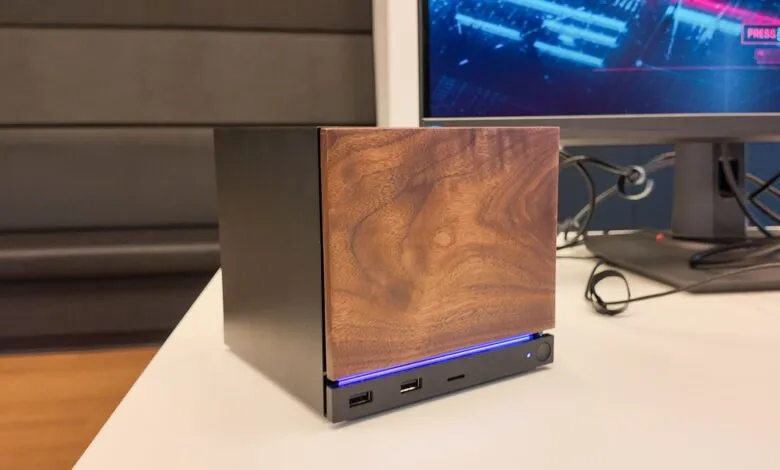
Examining the hardware itself reveals more cost-saving measures. The internal design is notably streamlined, featuring a unitary construction with a single heatsink and fan. The compact 200 W power supply also acts as part of the chassis, eliminating the need for a separate structural frame. The selection of ports is minimal, just one USB Type-C and a single NVMe slot, further reducing production costs. The GPU is based on AMD’s affordable Navi 33 (RDNA 3) architecture, paired with a last-generation six-core Zen 4 CPU.
The market context is crucial. While high-end mini PCs are plentiful, they are often expensive due to the premium cost of compact components. Valve’s challenge is to engineer a small, affordable gaming PC without the typical mini-ITX price inflation. The company’s goal seems to be conquering the affordability challenge rather than simply creating another expensive niche product.
The upcoming two-model lineup (512 GB and 2 TB) provides Valve with pricing flexibility. This allows for an attractive entry-point, potentially around $529, with a premium model priced higher, perhaps near $649. This strategy mirrors the Steam Deck’s launch, where pre-orders heavily favored the more expensive SKU.
Ultimately, for the Steam Machine to succeed in significant numbers, it must be well-priced. It’s considered highly unlikely to breach the $800 barrier, as consumers would simply opt for a more powerful pre-built desktop at that point. The sweet spot for the 512 GB version is anticipated to be between $500 and $600, with the 2 TB model approaching $700. Valve has the financial resources to accept lower margins to drive adoption, a lesson likely learned from its past hardware ventures. While a shockingly low price of $350 is a hopeful fantasy, a strategic price point of $499 for the base model would be a psychologically powerful and tempting offer for consumers.
(Source: PC Gamer)