Wyoming’s ‘Dinosaur Mummies’ Reveal Duck-Billed Dinosaur Secrets
▼ Summary
– Edmontosaurus annectens was first discovered in 1908 in Wyoming by C.H. Sternberg, with its scaly skin imprints providing an initial idea of its appearance.
– Over a century later, Paul C. Sereno’s team found two more Edmontosaurus mummies with detailed external anatomy preserved in clay, revealing its true look for the first time.
– Charles R. Knight’s 1909 drawing of Edmontosaurus, based on the first specimen, inaccurately depicted a crest running the full body length due to the missing tail.
– In 1984, Jack Horner updated the image by identifying tail spikes but incorrectly reconstructed them as rectangular and extending to the head.
– Sereno’s recent findings have corrected past inaccuracies, providing a definitive and accurate depiction of Edmontosaurus’s appearance.
The remarkable discovery of new “dinosaur mummies” in Wyoming is reshaping our understanding of the duck-billed Edmontosaurus, offering an unprecedented glimpse into the actual appearance of this Cretaceous giant. These exceptionally preserved fossils reveal intricate details like skin texture and tail spikes with stunning clarity, correcting artistic interpretations that have persisted for over a century.
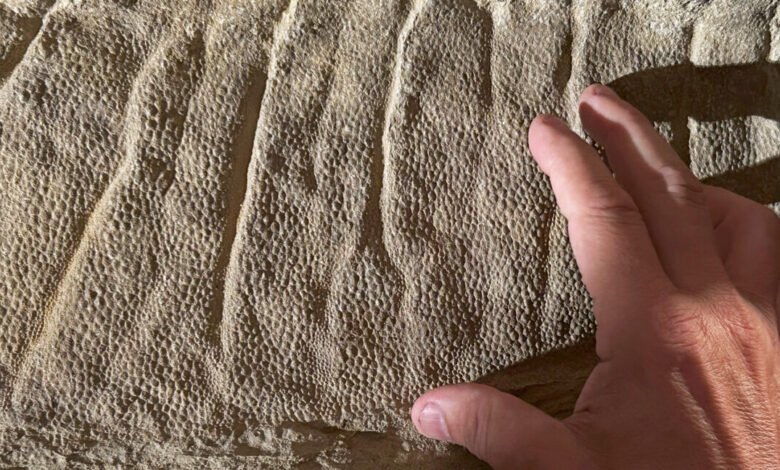
Back in 1908, fossil collector C.H. Sternberg unearthed the first notable Edmontosaurus annectens specimen in east-central Wyoming. This skeleton, later known as the “AMNH mummy,” became housed at the American Museum of Natural History. What made it extraordinary was the presence of scaly skin impressions preserved in the surrounding rock, providing the earliest rough approximation of the animal’s outward appearance.
A team of researchers, led by University of Chicago professor Paul C. Sereno, recently returned to Sternberg’s original dig site. There they excavated two additional Edmontosaurus mummies, each preserving the complete fleshy external anatomy within an incredibly fine, sub-millimeter layer of clay. For the first time, scientists have obtained a definitive and highly detailed image of the dinosaur’s true form, including the precise size of its body scales and the specific arrangement of defensive spikes along its tail. The findings contained several unexpected revelations.
Our visual conception of Edmontosaurus has undergone significant evolution over the decades, even prior to this latest study. The initial reconstruction was illustrated in 1909 by famed paleoartist Charles R. Knight, who based his work on Sternberg’s original specimen. “He was accurate in some ways, but he made a mistake in that he drew the crest extending throughout the entire length of the body,” Sereno notes. Because the mummy Knight studied was missing its tail, the artist understandably used creative license to complete the animal, resulting in a depiction that somewhat resembled a mythical dragon.
A major update to this image arrived in 1984, thanks to the work of prominent paleontologist Jack Horner. He discovered a section of Edmontosaurus tail that featured spikes rather than a continuous crest. According to Sereno, “The specimen was not prepared very accurately, so he thought the spikes were rectangular and didn’t touch each other.” This led to a revised reconstruction where Horner extended these spikes from the tail all the way up to the head, an interpretation we now know was incorrect. Over the years, these competing visions resulted in multiple conflicting portrayals of the dinosaur. Sereno confidently states that with the new mummies, the scientific community has finally pinned down the authentic likeness of Edmontosaurus.
(Source: Ars Technica)