Lenovo Legion Tower 7i Gen 10: Our Verdict
▼ Summary
– The Legion Tower 7i is a high-performance gaming PC featuring an Nvidia RTX 5080 GPU and Intel Core Ultra 9 285K processor cooled by a 360mm AIO system.
– It delivers strong gaming performance, achieving 76 fps in Cyberpunk 2077 at 4K with ray tracing and up to 198 fps with frame generation enabled.
– The design features a slimmer case than previous models with RGB lighting, though the RAM lacks aesthetic covers and the bundled keyboard/mouse are low quality.
– Pricing starts at $2,299 for base configurations, with the reviewed RTX 5080/2TB SSD model costing $3,099, though Lenovo frequently offers sales.
– The system includes useful software like LegionSpace for performance monitoring but comes with bloatware such as Lenovo Now that should be uninstalled.
The Lenovo Legion Tower 7i Gen 10 delivers a clean, high-performance gaming experience, packing serious power with components like the Nvidia GeForce RTX 5080 and Intel Core Ultra 9 285K processor. This prebuilt system is cooled by a 360mm AIO liquid cooler, making it a compelling option for gamers seeking a robust, ready-to-play rig, though its premium price tag is a significant consideration. While the performance is undeniably strong for modern AAA titles, the case design leans more toward a budget aesthetic, and the included RAM lacks any decorative lighting, which might disappoint enthusiasts who prioritize visual flair.
Pricing for the Legion Tower 7i starts at $2,299, which gets you a configuration with an Intel Core Ultra 9 285K, an RTX 5070 Ti, 32GB of RAM, and a 1TB solid-state drive. The model reviewed here, equipped with an RTX 5080 and a 2TB SSD, carries a price of $3,099. It’s worth noting that Lenovo frequently runs sales on its gaming desktops, so holding off for a promotional period could lead to substantial savings.
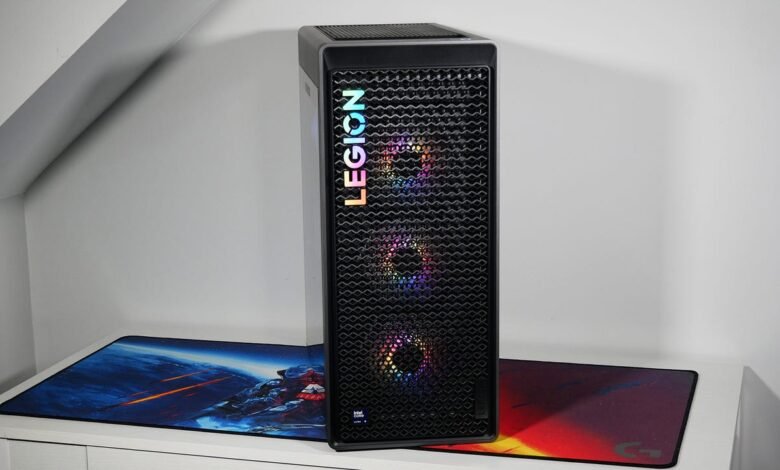
In terms of design, the Tower 7i has undergone a slight slimming from its predecessor, now standing 18.8 inches tall and 16.34 inches wide. While still a substantial 35-pound mid-tower, the reduction in bulk is a welcome change. The chassis is finished in a stormy gray paint that appears quite ordinary until the system powers on. Once illuminated, bold RGB lighting brings the case to life, accentuating a honeycomb pattern and a prominent Legion logo. Rounded edges and top-mounted fans contribute to a mechanical vibe. Peering through the tempered glass side panel reveals white LEDs highlighting the internal components, with the liquid cooler, graphics card, and rear fans all featuring customizable RGB. The motherboard-mounted RAM, however, remains unadorned.
Removing the glass panel is straightforward, requiring only the loosening of two thumbscrews. Inside, the build is exceptionally tidy, with cables neatly managed. The RTX 5080 graphics card occupies two PCIe slots, and while additional expansion slots are available, they offer limited clearance for thicker add-in cards. Accessing the rear panel proved more challenging, with tight thumbscrews that necessitated a screwdriver for removal. Cable management in the back relies on zip ties tucked into the space near the power supply, presenting a neat appearance but complicating any potential upgrades.
Front-panel connectivity has been moved to the top of the case, near the power button. You’ll find a headphone jack, one USB 3.2 Gen 1 Type-A port, two USB 2.0 Type-A ports, and a welcome addition: a USB 3.2 Gen 2 Type-C port, which was absent on the previous model. Around back, a second Type-C port supports Thunderbolt 4, alongside four USB 3.2 Gen 1 Type-A ports, two USB 2.0 Type-A ports, an Ethernet jack, and a generous array of six audio ports. A DisplayPort on the motherboard is primarily intended for troubleshooting.
The package includes a generic keyboard and mouse, which fall short for serious gaming. The mouse struggled to keep pace during fast-paced action in Marvel Rivals, while the keyboard features mushy membrane keys and offers poor ergonomic support.
Out of the box, the system comes with some pre-installed software. The Lenovo Vantage application provides useful functions like warranty tracking and driver updates, but the ‘Lenovo Now’ app simply links to a subscription marketplace and is best uninstalled. The LegionSpace software, however, is a valuable tool for monitoring system vitals, adjusting performance profiles, and customizing RGB lighting. It also includes an option for GPU overclocking, though this should be approached with caution.
Performance is where the Legion Tower 7i truly excels. The combination of the RTX 5080, Intel Core Ultra 9 285K, and 64GB of RAM handles demanding games with ease. In Cyberpunk 2077 at 4K with Ray Tracing Ultra and DLSS Performance, the system achieved a smooth 76 fps. Engaging Frame Generation boosted this to 124 fps, and with Multi-Frame Generation enabled, it reached an impressive 198 fps. It also delivered 62 fps in Assassin’s Creed Shadows, which jumped to 94 fps with frame generation. While Metro Exodus proved more challenging, running at 59 fps, competitive titles like Call of Duty: Black Ops 6 ran flawlessly at 121 fps. During gameplay in Marvel Rivals at 4K with high settings, the average frame rate was a very playable 167 fps. While you may not max out a 4K 240Hz display on the most extreme settings, the Legion Tower 7i provides more than enough performance for the vast majority of gamers. For those unwilling to compromise, an RTX 5090 configuration is available, though it enters a price bracket where competing boutique builders start to seem more reasonable.
![Image of the Lenovo Legion Tower 7i with its side panel removed, showing the clean internal layout and large graphics card.] ![Image of the front of the Lenovo Legion Tower 7i case, highlighting the honeycomb design and Legion logo.] ![Image showing the top I/O panel of the Legion Tower 7i, featuring the power button and various USB ports.] ![In-game screenshot from Cyberpunk 2077 running on the system, demonstrating high-fidelity graphics.] ![A chart showing the performance benchmarks of the Legion Tower 7i across various games and synthetic tests.]
(Source: IGN)