Steam Frame vs. Other VR Headsets: Which Is Best?
▼ Summary
– Valve announced the Steam Frame, a standalone VR headset that streams PC games wirelessly and plays games locally using an onboard Arm chip.
– The headset includes a wireless dongle for low-latency streaming of both flat and VR games from a PC, with no noticeable lag experienced during testing.
– It runs SteamOS on Arm and uses real-time emulation to play a vast portion of the Steam library locally without requiring developer modifications.
– Performance for high-end games locally may be limited, as developers are advised to target lower specs than the Steam Deck, and some stuttering occurred in tests.
– Valve aims to price the Steam Frame below its previous Index model, with a release scheduled for early 2026.
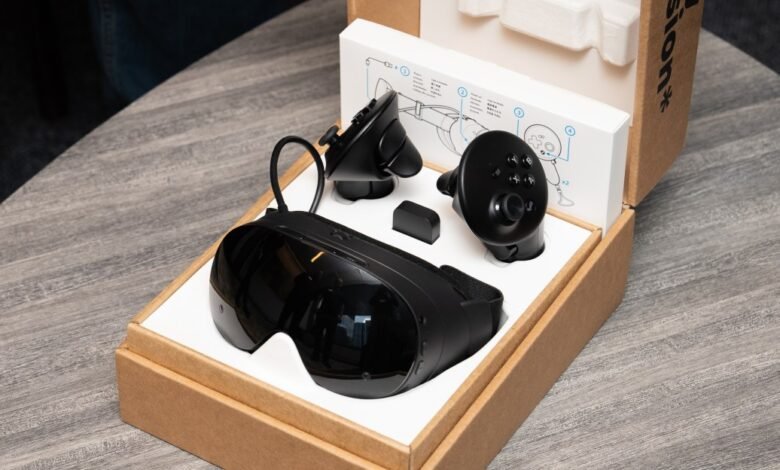
Choosing the right virtual reality headset can feel overwhelming with so many options available. Valve’s newly announced Steam Frame enters the market as a versatile standalone device, capable of both streaming PC games wirelessly and running them locally using an onboard Arm processor. This dual functionality sets it apart from the company’s previous tethered Index model and positions it as a unique competitor against popular headsets like the Meta Quest 3, Samsung Galaxy XR, and Apple Vision Pro.
A defining feature of the Steam Frame is its emphasis on game streaming. Every unit includes a wireless dongle that plugs into your computer, enabling you to stream both traditional and VR titles to the headset over a low-latency connection. During a hands-on demonstration at Valve’s headquarters, playing Half-Life: Alyx felt impressively responsive with no noticeable lag.
Beyond streaming, the Frame can also run games locally. Valve has adapted SteamOS for the Arm architecture, and the headset is powered by a Snapdragon 8 Gen 3 chip. What makes this particularly noteworthy is its ability to run a vast portion of the existing Steam library without requiring developers to modify their games. The system uses an emulator to translate Windows x86 code in real time, making countless titles playable right on the device.
However, you shouldn’t expect to run the most demanding games locally. Valve advises developers to target performance lower than what they would for a Steam Deck. Even while playing less intensive games like Hollow Knight: Silksong and Hades II, some stuttering was observed, though Valve has identified this as a bug and plans to make improvements before and after the official launch.
When comparing specifications, the Steam Frame holds its own against the competition. It features pancake lenses, an LCD screen with a resolution of 2160 x 2160 per eye, and a refresh rate that can reach up to 144Hz experimentally. It includes 16GB of RAM and offers storage options of 256GB or 1TB, expandable via a microSD card slot. The headset supports Wi-Fi 7 and comes with a dedicated Wi-Fi 6E adapter specifically for low-latency streaming. It also includes eye tracking, a feature not available on the Meta Quest 3 but present on the Samsung and Apple headsets.
In terms of design, the core unit of the Steam Frame weighs 185 grams, increasing to 440 grams with the head strap that incorporates audio and a rear battery. This makes it lighter than the Meta Quest 3 (515g), the Samsung Galaxy XR (545g), and significantly lighter than the Apple Vision Pro (750–800g).
Pricing for the Steam Frame has not been finalized, but Valve has indicated it aims for a cost lower than its previous Index headset. The Meta Quest 3 starts at $499.99, while the Samsung Galaxy XR and Apple Vision Pro are priced at $1,799.99 and $3,499, respectively. The Valve Index was originally sold for $999 with its necessary controllers and base stations.
A direct comparison with the Index highlights the Steam Frame’s advancements. The new headset is much lighter, uses modern pancake lenses instead of Fresnel, offers a higher per-eye resolution, and provides a refresh rate of up to 144Hz. Unlike the Index, which required external base stations for tracking, the Frame uses inside-out tracking with cameras and includes eye tracking.
Scheduled for release in early 2026, the Steam Frame represents a significant step forward for Valve. Its combination of high-quality wireless streaming and broad local compatibility through emulation makes it a compelling new contender in the VR space.
(Source: The Verge)


