Unlocking Gravity’s Secrets with New Black Hole Images

▼ Summary
– The Event Horizon Telescope has recently provided the first images of a black hole’s immediate surroundings and is improving resolution to study extreme gravity.
– Researchers are exploring alternative gravity theories beyond general relativity due to its incompatibility with quantum mechanics and inability to explain dark matter.
– The extreme environment near a black hole may amplify subtle differences between general relativity and alternative gravity theories, making them detectable.
– General relativity successfully explains many cosmic and Earth-based phenomena, so any alternative theories must differ in very subtle, hard-to-detect ways.
– Studying the nested photon rings around black holes offers a promising method to test gravity theories in strong gravitational fields, as predicted by general relativity.
The recent capture of images depicting the immediate surroundings of a black hole by the Event Horizon Telescope marks a pivotal moment in astrophysics. These groundbreaking visuals are steadily being refined, offering an unprecedented look into regions governed by the most intense gravitational forces known to exist. This progress opens new pathways for testing the fundamental laws that govern our universe.
A central question arises: which theory of gravity are we actually observing? General relativity, while remarkably successful, faces theoretical challenges. It does not integrate seamlessly with quantum mechanics, and it fails to account for the mysterious phenomenon of dark matter. These shortcomings have prompted physicists to develop numerous alternative theories that seek to resolve these inconsistencies. The intensely warped space near a black hole could potentially magnify the subtle distinctions between general relativity and its proposed alternatives. Consequently, a team of researchers is investigating whether future, more powerful telescopes could detect these differences clearly enough to eliminate some candidate theories.
The primary hurdle for any new theory is that general relativity works exceptionally well. It accurately describes the universe’s large-scale architecture and predicts phenomena we can verify on Earth. This means any competing theory must deviate from Einstein’s framework in extremely fine, almost imperceptible ways. Detecting such minute discrepancies presents a formidable scientific challenge.
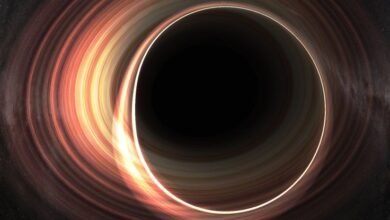
However, the environment surrounding a black hole provides a unique natural laboratory. Its gravitational field is so powerful that a spinning black hole literally drags the fabric of spacetime around with it, an effect known as frame dragging. This warping forces light to travel along dramatically curved paths before it can reach our telescopes. The resulting image is a direct product of the underlying gravitational theory. According to the research team, general relativity forecasts that the visual signature of this region will appear as a sequence of nested, ring-like structures. Each ring corresponds to the number of half-orbits photons complete around the black hole before escaping toward an observer. Precisely measuring the detailed structure and precise positioning of these photon rings is considered the most promising method for probing gravity under conditions of extreme, yet stable, curvature.
(Source: Ars Technica)