Czinger 21C: The Future Military Supercar
▼ Summary
– The Czinger 21C hypercar shares manufacturing technology with defense systems, using the same additive manufacturing machines that produce military components like cruise missiles.
– Divergent 3D’s laser sintering technology enables rapid development, reducing production time from years to months and cutting part counts by over 90% for systems like the RAACM cruise missile.
– The 21C hypercar showcases Divergent 3D’s manufacturing-as-a-service approach, featuring a 1,250-horsepower hybrid powertrain and record-breaking performance capabilities.
– Divergent 3D is developing its own advanced 3D printers to enable faster, larger, multi-material printing for high-performance applications in aerospace and automotive industries.
– While the 21C is the visible flagship product, Divergent 3D’s primary business is in aerospace and defense, with plans to expand into high-volume automotive manufacturing for major brands.
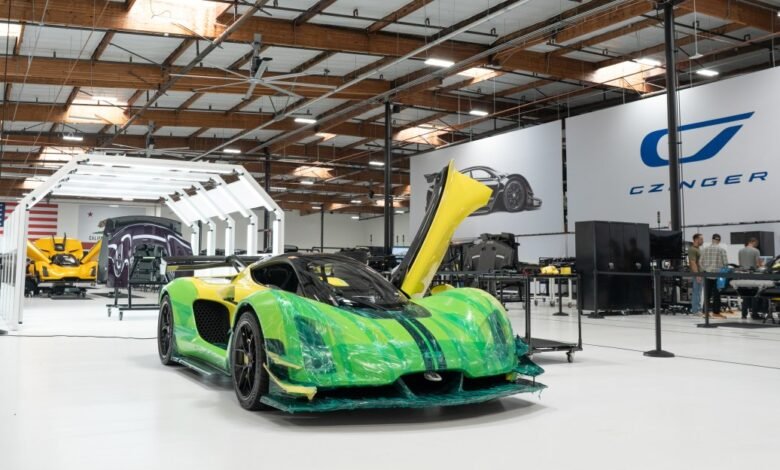
While many cars have leaned on military-inspired marketing over the decades, the Czinger 21C represents a genuine fusion of defense technology and automotive engineering. This $2.35 million hypercar shares its manufacturing DNA with precision-guided munitions and military drones, produced using the same advanced additive processes by parent company Divergent 3D. Unlike traditional halo cars that serve as brand ambassadors, the 21C showcases a revolutionary manufacturing-as-a-service model, built in facilities that also craft next-generation aerospace components.
Walking through Divergent 3D’s Torrance headquarters reveals a manufacturing floor where automotive and defense projects coexist. Intricate suspension parts for upcoming hypercars sit alongside angular cruise missile bodies, all bearing the distinctive satin finish of laser-sintered components. This additive manufacturing technique uses high-power lasers to fuse layers of metal powder into complex, lightweight structures. CEO Lukas Czinger explains that their approach dramatically accelerates development timelines. A complete cruise missile airframe, for instance, can progress from initial design to flight-ready status in just two to three months, a process that traditionally required years.
The manufacturing breakthrough originated with former CEO Kevin Czinger, who established Divergent 3D in 2014. His son Lukas later founded Czinger Vehicles in 2019, taking leadership of the parent company earlier this year. While laser sintering itself isn’t new, Divergent 3D’s integrated approach, combining design, production, and testing under one roof, enables unprecedented speed and efficiency. The company currently utilizes industry-standard printers from SLM Solutions but is transitioning to its own Divergent Evolutionary Printer. This in-house system promises larger, faster prints with multi-material capabilities, including aluminum and high-performance nickel alloys for demanding aerospace applications.
Generative design software further optimizes parts for strength and minimal weight, creating a comprehensive advanced manufacturing ecosystem. What better demonstration of this capability than a record-breaking, 3D-printed hypercar?
Getting behind the wheel of the Czinger 21C is anything but graceful. The driver sits centrally, reminiscent of the classic McLaren F1, surrounded by sweeping fenders that cover massive front wheels and carbon-ceramic brakes. On public roads, the car initially operates nearly silently using its trio of electric motors, which provide around 500 horsepower. Engaging the twin-turbo V8 unleashes the full 1,250 horsepower, transforming the driving experience entirely. Acceleration to 60 mph happens in under two seconds, though legal speed limits prevent exploring its full potential outside a track.
The V Max version I drove is optimized for high-speed stability, capable of reaching 253 mph. In traffic, the 21C feels tense and eager, but on open roads it delivers breathtaking power and razor-sharp handling. It recently completed a 1,000-mile, five-track tour of California, setting new records at each venue.
Only ten 21C models have been delivered so far, each commanding a seven-figure price. However, automotive projects represent just a fraction of Divergent 3D’s business, which primarily serves aerospace and defense clients. Recent funding rounds valued the company at $2.3 billion, reflecting strong growth. Current automotive partners include Aston Martin, Bugatti, and McLaren, all incorporating Divergent’s components into their vehicles.
Looking ahead, Czinger envisions expanding into high-volume production for major automakers within the next decade, while also developing an even more advanced hypercar. The 21C stands as a bold statement of what’s possible when cutting-edge defense manufacturing meets automotive ambition.
(Source: The Verge)