Achieve 100 MBit/s Ethernet on a Raspberry Pi Pico
▼ Summary
– The Raspberry Pi Pico can achieve bit-banged 100 MBit/s Fast Ethernet transmission using [Steve]’s Pico-100BASE-TX library, reaching speeds of roughly 11 Mbyte/s.
– [Steve] implemented the three voltage levels on the Pico using two GPIOs, enabling the higher-speed Ethernet functionality.
– To the best of [Steve]’s knowledge, this is the first bit-banged 100 MBit/s Ethernet implementation using a microcontroller.
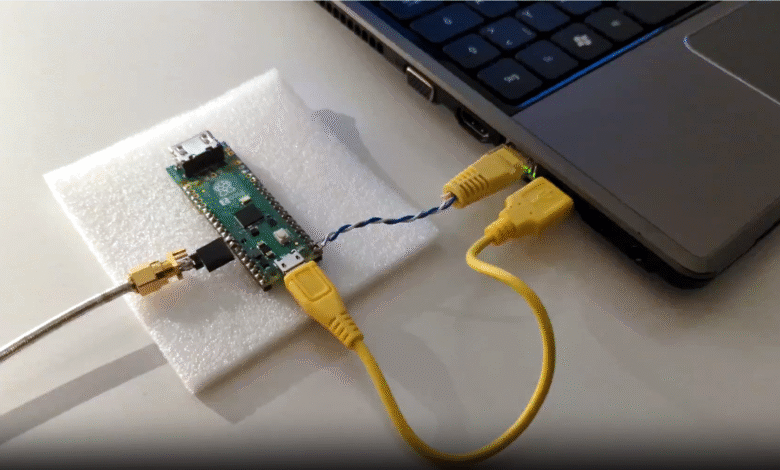
Achieving 100 MBit/s Fast Ethernet on a Raspberry Pi Pico represents a remarkable technical breakthrough, pushing the limits of what many believed possible with this compact microcontroller. Thanks to the innovative Pico-100BASE-TX library developed by Steve, both the RP2040 and RP2350 chips can now handle data transmission at speeds around 11 Mbyte per second. This performance level fully supports the demands of 100 MBit/s Ethernet, a feat that significantly outpaces earlier implementations.
Previous projects managed to establish 10BASE-T connectivity on the Pico, but reaching 100BASE-T required far more than simply increasing the bit rate. The older 10BASE-T standard relies on two voltage levels and Manchester encoding, while 100BASE-T introduces three distinct voltage levels and a much more intricate encoding scheme. Steve ingeniously addressed this challenge using just two GPIO pins on the Pico, demonstrating exceptional engineering creativity. For those interested in the technical specifics, the project’s repository includes a detailed README along with several practical application examples.
According to Steve, this appears to be the first known instance of a microcontroller achieving bit-banged 100 MBit/s Ethernet. It is important to note that the current implementation supports transmission only; receiving data presents a separate and considerably more complex set of obstacles. However, the maker community thrives on such challenges, and it is quite possible that an inventive developer will devise a method for bidirectional communication in the future. Should you succeed in creating a receive function, sharing your discoveries would undoubtedly benefit the wider electronics and DIY communities.
(Source: Hack A Day)