Engineering Metal-Ordered Polymers
▼ Summary
– Polymers are typically disordered tangles of molecular chains, but since 1990 chemists have developed techniques to create precisely structured polymers called metal-organic frameworks (MOFs).
– MOFs have unique properties such as large pores for gas storage or filtration and built-in catalytic centers, making them useful for specific applications.
– Three researchers, Richard Robson, Susumu Kitagawa, and Omar Yaghi, were honored with a Nobel Prize for their contributions to developing MOFs.
– In contrast to MOFs, traditional polymers form from molecules linked by flexible bonds, resulting in disordered structures with limited chemical control beyond bulk manipulation.
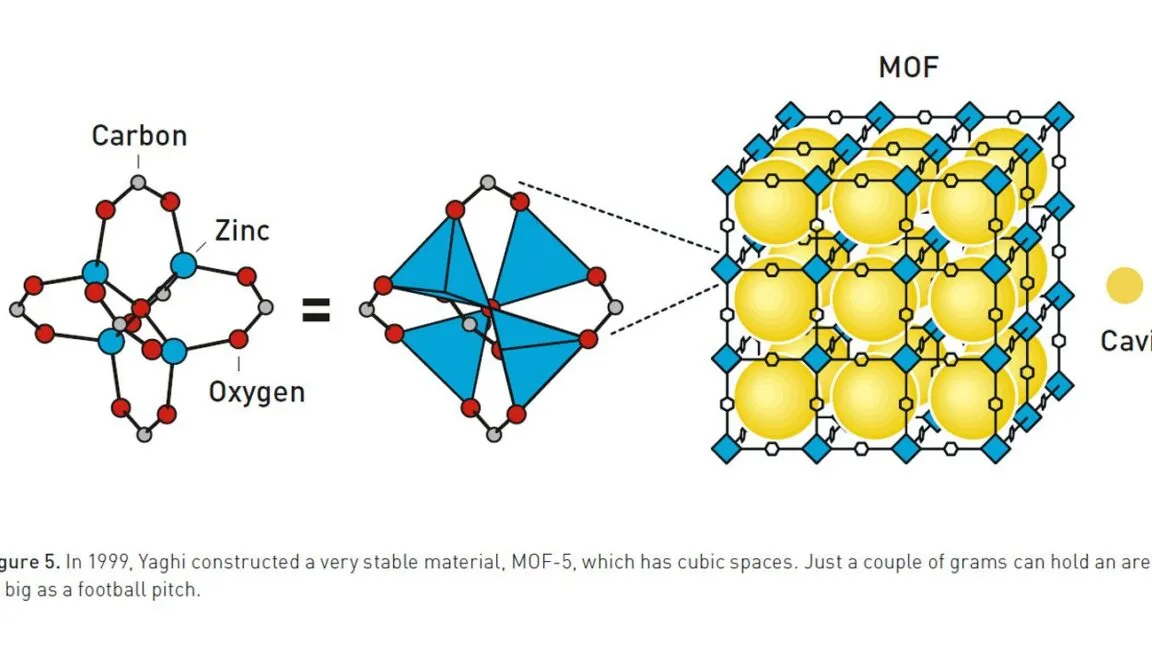
– MOFs use metals as hubs to control molecular geometry, enabling the creation of specific 3D structures through rigid bonds and set angles between metals and organic molecules.
The world of materials science has been transformed by the development of metal-organic frameworks (MOFs), a class of polymers with meticulously ordered structures. Unlike traditional polymers that form chaotic tangles, MOFs are engineered with precision, offering unique properties such as expansive pores for gas storage and filtration, along with integrated catalytic centers. This groundbreaking approach to polymer design represents a significant leap forward in functional material engineering.
In a landmark recognition of this field’s importance, the Nobel Prize Committee recently awarded three pioneering researchers. Richard Robson received honors for demonstrating the very first MOF, while Susumu Kitagawa and Omar Yaghi were celebrated for advancing these materials to their full potential. Their collective work has established an entirely new paradigm for constructing molecular architectures.
Traditional polymers typically form through the linkage of individual molecules with flexible bonds. This flexibility allows molecular chains to move freely, resulting in the disordered, spaghetti-like structures found in everyday plastics and rubber products. While manufacturers can influence certain bulk characteristics by adjusting processing conditions or selecting different molecular building blocks, the fundamental chemistry of these materials offers limited opportunities for precise structural control.
MOFs operate on an entirely different principle, using metal atoms as structural anchors. These metal centers function as geometric hubs, with rigid organic molecules extending outward in predetermined directions. A metal’s specific electron orbital configuration dictates both the number of organic molecules it can bond with and the exact angles between these connections. This inherent coordination chemistry enables scientists to deliberately construct specific three-dimensional frameworks where metal nodes and organic linkers alternate in perfect crystalline order. By carefully selecting appropriate metals and organic components, researchers can essentially program the final architecture of these materials, creating tailored structures with exceptional precision.
(Source: Ars Technica)
