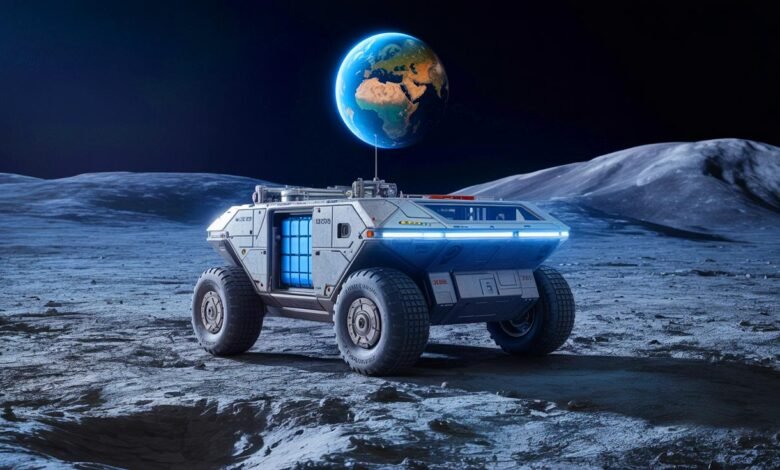
GM’s Unstoppable Lunar Rover With Crab Walk Powers NASA’s Artemis Moon Missions
▼ Summary
– The Lunar Terrain Vehicle (LTV) is designed to withstand the Moon’s extreme conditions, including temperatures as low as -334°F, and support extended missions.
– General Motors is developing a rechargeable lithium-ion battery for the LTV with a projected lifespan of ten years and a range of at least 19,000 miles.
– Advanced mobility features like Crab Walking and zero-point turning enable the LTV to navigate the Moon’s challenging terrain, drawing on GM’s off-road technology.
– The LTV can be operated by astronauts or remotely from Earth, using sensors such as LiDAR and cameras for autonomous navigation and reduced cognitive load.
– NASA’s Artemis program will use the LTV for sustainable lunar exploration, with the vehicle expected to support the Artemis V mission in 2030 or later.
NASA’s Artemis program is poised to revolutionize lunar exploration with the development of a new Lunar Terrain Vehicle (LTV), a high-tech rover engineered to conquer the Moon’s brutal environment and support long-term human presence. This modern lunar buggy represents a monumental leap beyond the Apollo-era rovers, designed not as a disposable tool but as a durable, reusable asset for astronauts. It embodies the fusion of cutting-edge automotive innovation with the rigorous demands of space travel, promising to extend mission capabilities and unlock new scientific discoveries on the lunar surface.
The Moon presents a formidable set of obstacles for any machinery. Its surface is a rugged landscape of fine, abrasive dust, jagged rocks, and vast craters, all subject to extreme temperature swings. During the long lunar night, thermometers can plummet to a staggering -334 degrees Fahrenheit. The Artemis program’s goal of establishing a sustainable human outpost hinges on vehicles that can not only survive these conditions but thrive in them. The LTV is being crafted as that foundational piece of mobility infrastructure.
A cornerstone of the new rover’s design is its revolutionary power system. General Motors is contributing its advanced battery technology, developing a rechargeable lithium-ion battery pack with an anticipated operational life of up to ten years. This is a dramatic departure from the single-use batteries of the past. Engineers project this system will enable the LTV to travel a lifetime range exceeding 19,000 miles, a figure that dwarfs the 57-mile range of its Apollo predecessors. The battery chemistry leverages high-nickel NCMA cathodes, similar to those used in GM’s terrestrial electric vehicles, refined for the unforgiving space environment.
To guarantee absolute reliability millions of miles from the nearest repair shop, GM employs meticulous manufacturing processes. The battery cells are assembled using super-precise laser welding and inspected with flash thermography to detect any microscopic defects. This relentless focus on quality control is non-negotiable for a vehicle that must operate flawlessly in the vacuum of space.
Mobility on the Moon requires more than just robust construction; it demands agility. The LTV’s design incorporates four wheels, each powered by its own independent electric motor. This configuration enables sophisticated maneuvers that are crucial for navigating tricky terrain. The vehicle will be capable of Crab Walking, allowing it to move diagonally, and zero-point turning, which lets it spin in place. These features, inspired by off-road technology in vehicles like the GMC Hummer EV, provide astronauts with unparalleled control to traverse sandy plains, climb rocky slopes, and navigate around obstacles.
Furthermore, the LTV is being built with a high degree of autonomy. It can be piloted directly by crew members on the lunar surface or controlled remotely from mission control on Earth. An extensive sensor suite, including LiDAR, radar, and high-resolution cameras, gives the vehicle a comprehensive view of its surroundings. This intelligent system is designed to reduce the workload for astronauts, allowing them to concentrate on their primary mission objectives: conducting experiments and exploring.
The selection of a final LTV design is a critical upcoming milestone for NASA. The chosen vehicle is scheduled to support the Artemis V mission, currently planned for the 2030s. This will be the first time since the Apollo program that astronauts have a dedicated vehicle for exploration, marking a new chapter in our journey to the Moon and beyond. The development of this sophisticated rover is a clear signal that the era of sustainable lunar exploration is dawning, paving the way for future human missions to Mars and deeper into the solar system.
(Source: Energy Reporters)


