Nanoleaf Floor Lamp Review: Simple, Affordable, But App Needs Work
▼ Summary
– The Nanoleaf Smart Multicolor Floor Lamp is an affordable smart light packed with features like music reactivity, screen mirroring, and extensive customizable light scenes.
– Assembly is straightforward with the help of Nanoleaf’s online videos, taking less than 20 minutes to complete despite initial concerns.
– It offers smooth color transitions and mood lighting with 1,700 lumens, though it is not as bright as some premium competitors like Philips Hue.
– The lamp supports multiple control methods including Wi-Fi, Bluetooth, Matter, and voice commands via smart home platforms, but the companion app is criticized for being unintuitive and convoluted.
– Despite the app’s shortcomings, the lamp provides excellent value for money, performing reliably in daily use with features like AI-generated scenes and a physical controller for basic functions.
The Nanoleaf Smart Multicolor Floor Lamp delivers an impressive array of smart lighting capabilities without demanding a premium price. This sleek floor lamp features music-reactive lighting, screen mirroring, and extensive color customization, all wrapped in a straightforward design that’s surprisingly simple to assemble. While its companion app presents some usability challenges, the lamp’s everyday performance and affordable cost make it a compelling option for smart home enthusiasts.
Since introducing its first smart bulb, Nanoleaf has built a reputation for blending advanced features with accessible pricing. The Smart Multicolor Floor Lamp, unveiled at CES 2025, continues this tradition by offering one of the market’s more budget-friendly smart floor lamps. It may not boast a flashy exterior, but it’s loaded with functionalities like sound reactivity, screen synchronization, and AI-driven scene creation, just type a descriptive word and the app generates a matching color scheme.
Assembly initially seemed daunting, but a brief instructional video from Nanoleaf clarified the process. Within twenty minutes, the lamp was fully constructed and ready for use.
Newcomers to the Nanoleaf ecosystem should find pairing the lamp with the iOS or Android app straightforward. However, users with multiple older Nanoleaf devices might encounter connectivity issues if those products haven’t been used recently. Persistent “offline” notifications for dormant devices can interfere with setting up the new lamp, sometimes requiring removal of old products from the app. Once any legacy device conflicts are resolved, scanning the QR code on the lamp or its packaging enables quick connection.
Upon initial activation, the lamp emits a steady colored light, but the app provides immediate access to a vast library of user-designed Scenes. You can browse, preview, and apply these or craft your own custom lighting combinations.
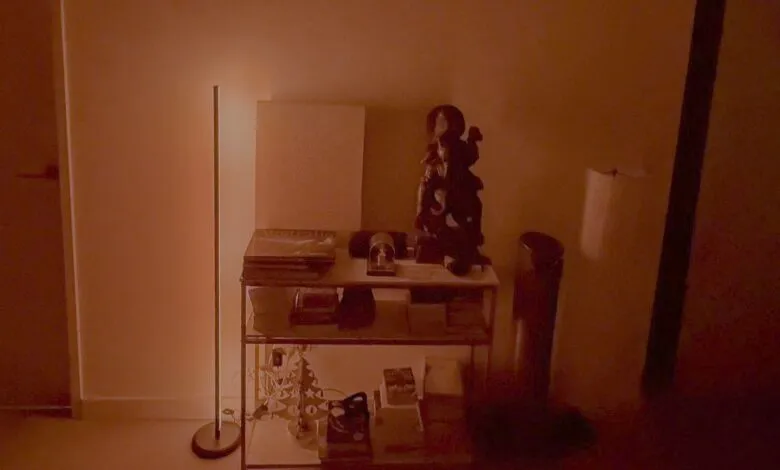
With a maximum output of 1,700 lumens, this isn’t the brightest floor lamp available. Competing models like the Philips Hue Signe Gradient reach 2,500 lumens and the Govee Floor Lamp Pro offers 2,100 lumens, though both come at significantly higher prices. The Nanoleaf lamp excels at creating ambient mood lighting rather than fully illuminating large spaces. Even simple white or warm yellow settings contribute to a cozy atmosphere. For best results, position it as a wall washer, directing light toward a wall, since looking directly at the lamp at full brightness can be uncomfortable.
Color transitions are exceptionally smooth, accommodating everything from bold, saturated hues to soft pastels. Daily operation is reliable, with no performance complaints regarding color rendering or effect fluidity.
Nanoleaf has integrated an remarkable number of features into this model. It contains 72 LEDs distributed across 24 color zones, enabling detailed customization. Connectivity options include Wi-Fi, Bluetooth, and compatibility with Matter-enabled smart home hubs. The lamp also inherits Rhythm Mode from Nanoleaf’s light panels, allowing it to pulse and change with music beats. Screen mirroring is supported for TVs equipped with the Nanoleaf 4D kit, and a desktop app enables synchronization with PC displays.
While Rhythm Mode and screen mirroring operate without lag, the color changes don’t always align perfectly with each musical beat. Loud conversations can also disrupt the audio responsiveness, as the lamp may react to prominent voices instead of the background music.
This lamp offers considerable versatility without complex installation requirements. Unlike some competitors, it omits a built-in speaker, but this absence doesn’t significantly detract from its overall appeal.
The primary drawback involves the Nanoleaf app itself. The interface lacks intuitiveness, a recurring issue noted in reviews of other Nanoleaf products. Although it contains all necessary functions for smart light management, the layout and workflow feel unnecessarily complicated. Setting up schedules exemplifies this problem, creating a routine with both start and end times requires establishing two separate routines instead of a single, integrated schedule. This contrasts sharply with competing apps from Philips Hue, TP-Link Tapo, or Laser ConnectSmart, which handle scheduling more seamlessly.
Despite its flaws, the Nanoleaf app remains essential for accessing special features. The AI Magic Scenes tool generates color palettes from typed keywords, and app integration is required for voice control through Google Home, Alexa, Samsung SmartThings, or Apple HomeKit. Many users might prefer controlling the lamp through their smart home platform’s native app, such as Apple Home, which imports favorite Scenes and supports Siri voice commands.
For those frustrated with the app, a physical controller on the power cord offers basic functionality, power cycling, favorite Scene rotation, and brightness adjustment. This controller is most effective after completing initial customizations via the app, since default color settings may not align with personal preferences.
Even considering the app’s shortcomings, the Nanoleaf Smart Multicolor Floor Lamp stands out for its excellent value and reliable performance.
Pricing and Availability
The Nanoleaf Smart Multicolor Floor Lamp is priced at $119.99 in the US, £69.99 in the UK, and AU$149.99 in Australia. It’s available for purchase through Nanoleaf’s official store and authorized retailers. Although originally announced at $99.99, the current price remains competitive, especially compared to the Philips Hue Signe Gradient at $362.99 and the Govee Floor Lamp Pro at $199.99. The absence of a speaker base is a minor trade-off given the significant cost savings.
Design and Build Quality
The lamp arrives as several components requiring assembly. A circular metal base, three curved pole segments, and a flexible light strip comprise the main parts. Connectors screw into the pole sections, which then attach to the base. Inserting the light strip into the assembled pole seems challenging initially, but the flexible design allows it to fit securely. The included power cable features an integrated physical controller.
Once assembled, the lamp stands 1.4 meters tall. The construction feels sturdy despite its slender profile, lifting it by the top section causes no loosening or wobbling. The base tends to show dust marks easily, though these wipe clean. Long-term scratch resistance might be a consideration.
Verdict
The Nanoleaf Smart Multicolor Floor Lamp is ideal for budget-conscious shoppers seeking feature-rich smart lighting. Its color performance, music synchronization, and screen mirroring capabilities provide substantial functionality at an accessible price. Those prioritizing app simplicity or needing very bright illumination might consider alternatives, but for creating dynamic ambient lighting, this lamp delivers outstanding value.
Alternatives to Consider
The Govee Floor Lamp 2 includes a handheld remote for convenient control and is widely available, though it’s less bright and often higher priced. The Philips Hue Signe Gradient Table Lamp offers superb performance and a smoother app experience, but commands a much steeper price.
Testing Methodology
The lamp was assembled using online video guides, paired with the Nanoleaf app, and integrated into Apple HomeKit. Testing involved experimenting with various user-created Scenes, assessing Rhythm Mode with a nearby speaker, and evaluating scheduling capabilities. Placement tests determined optimal positioning for ambient lighting effect.
(Source: TechRadar)