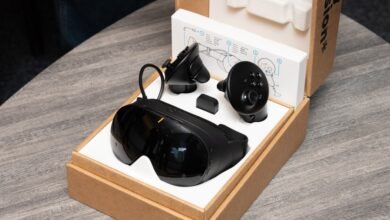
Top VR Headsets for 2025: UAE & Saudi Arabia Guide

▼ Summary
– PCMag recommends the Meta Quest 3 as the best overall standalone VR headset for its balance of price and features, including a color passthrough camera.
– The HTC Vive Pro 2, combined with Valve Index controllers, is recommended for the best high-end, PC-tethered VR experience, offering superior visuals.
– The Valve Index system is praised for its revolutionary controllers that track individual finger movements, significantly enhancing immersion in supported games.
– The Meta Quest 3S is highlighted as the most affordable and best introductory standalone headset, offering a strong VR experience with minimal compromises.
– Modern VR headsets are categorized as either tethered (requiring a PC/console) for high-end performance or standalone (wire-free) for greater physical freedom and accessibility.
Navigating the world of virtual reality in 2025 presents an exciting challenge for tech enthusiasts in the UAE and Saudi Arabia. With options ranging from fully standalone units to powerful PC-tethered systems, choosing the right headset depends heavily on your budget, existing hardware, and desired level of immersion. This guide breaks down the top contenders based on extensive testing, focusing on performance, comfort, and overall value to help you make an informed decision.
For those seeking the pinnacle of visual fidelity without stepping into professional-grade equipment, the HTC Vive Pro 2 paired with Valve Index controllers delivers an unparalleled experience. This combination demands a significant investment, starting at around $1,300 before considering the cost of a high-specification PC, but rewards users with stunning clarity and revolutionary control. The headset boasts an incredibly sharp 2,448 by 2,448 pixels per eye and integrates seamlessly with the SteamVR platform, while the Viveport store offers a subscription service for unlimited access to a vast library of VR content.
The Valve Index system stands out primarily for its groundbreaking controllers, which track individual finger movements to create a deeply immersive experience in supported games. While the headset itself offers crisp graphics and a high refresh rate, it is the controllers that truly define the package. For existing SteamVR users, purchasing the controllers separately for $280 can revitalize an older setup. Using them with a Meta Quest headset is possible but requires additional investments in base stations and a Link cable.
PlayStation 5 owners have a compelling option in the PS VR2, a substantial upgrade over its predecessor. It leverages the console’s power alongside new eye-tracking technology and motion controllers to create a highly engaging VR environment. The comfortable, lightweight design features a sharp OLED display with a 2,000-by-2,040-pixel resolution for each eye. It’s important to note that it does not support games from the original PlayStation VR.
If you’re new to virtual reality and prefer to avoid a large initial investment, the Meta Quest 3S serves as an excellent entry point. As a standalone device, it requires no PC or console, offering a solid VR experience with color pass-through cameras. It shares the same powerful processor as the more expensive Quest 3, though its display is less sharp and has a narrower field of view. For many, its affordability makes it the ideal first step into VR.
The Meta Quest 3 represents the best balance of features and freedom for most users. It costs $200 more than the 3S, but the investment brings a higher-resolution display and a wider field of view, significantly enhancing immersion. This standalone headset also includes a color passthrough camera for mixed reality experiences and is powered by a robust Qualcomm Snapdragon XR2 Gen 2 processor. It even surpasses the more expensive Meta Quest Pro in certain aspects, making it our top recommendation for a wire-free VR system.
When deciding on the best headset, the primary choice is between tethered and standalone models. Tethered headsets like the HTC Vive Pro 2, Valve Index, and PS VR2 connect to a PC or console, allowing for more graphically complex experiences at the cost of being physically connected by a cable. Standalone devices such as the Meta Quest series offer complete freedom of movement, processing everything onboard, though they can also connect to a PC via an optional cable for an expanded library.
The Apple Vision Pro occupies a unique space as the most advanced standalone device available, though Apple markets it as a “spatial computer.” It relies entirely on eye and hand tracking for control and features an incredibly intuitive interface. Its $3,500 price tag and first-generation status place it in a category of its own, aimed at early adopters and professionals. Another model to watch is Sony’s announced “spatial reality” headset, which promises intuitive controllers for content creators, though details remain scarce ahead of a potential CES 2025 reveal.
For those interested in the concept of the metaverse, Meta’s Quest headsets are the primary gateways. While Meta’s own Horizon apps have seen limited adoption, platforms like Roblox and VRChat have evolved into vibrant user-driven social spaces that are accessible through these devices.
It’s also crucial to distinguish between Virtual Reality (VR) and Augmented Reality (AR). AR headsets like the Microsoft HoloLens or Magic Leap One use transparent lenses to overlay digital images onto your real-world environment. These are currently development-focused tools costing thousands of dollars and are not considered consumer-ready products. The Apple Vision Pro and Meta Quest Pro offer pass-through AR capabilities, using cameras to blend digital objects with your surroundings, representing the current consumer-friendly edge of this technology.
For those seeking more immediate solutions, several consumer smart glasses project large virtual screens for media consumption and mobile work, though they do not offer true augmented reality interactivity. The VR landscape continues to evolve rapidly, promising even more advanced and accessible options in the near future.
(Source: PC MAG)