ASRock X870 LiveMixer: 25 USB Ports, But 10 Are Slower USB 2.0
▼ Summary
– The ASRock X870 LiveMixer WiFi motherboard supports up to 25 USB ports, including dual USB4, one 20Gbps, twelve 5Gbps, and ten USB 2.0 ports.
– It is designed for AMD Ryzen 7000-9000 series processors using the AM5 socket and supports PCIe 5.0 and DDR5 memory up to 256GB.
– The board includes four M.2 slots (two PCIe 5.0), multiple PCIe slots, 5Gb LAN, WiFi 7, and is aimed at content creators and users with many peripherals.
– Despite its strong features and competitive $229 price, the high number of USB 2.0 ports may limit long-term usefulness and appears outdated.
– Reviewers praise it as feature-rich for its price range but criticize the reliance on legacy USB ports instead of more modern options.
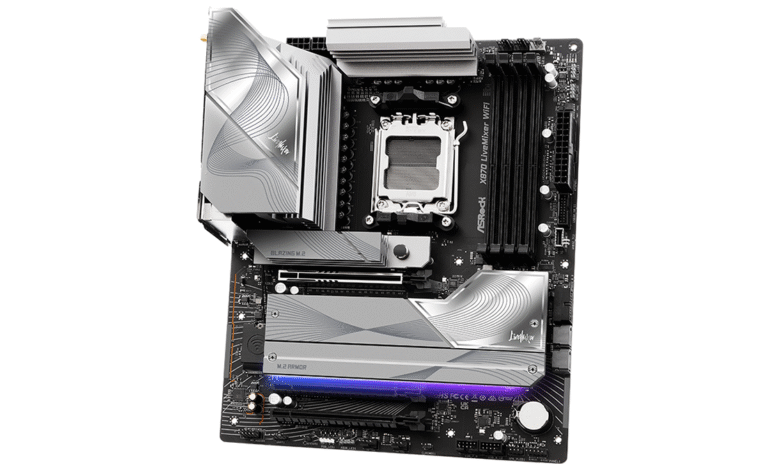
The ASRock X870 LiveMixer WiFi makes a bold entrance into the motherboard market with an unprecedented number of USB ports, targeting content creators and power users who demand extensive connectivity. Designed for AMD’s Ryzen 7000 through 9000 series processors, this ATX board combines modern features like PCIe 5.0 and DDR5 support with a staggering total of 25 USB ports. However, a closer look reveals that ten of those ports rely on the aging USB 2.0 standard, raising questions about the board’s long-term relevance in an era of faster data transfer and charging.
Priced at $229, the X870 LiveMixer includes dual USB4 ports, one 20Gbps USB port, twelve 5Gbps USB ports, and ten USB 2.0 connectors. While the abundance of ports may appeal to users with numerous peripherals, such as sim racing enthusiasts, audio professionals, or those using multiple capture devices, the heavy use of USB 2.0 feels like a step back. These slower ports may accommodate legacy hardware like older keyboards or mice, but they fall short for modern storage devices or high-bandwidth accessories.
Built on the X870 chipset and supporting the AM5 socket, the motherboard offers robust foundational specs. It includes four DDR5 DIMM slots capable of handling up to 256GB of memory, with official support for speeds exceeding 8000MT/s, though AMD recommends optimized performance around DDR5-6000. For expansion, the board provides one PCIe 5.0 x16 slot dedicated to graphics, along with two PCIe 3.0 x16 slots operating at x4 speed.
Storage options are equally impressive, with four M.2 slots, two supporting cutting-edge PCIe 5.0 NVMe drives, and two SATA connectors for additional drives. Networking is handled by a Realtek 5Gb Ethernet controller and WiFi 7 with Bluetooth 5.4, ensuring high-speed wired and wireless connectivity. Audio duties fall to a Realtek ALC4082 codec, complemented by standard audio jacks and S/PDIF output.
The rear I/O panel further enhances usability with HDMI 2.1 output and a BIOS flashback button, simplifying future processor upgrades without requiring a CPU installed. Reviewers have praised the board’s value proposition, noting its strong power delivery system and extensive heatsinking, which contribute to stable performance under load.
Despite these strengths, the decision to incorporate ten USB 2.0 ports feels like a missed opportunity. In a market increasingly dominated by USB4 and faster standards, this reliance on legacy technology may limit the board’s appeal for users looking to future-proof their setups. While the X870 LiveMixer WiFi undoubtedly offers exceptional connectivity and features for its price, a more forward-looking port selection could have solidified its position as a standout choice for years to come.
(Source: TechRadar)


