DJI Mic 3: Record 4 Subjects Simultaneously in a Compact Design
▼ Summary
– The DJI Mic 3 features a smaller, lighter transmitter with improved mounting options and a rotating clip, though it lacks a 3.5mm mic port compared to the Mic 2.
– It supports recording up to four subjects simultaneously with eight receivers and includes high-precision timecode capture for easier audio and video syncing in post-production.
– Audio quality is enhanced with two adaptive gain control modes, three tone presets, active noise cancellation, and lossless 48kHz 24-bit audio transmission.
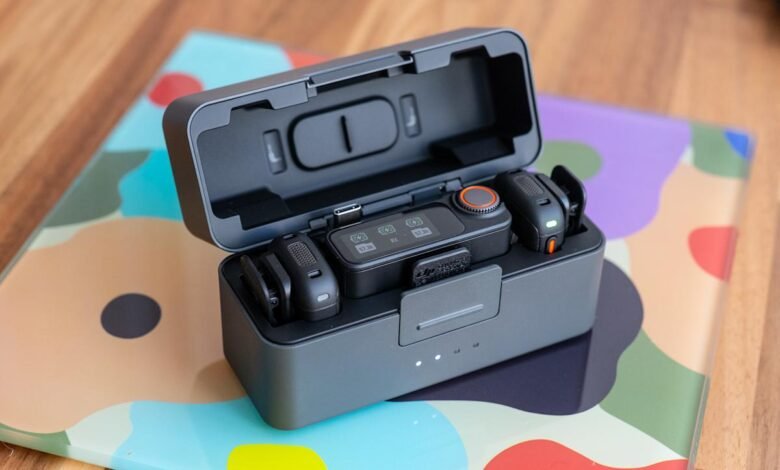
– The charging case provides extended power, allowing up to 28 hours of use and supports inserting transmitters with magnetic mounts and windscreens attached.
– Priced at $329 for a kit with two transmitters and a receiver, it is compatible with DJI’s OsmoAudio system and available in most territories, including the US.
DJI Mic 3 elevates wireless audio recording with the ability to capture four subjects simultaneously in a remarkably compact and lightweight design. This latest flagship model introduces significant upgrades in sound quality, noise reduction, and connectivity, though it does omit one key feature found in its predecessor.
The most immediate change is the transmitter’s reduced size and weight. At just 16 grams, it’s noticeably lighter than the Mic 2 and now features a rotating clip alongside the magnetic mount, offering greater flexibility in placement. A selection of five windscreen colors allows for better visual integration with clothing, though the prominent DJI branding on both sides remains.
A redesigned charging case accommodates the receiver and two transmitters even with windscreens attached. Each transmitter delivers up to eight hours of use, while the receiver lasts ten hours. The case itself provides enough power for 2.4 full recharges, extending total usage to around 28 hours, ideal for long shooting days.
One of the most compelling new features is the support for up to four transmitters and eight receivers at once, enabling multi-camera setups to record four people simultaneously. High-precision timecode embedding simplifies audio and video synchronization in post-production, a major advantage for editors.
For Sony camera users, a quadrophonic mode allows independent four-channel output to a single device. Range is impressive, with DJI claiming up to 400 meters thanks to automatic frequency hopping between 2.4GHz and 5GHz bands.
Audio quality sees substantial improvements. Two adaptive gain control modes tailor performance to different environments: Automatic mode prevents clipping in loud settings, while Dynamic mode maintains consistent volume in quieter spaces. Three tone presets, Regular, Rich, and Bright, accommodate varying voice types with minimal need for post-processing.
Active noise cancellation operates on two levels to reduce background interference like wind or HVAC noise. While effective, it does subtly affect vocal tone, as is common with noise reduction algorithms. A lossless audio option transmits uncompressed 48kHz/24-bit sound to the receiver, though the difference may be imperceptible to most users.
Internally, the Mic 3 records in both 24-bit and 32-bit float, capturing two files simultaneously to prevent clipping and offer greater editing flexibility, a clear upgrade over the Mic 2.
However, the removal of the 3.5mm mic input on the transmitter may disappoint professionals who rely on external lavalier mics. While the built-in mic performs well, it may not meet broadcast-level demands.
Seamless integration with DJI’s OsmoAudio ecosystem allows pairing with devices like the Osmo 360 and Action 5 Pro without a receiver. For other equipment, connectivity options include 3.5mm TRS, TRRS monitoring, USB-C, and Bluetooth with the included adapter.
The DJI Mic 3 is now available globally. A full kit with case, two transmitters, and receiver retails for $329, while a single-transmitter version costs $219.
(Source: Engadget)