SpaceX Starship Achieves Historic Successful Test Flight
▼ Summary
– SpaceX successfully launched its tenth Starship test flight from Texas, reaching an altitude of 192 kilometers and splashing down in the Indian Ocean after an hour.
– The launch drew significant attention with over 1.8 million livestream viewers, partly due to past failures and environmental protests in Texas and concerns from Mexico about debris.
– Starship is a fully reusable system consisting of the Super Heavy booster and the spacecraft, designed for crew and cargo transport to outer space, including Mars colonization ambitions.
– During the flight, eight Starlink simulators were deployed and tests were conducted on the Super Heavy booster, which splashed down in the Gulf of Mexico.
– The spacecraft sustained damage during re-entry and was destroyed upon attempting a vertical ocean landing, though the mission provided valuable data for analysis.
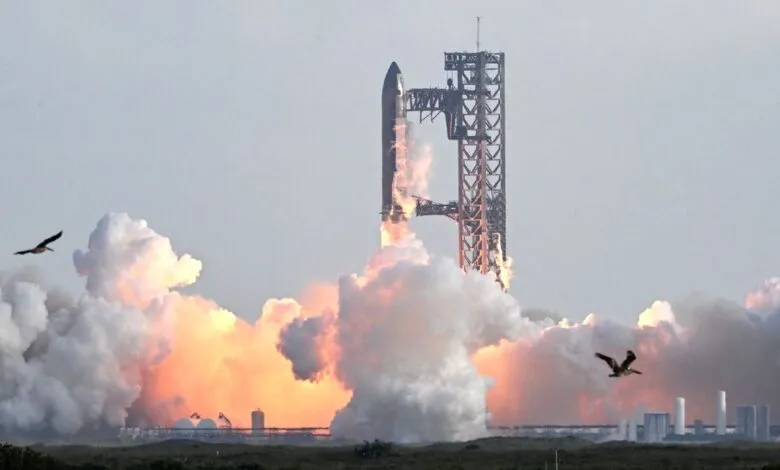
The latest SpaceX Starship test flight marks a major milestone in the company’s ambitious space program, achieving key objectives that bring reusable interplanetary travel closer to reality. After multiple delays, the massive rocket successfully launched from Starbase, Texas, demonstrating significant progress in both launch and re-entry capabilities.
On Tuesday evening, the fully stacked Starship vehicle lifted off, climbing to an altitude of 192 kilometers and accelerating to over 26,000 kilometers per hour on a suborbital path toward the Indian Ocean. The mission concluded with a controlled splashdown roughly one hour after launch, providing valuable data for future flights.
Public interest in this tenth integrated flight test reached unprecedented levels, with more than 1.8 million viewers tuning into the live broadcast. The heightened attention stems partly from previous setbacks, including a dramatic mid-flight explosion in June that destroyed an earlier vehicle. Environmental concerns and protests from local communities in Texas, as well as complaints from the Mexican government regarding falling debris, have also kept the program in the spotlight.
As a cornerstone of Elon Musk’s vision for Mars colonization, Starship represents more than a technological experiment, it is a critical asset for NASA and other U.S. government agencies planning lunar and deep-space missions. The fully reusable system comprises the Super Heavy booster, equipped with 33 Raptor engines, and the Starship spacecraft itself, designed to carry crew and cargo beyond Earth’s orbit.
This mission included several secondary objectives that were successfully met. Eight Starlink satellite simulators, matching the dimensions of upcoming V3 models, were deployed over the Atlantic Ocean. The Super Heavy booster executed a precise splashdown in the Gulf of Mexico shortly after stage separation, while the upper stage continued its journey across the globe.
During high-speed re-entry, visible damage occurred on the spacecraft’s heat shield and exterior, but the vehicle remained largely intact until its final descent. The flight ended with the planned destruction of the ship during its landing attempt over the ocean, a deliberate part of the test profile aimed at gathering engineering data under extreme conditions.
SpaceX engineers now have a wealth of information to review as they continue refining the design and operation of what could become humanity’s most capable launch system.
(Source: Wired)