Why Aren’t There Any Great Superman Games?
▼ Summary
– Superman has struggled to have a successful video game despite being a pop culture icon, lacking a standout title like Batman’s Arkham series or Spider-Man games.
– The core challenge is balancing Superman’s overpowered abilities (strength, flight, invulnerability) while creating engaging gameplay with meaningful challenges.
– Past Superman games often weakened his powers or used restrictive mechanics (limited-use meters, protection missions), failing to capture the true Superman experience.
– Superman 64 is infamous for its poor design, clunky controls, and frustrating gameplay, representing a low point in the franchise’s gaming history.
– Modern solutions could involve narrative-driven gameplay, epic boss battles, or prioritizing flight mechanics over combat, but no developer has yet cracked the formula.
Superman remains one of the most iconic superheroes in history, yet video game developers still struggle to translate his godlike abilities into compelling gameplay. Despite decades of attempts, no studio has managed to deliver a truly great Superman game, one that captures the thrill of his powers while maintaining meaningful stakes. With James Gunn’s upcoming Superman film reigniting interest in the character, now is the perfect time to examine why gaming’s most powerful hero has never soared to the heights of Batman or Spider-Man.
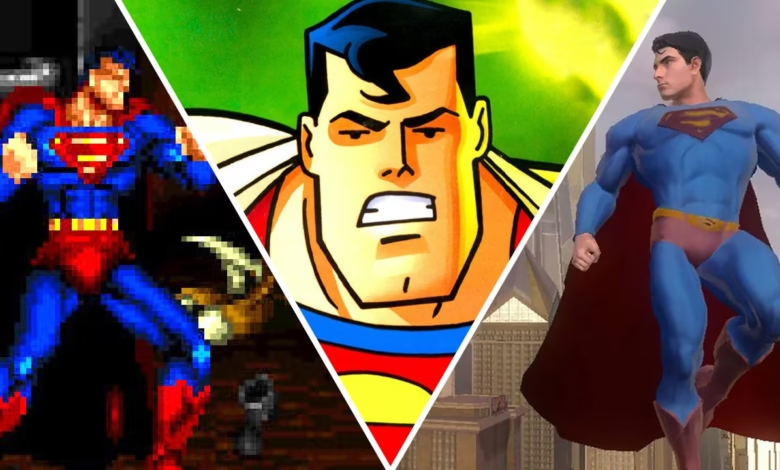
The core challenge lies in Superman’s overwhelming power set. Unlike grounded heroes who rely on gadgets or martial arts, Kal-El boasts near-invincibility, super-speed, flight, and an arsenal of abilities like heat vision and freeze breath. Early games tried to balance this by artificially limiting his powers, think energy meters that drained with each use, but that approach only made players feel weaker, not heroic. The 1978 Atari 2600 game forced Superman to seek Lois Lane’s kiss to restore his abilities after Kryptonite exposure, while the NES version locked his powers behind frustratingly finite resources. Neither captured the essence of being Superman.
By the 1990s, developers shifted toward generic side-scrolling brawlers, like The Death and Return of Superman, which reduced the Man of Steel to punching through waves of faceless enemies. These games kept Superman relevant but failed to innovate. Then came Superman 64, a notorious disaster that remains a benchmark for bad game design. Its clunky flight mechanics, endless ring challenges, and fog-covered Metropolis made it nearly unplayable, proof that nailing Superman’s movement in 3D was no easy feat.
Later attempts, like Superman Returns (2006), tried a different approach: making Superman himself invincible while tasking players with protecting Metropolis. The city had a health bar, not the hero. On paper, this made sense, Superman’s greatest struggle isn’t surviving, but saving others. Yet poor controls, repetitive missions, and a baffling final boss (a tornado) doomed the experiment. Protection mechanics are notoriously tricky to execute well, and without refined AI or engaging objectives, they quickly become tedious.
So where does the franchise go from here? Modern developers might need to rethink the traditional action-game formula entirely. Combat doesn’t have to be the focus, games like Death Stranding and Shadow of the Colossus prove that exploration and epic boss battles can drive engagement. Imagine a Superman game where players face off against towering threats like Doomsday or Darkseid, with flight and super-speed making traversal as exhilarating as combat.
Flight, above all else, is the key. Just as web-swinging defines Spider-Man games, Superman’s ability to soar should feel effortless and thrilling. No game has yet perfected it, but the right studio could take inspiration from Spider-Man 2 (2004), which set the standard for superhero movement.
With James Gunn’s film on the horizon, there’s hope that a bold developer will finally crack the code. Superman deserves a game that lets players truly embody his power, without sacrificing challenge or excitement. Until then, the Man of Steel’s gaming legacy remains frustratingly grounded.
(Source: IGN)