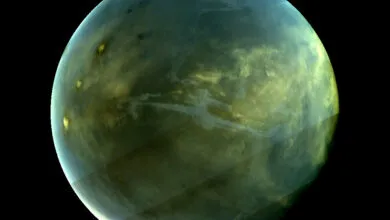
New Study Reveals Mars Had a Cold, Harsh Climate

▼ Summary
– The Curiosity rover found evidence that Martian sedimentary rocks may have sequestered carbon dioxide, reducing the planet’s greenhouse effect.
– Scientists led by Benjamin Tutolo concluded Mars had a carbon cycle that could explain past liquid water on its surface.
– Edwin Kite’s team developed the first Martian climate model incorporating topography, solar luminosity, and other factors over 3.5 billion years.
– Earlier Mars climate models lacked either long-term or high spatial resolution, but Kite’s model combined both for the first time.
– The model suggests Martian life would have faced harsh conditions, starting from the “era of salts” 3.5 billion years ago.
New research suggests Mars once had a frigid, inhospitable climate, challenging previous assumptions about the planet’s warmer past. The findings come from data collected by NASA’s Curiosity rover during its ascent of Mount Sharp, the tallest sedimentary formation on Mars. Samples analyzed by the rover revealed traces of carbon dioxide trapped in ancient rocks, a process similar to how limestone forms on Earth. This discovery indicates that Mars may have experienced a carbon cycle that gradually stripped greenhouse gases from its atmosphere, leading to dramatic cooling.
A team of planetary scientists, including researchers from the University of Chicago and the University of Calgary, developed the first detailed climate model incorporating these findings. The model accounts for Martian geography, solar radiation, and orbital dynamics over billions of years, painting a clearer picture of how the planet’s environment changed. Unlike earlier simulations that treated Mars as a single, uniform entity, this new approach factors in terrain variations, mountains, valleys, and ancient river systems, while tracking long-term atmospheric shifts.
The results suggest that even when liquid water existed on Mars, conditions were likely harsh and freezing. “Previous models either lacked detail or couldn’t simulate extended time periods,” explained Edwin Kite, lead researcher on the study. “Our work bridges that gap, showing how Mars transitioned from a world with sporadic water to the barren landscape we see today.”
The study focuses on a period roughly 3.5 billion years ago, referred to as the “era of salts,” when minerals began accumulating in drying lakebeds. These findings imply that any potential microbial life would have faced extreme challenges, surviving in brief, isolated pockets rather than thriving in a stable, Earth-like environment.
By combining geological evidence with advanced simulations, scientists are gaining unprecedented insight into Mars’ climatic history, revealing a planet far colder and more hostile than once imagined.
(Source: Ars Technica)