Europe’s Top 5 Launcher Challenge Contenders Revealed
▼ Summary
– The European Space Agency (ESA) has chosen five launch startups, Isar Aerospace, MaiaSpace, Rocket Factory Augsburg, PLD Space, and Orbex, to compete for up to 169 million euros in funding as alternatives to Arianespace.
– Only Isar Aerospace has attempted an orbital launch, which failed during a test flight in March, while the other companies have yet to launch a rocket.
– No company is guaranteed funding; ESA and the startups will negotiate with European governments before final decisions are made at the November ministerial council meeting.
– ESA labeled the five as “preselected challengers” competing for launch contracts and a demonstration to showcase upgraded vehicles for heavier payloads, though all currently focus on small rockets.
– ESA is temporarily abandoning its “geographic return” policy for this competition, which normally ensures funding distribution based on member states’ contributions.
Europe has taken a bold step toward securing its independent access to space by shortlisting five promising rocket startups for a high-stakes funding competition. The European Space Agency revealed its selection of Isar Aerospace, MaiaSpace, Rocket Factory Augsburg, PLD Space, and Orbex as potential challengers to established players like Arianespace. These companies could share up to 169 million euros in development funding, though no guarantees exist until final budget approvals later this year.
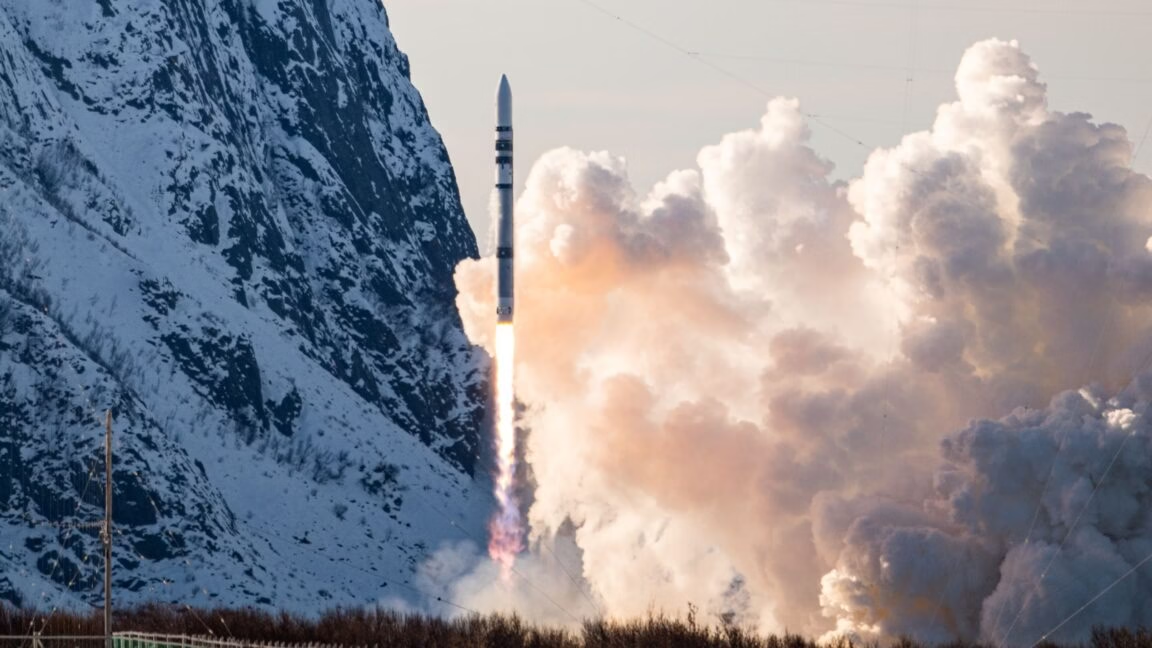
Among the contenders, only Isar Aerospace has attempted an orbital launch, a March test flight from Norway that ended prematurely when its Spectrum rocket failed shortly after liftoff. The other four firms remain in earlier development phases, with all currently focused on small satellite launch vehicles rather than heavy-lift capabilities. ESA plans to evaluate their progress through technical demonstrations before committing to formal contracts.
This initiative marks a significant departure from ESA’s traditional procurement approach. For decades, the agency operated under geographic return rules, which tied industrial contracts to member states’ financial contributions. Projects like the Ariane 6 rocket followed this model, with France and Germany securing major manufacturing roles as primary funders. The new competition deliberately bypasses these requirements, aiming instead to foster innovation and accelerate Europe’s commercial launch capabilities.
The selection process began earlier this year when ESA invited proposals for its European Launch Challenge, receiving twelve submissions before narrowing the field to five. Final funding decisions hinge on negotiations between the startups, national governments, and ESA leadership ahead of November’s ministerial council meeting. Until then, the preselected companies must prove their technical and financial viability while competing for a limited pool of resources.
By backing multiple independent ventures, ESA hopes to cultivate a more dynamic and competitive space sector. The strategy mirrors successful models seen in the U.S., where private companies like SpaceX and Rocket Lab transformed the launch industry. Whether Europe’s challengers can achieve similar disruption remains uncertain, but the agency’s willingness to break with tradition signals a clear shift in priorities toward rapid, cost-effective access to orbit.
(Source: Ars Technica)