Double Detonation: New Evidence in Supernova Research
▼ Summary
– Type Ia supernovae are crucial for measuring cosmic distances due to their consistent brightness, aiding in the discovery of dark energy’s role in the Universe’s expansion.
– These supernovae result from white dwarf explosions, which occur when added mass triggers runaway fusion, though the source of this mass is debated.
– An alternative “double detonation” theory suggests small surface explosions can compress a white dwarf’s interior to restart fusion without reaching critical mass.
– White dwarfs, remnants of Sun-like stars, are rich in carbon and oxygen but cannot fuse them further unless additional mass is acquired.
– In binary systems, white dwarfs can gain mass from companion stars, potentially reaching the threshold needed to reignite fusion and cause a supernova.
Astronomers have uncovered compelling new evidence supporting an alternative theory about how certain stellar explosions occur, potentially reshaping our understanding of cosmic distance measurements. Type Ia supernovae serve as cosmic yardsticks because their uniform brightness allows scientists to calculate vast interstellar distances with remarkable precision. These measurements played a pivotal role in discovering the accelerating expansion of the universe, driven by the mysterious force known as dark energy. Despite their importance, the exact mechanisms triggering these explosions remain hotly debated.
The prevailing view suggests these supernovae originate from white dwarfs, dense stellar remnants composed mainly of carbon and oxygen. Normally stable, these objects can explode if they accumulate enough additional mass, typically by siphoning material from a companion star. However, recent findings point to another possibility: a “double detonation” scenario where a smaller surface explosion compresses the dwarf’s core, igniting runaway fusion even before critical mass is reached.
White dwarfs represent the final evolutionary stage for stars like our Sun. After exhausting their nuclear fuel, they settle into a compact, inert state, radiating residual heat over billions of years. But in binary systems, their fate can change dramatically. Gravitational interactions with a neighboring star may transfer enough matter to push the dwarf past its stability limit, triggering a cataclysmic explosion.
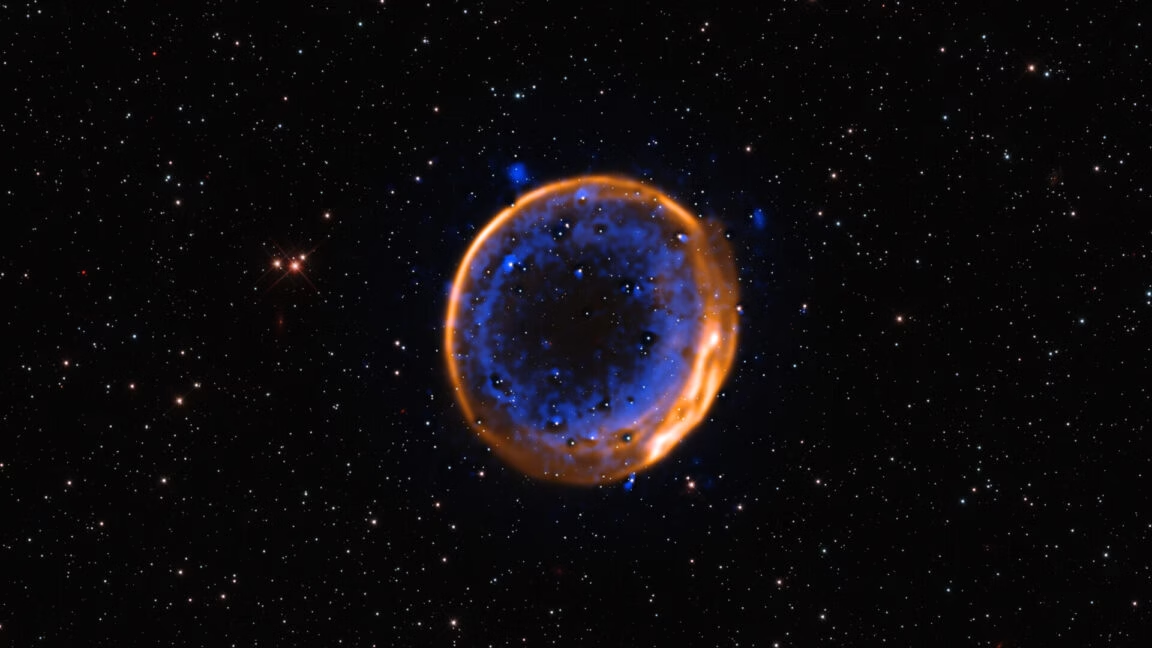
The double detonation model offers a twist on this narrative. Instead of requiring a massive influx of material, a localized detonation on the dwarf’s surface could generate shockwaves that compress the core, sparking fusion prematurely. Observations of supernova remnants now provide tangible support for this theory, revealing chemical signatures consistent with layered explosions.
This discovery could refine how astronomers interpret Type Ia supernovae, ensuring more accurate cosmic distance calculations. By clarifying the conditions that lead to these stellar detonations, researchers move closer to unraveling the broader mysteries of dark energy and the universe’s expansion. The findings underscore the dynamic nature of stellar physics, where even well-established theories continue to evolve with new evidence.
(Source: Ars Technica)