Tuesday Telescope: Spot the Howling Wolf Constellation
▼ Summary
– The Tuesday Telescope focuses on real science and cosmic wonders, contrasting with pseudoscience like horoscopes.
– In the 1800s, unusual emission lines in stars were later explained by the discovery of helium in 1868.
– Wolf-Rayet stars, named after astronomers Charles Wolf and Georges Rayet, are central stars in planetary nebulae that eject gas at high speeds.
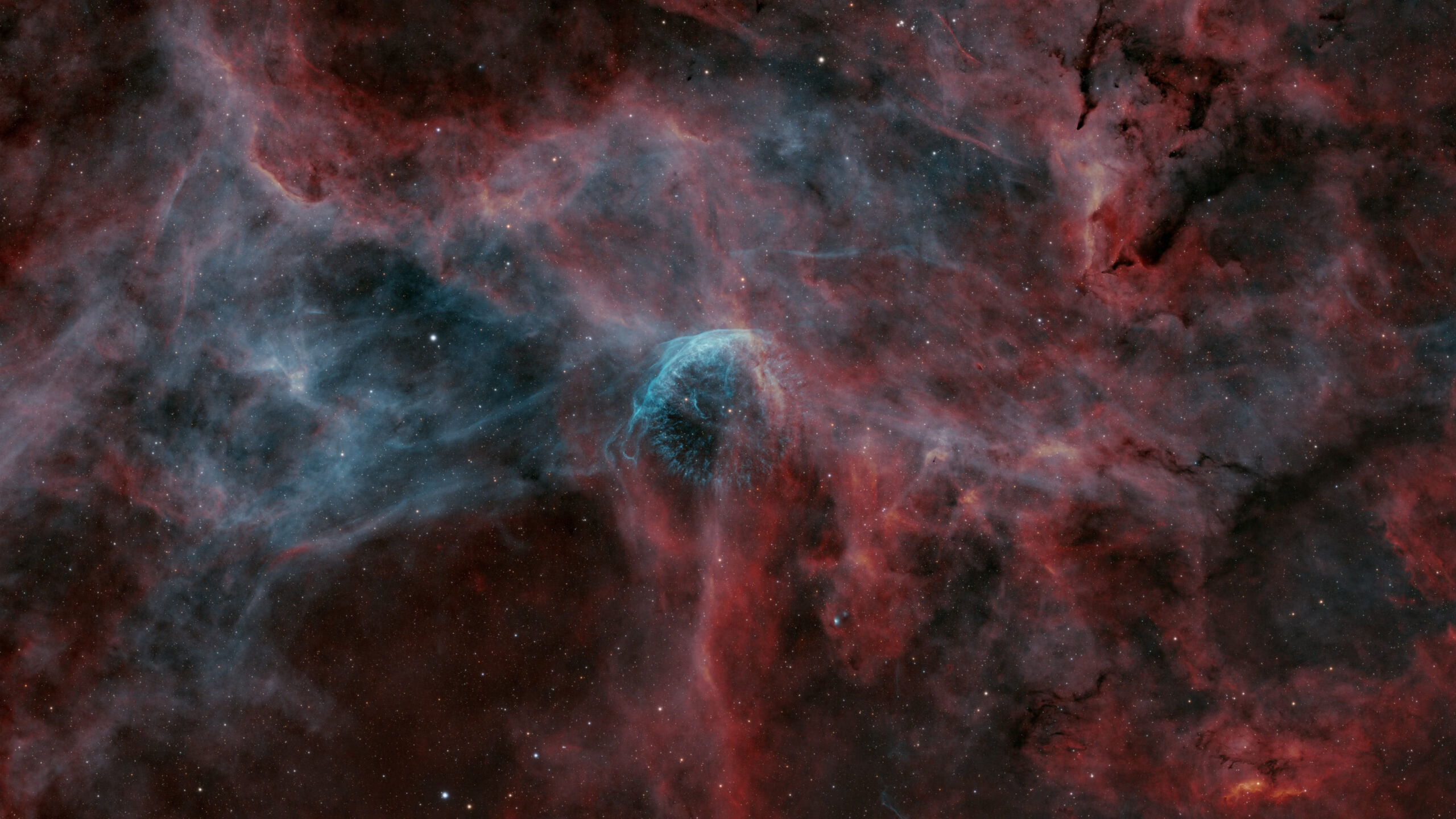
– Chris McGrew captured an image of WR 134, a Wolf-Rayet star 6,000 light-years away, showing ionized oxygen gas blown by stellar winds.
– McGrew highlights WR 134 as a prized deep-sky object he finally photographed after years of waiting for ideal conditions.
Gazing into the cosmos reveals wonders far beyond our everyday experience, and few celestial sights capture the imagination like the dramatic Wolf-Rayet stars. These stellar phenomena offer a breathtaking glimpse into the violent beauty of our universe, where massive stars shed their outer layers in spectacular fashion.
Back in the 19th century, astronomers were puzzled by strange emission lines coming from certain stars. The mystery wasn’t solved until helium was identified in 1868, revealing that these unusual spectral signatures came from stars rich in this element. Named after French astronomers Charles Wolf and Georges Rayet, Wolf-Rayet stars are now known to be massive, short-lived stars surrounded by rapidly expanding gas clouds.
One particularly striking example is WR 134, a variable star located roughly 6,000 light-years away in the constellation Cygnus. Astrophotographer Chris McGrew recently captured a stunning image of this celestial object from the dark skies of New Mexico. The photo reveals a brilliant blue shell of ionized oxygen gas, sculpted by powerful stellar winds.
McGrew described the experience of photographing WR 134 as a long-awaited achievement. “This deep-sky object has been imaged countless times, and I completely understand why,” he said. “Ever since I first saw it, I knew I had to capture it myself. It took years before I had the right conditions and time, but finally getting the shot was worth the wait.”
For those eager to explore the night sky, Wolf-Rayet stars like WR 134 serve as a reminder of the universe’s dynamic nature. If you’ve captured an awe-inspiring celestial image, consider sharing it, the cosmos always has more wonders to reveal.
(Source: Ars Technica)