2026 Nissan Leaf: What We Know So Far

▼ Summary
– Nissan covered travel costs for Ars to preview the 2026 Leaf, though Ars maintains editorial independence.
– The 2026 Leaf is Nissan’s most critical EV launch since the original, needing to compete with stronger rivals.
– It offers two battery options (52 kWh and 75 kWh) with active thermal management and up to 303 miles of range.
– The new Leaf is slightly smaller and more aerodynamic, with a space-efficient interior and improved powertrain integration.
– It features a NACS port for DC fast charging (35 min for 10-80%) and a J-1772 connector for AC charging, though the setup may confuse users.
The 2026 Nissan Leaf represents a crucial step forward for the brand, bringing significant upgrades to compete in today’s crowded EV market. Building on the legacy of the original mass-market electric vehicle, this latest iteration addresses past shortcomings while introducing modern technology that buyers now expect.
Two battery options will be available: a 52 kWh base pack and a 75 kWh extended-range variant, both featuring active thermal management, a first for the Leaf lineup. This improvement directly tackles previous concerns about fast-charging performance. The larger battery delivers an impressive 303 miles (488 km) of range in the S+ trim, making it far more competitive with rivals.
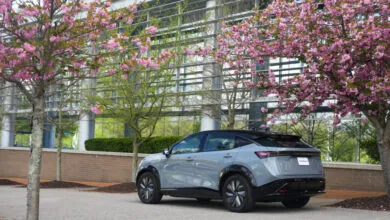
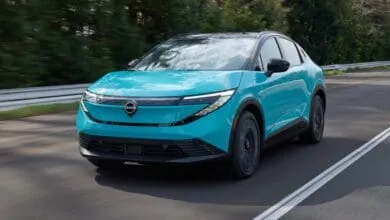
Design refinements include a slightly shorter overall length (3 inches/76 mm) while maintaining nearly the same wheelbase, ensuring interior space isn’t compromised. The car is also 0.8 inches (20 mm) wider, with a sleeker profile that reduces drag. Inside, Nissan has optimized cabin efficiency, offering more usable space despite the compact exterior dimensions.
Under the hood, or rather, beneath the floor, the Leaf adopts Nissan’s new 3-in-1 powertrain, combining the motor, inverter, and reducer into a single unit. This not only saves space but also enhances driving dynamics with improved responsiveness. Power outputs vary by battery size: 174 hp (130 kW) for the 52-kWh model and 215 hp (160 kW) for the 75-kWh version.
Charging capabilities see a major overhaul, ditching the outdated CHAdeMO connector in favor of a Tesla-style NACS port for DC fast charging. However, AC charging still requires the SAE J-1772 plug, located on the opposite side of the vehicle. While this dual-port setup might confuse some owners, Nissan claims the system will provide clear guidance to prevent charging errors.
Fast-charging performance is notably improved, with both battery sizes reaching 10-80% in just 35 minutes when connected to a 150 kW DC charger. Though not class-leading, it’s a dramatic leap over the previous model and even surpasses the Ariya’s peak charging rate.
With these upgrades, the 2026 Leaf aims to reclaim its position as a practical, affordable EV, but in a market where competitors have raised the bar, Nissan must deliver flawlessly to stand out.
(Source: Ars Technica)