Artemis Program’s Next Challenge: Safe Reentry

▼ Summary
– For NASA, the most critical phase of a lunar mission is the spacecraft’s high-speed reentry into Earth’s atmosphere, which lasts under 20 minutes.
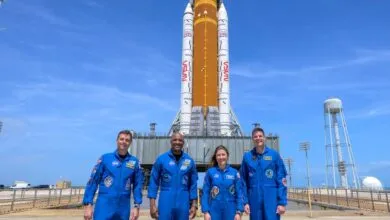
– The Artemis II crew will be the first to return from lunar orbit in 50 years and will experience reentry at nearly twice the speed of a return from the International Space Station.
– During reentry, the Orion capsule will endure temperatures of 2,700°C and a communication blackout while relying on its heat shield for protection.
– The heat shield is made of Avcoat, a material designed to ablate, or burn away in a controlled manner, to protect the crew.
– During the uncrewed Artemis I test, the Avcoat shield eroded unevenly and more than expected, deviating from engineering models.
For NASA’s Artemis program, the final and most demanding phase of a lunar mission is not the journey out, but the fiery return home. The Artemis II astronauts will experience a reentry unlike any other in the modern era, facing extreme speeds and temperatures that will push their new spacecraft to its absolute limits.
This crew is set to become the first humans in half a century to travel to lunar orbit. Their return trip will subject the Orion capsule to velocities approaching 11 kilometers per second, nearly double the speed of a typical return from the International Space Station. At this pace, the spacecraft will slam into Earth’s atmosphere and generate a plasma cocoon with temperatures soaring to 2,700 degrees Celsius. For roughly six minutes, the crew will be out of contact with mission control, experiencing intense deceleration while relying on a single critical component: their heat shield.
Constructed from a material called Avcoat, this shield is engineered to ablate, or burn away in a controlled manner, carrying the immense heat away from the capsule. It is the only barrier protecting the astronauts from the inferno outside. However, the shield’s performance remains a paramount concern following its first uncrewed test.
During the Artemis I mission, the Orion capsule’s return from the moon revealed unexpected issues with the Avcoat. Instead of wearing down evenly as predicted by computer models, the material eroded unevenly and shed more mass than anticipated. These erosion patterns did not match engineering projections, highlighting a significant challenge that must be resolved before a crew flies. The success of the entire program hinges on understanding and perfecting this final, violent dance with Earth’s atmosphere.
(Source: Wired)