Oppo’s New Foldable: Nearly Creaseless Display Revealed

▼ Summary
– The Oppo Find N6’s foldable screen has an extremely subtle crease that is the least obtrusive the reviewer has encountered, being barely visible or feelable.
– Oppo achieved this using a 3D liquid printing process on the hinge to fill surface variations, resulting in an average smoothness of just 0.05mm.
– The company claims the crease will remain minimal over time due to the use of a thicker, more resilient type of foldable glass.
– Confirmed specifications include at least one 200-megapixel camera, stylus support, and IP56/58/59 dust and water resistance ratings.
– The phone’s full “global” launch is scheduled for March 17th, though its actual market availability remains uncertain based on the previous model’s limited release.
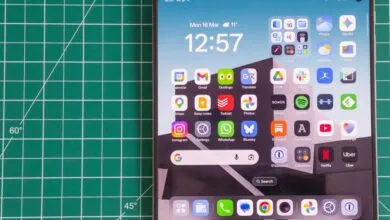
When you first pick up a foldable phone, your eyes likely dart straight to the screen’s center, searching for that telltale line. With the upcoming Oppo Find N6, you might find yourself squinting. The company is making a bold claim about this device, set for a full reveal on March 17th: it features the world’s first “zero-feel crease” foldable display. While calling it “zero” might be a slight exaggeration, the reality is impressively close. The crease is there, but you have to consciously seek it out to feel it under your thumb. Spotting it visually is just as difficult; it only becomes faintly visible under specific lighting and angles. This is, without question, the most subtle screen fold I have encountered on any device to date, so minimal that it’s hard to picture it ever being a genuine annoyance.
Oppo’s secret weapon for this near-invisible fold is an innovative manufacturing technique called 3D liquid printing. The core issue with creases stems from microscopic height variations on the hinge’s surface beneath the screen. Oppo’s solution is to meticulously fill these tiny gaps. A laser first scans the hinge to map every imperfection. A photosensitive polymer is then precisely printed into those low points and instantly hardened with UV light. This intricate process is repeated over twenty times, resulting in an average surface variation of a mere 0.05mm, thinner than a single strand of human hair.
Durability is another key focus. Oppo asserts that the Find N6’s crease will remain this discreet over the phone’s entire lifespan, resisting the deepening that can plague other foldables. To back this up, they are employing a slightly thicker grade of foldable glass, which is more resistant to permanent deformation and has better shape recovery. While long-term testing isn’t possible in a brief review period, the company demonstrated a prototype allegedly folded 200,000 times. Its crease felt indistinguishable from the pristine unit in my hands.
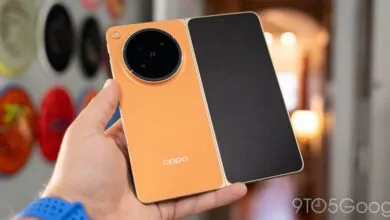
With the official launch still days away, Oppo is holding many specifications close to its chest. Confirmed features include at least one 200-megapixel camera, support for a stylus, and multiple ingress protection ratings (IP56, IP58, and IP59) for dust and water resistance. It’s worth noting that these ratings do not quite match the top-tier IP69 of the Honor Magic V6 or the IP68 of the Google Pixel 10 Pro Fold. The phone maintains a slim profile, comparable to last year’s Oppo Find N5 and the Samsung Galaxy Z Fold 7. Color options will include the silvery shade of the review model and a vibrant, iPhone-inspired orange.
All remaining details, including the crucial pricing and market availability, will be unveiled on March 17th. Oppo is promoting this as a “global” launch, but given that last year’s Find N5 was limited to China and a few Asian markets, the true extent of its worldwide release remains to be seen.
(Source: The Verge)