Donut Lab’s Solid-State Battery Passes Key Test, Confirms It’s Not a Supercapacitor

▼ Summary
– Donut Lab, a Finnish startup, has released independent test results to counter speculation that its new solid-state battery is actually a supercapacitor.
– The test, conducted by VTT Technical Research Centre of Finland, showed the battery retained 97.7% of its energy over a 10-day idle period, demonstrating stability unlike a supercapacitor.
– The company claims its battery has exceptional specifications, including an energy density of 400 Wh/kg and the ability to charge in under 10 minutes for 100,000 cycles.
– These claims are considered highly ambitious, as they far exceed the performance of current lithium-ion batteries used in electric vehicles.
– Significant unknowns remain, including independent verification of the battery’s chemistry and how it solves the dendrite problem common in solid-state batteries.
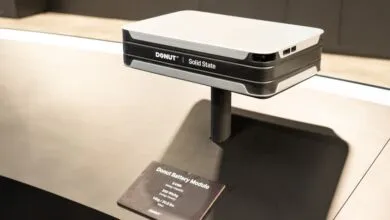
A Finnish startup has released new test results that strongly support its claim of developing a revolutionary solid-state battery, directly countering speculation that its technology is merely a supercapacitor. Donut Lab’s solid-state battery recently underwent a critical charge retention test, which is a key differentiator between long-term energy storage batteries and short-term power devices like supercapacitors. The independent evaluation, conducted by Finland’s VTT Technical Research Centre, focused on the cell’s ability to hold a charge while idle over an extended period.
This marks the third round of independent testing commissioned by the startup to validate its extraordinary performance claims. In a recent statement, CEO Marko Lehtimäki addressed the skepticism head-on, noting that many observers believed such specifications were only possible with supercapacitor technology. The latest data, he asserts, proves otherwise.
For the test, VTT connected the cell to specialized equipment and monitored its voltage every ten seconds across a ten-day idle period. The results showed the unit retained 97.7 percent of its stored energy, demonstrating high stability. A minor voltage drop occurred in the first hour due to initial chemical stabilization, but the charge level remained largely consistent thereafter. This behavior is fundamentally different from a supercapacitor, which typically experiences rapid and significant self-discharge over a similar timeframe, losing a substantial portion of its energy in just days. VTT’s report concludes the cell exhibits “normal battery-type charge retention,” not the linear discharge profile of a supercapacitor.
Clearing up this distinction is crucial for Donut Lab, as its performance claims are so ambitious they border on the unbelievable for many industry experts. The company states its battery achieves an energy density of 400 watt-hours per kilogram, significantly higher than the 200-300 Wh/kg typical of today’s lithium-ion cells. Furthermore, it promises a charge time under ten minutes and a lifespan of up to 100,000 cycles, dwarfing the 1,500 to 3,000 cycles expected from current battery technology. If proven true, such advancements would represent a monumental leap for electric vehicles, potentially solving key challenges around range, charging speed, and safety.
Despite these promising test results, significant questions remain unanswered. Independent analysis has yet to confirm the exact chemistry of the battery pack. A major hurdle for all solid-state battery developers, the “dendrite issue,” where metallic filaments can grow and cause short circuits, has not been publicly addressed by Donut Lab. The company plans further independent tests as part of its ongoing verification campaign, which may provide clarity on these critical engineering challenges. For now, the startup has successfully used empirical data to push back against one major point of skepticism, though the path to commercialization is long and requires much more validation.
(Source: The Verge)