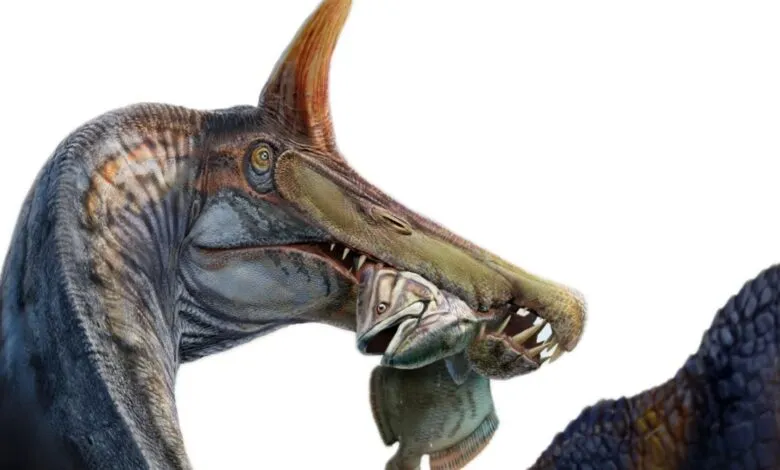
Unicorn-Like Spinosaurus Unearthed in Sahara
▼ Summary
– The Spinosaurus was initially depicted as a terrestrial predator in film, then later as a fully aquatic diver to align with updated scientific understanding.
– New fossil discoveries in the Sahara Desert, led by paleontologist Paul C. Sereno, challenge the idea that Spinosaurus was an aquatic diver.
– Previous evidence supporting an aquatic lifestyle came from fossils found in coastal deposits, suggesting it lived near ancient seas.
– The new fossils were found in a terrestrial area in Niger called Jenguebi, indicating Spinosaurus inhabited inland environments, not just coasts.
– The discovery team faced a challenging expedition involving guides and armed guards, highlighting the remote and difficult nature of the find.
The discovery of new Spinosaurus fossils in the Sahara Desert is challenging long-held beliefs about this iconic dinosaur’s lifestyle, suggesting it was neither the land-based giant of early films nor the fully aquatic hunter of recent portrayals. A research team, venturing into a remote region of Niger, has unearthed evidence that paints a more complex picture of how this creature lived and moved.
For years, the understanding of Spinosaurus has shifted dramatically. Initial portrayals, like the one in Jurassic Park III, showed it as a massive terrestrial predator. Later scientific findings, supported by fossils found in ancient coastal sediments, led to a revised image of it as a semiaquatic diver, an interpretation embraced by Jurassic World: Dominion. The creature’s crocodile-like snout, dense bones, and paddle-shaped feet all seemed to support a life spent largely in the water.
However, the latest fossils tell a different story. Led by University of Chicago paleontologist Paul C. Sereno, the team excavated bones from an inland site known as Jenguebi. This area was a terrestrial environment, far from the ancient shorelines where other Spinosaurus remains have been found. “When you want to find something really, truly new, you have to go where few have been or maybe nobody has been,” Sereno noted. The expedition itself was a monumental effort, requiring a convoy with local guides and security to navigate the harsh desert terrain.
The analysis of these new bones, particularly from the tail, reveals a critical detail. The tall neural spines that formed the dinosaur’s famous sail were not structured for powerful underwater propulsion. Instead, they appear too rigid and vertically oriented for efficient swimming. This suggests the Spinosaurus was not built for deep diving or chasing prey in open water. The sail-like structure was likely used for display, to regulate body temperature, or to help stabilize the animal in shallow waters, rather than acting as a diving fin.
This finding places the Spinosaurus in a unique ecological niche. It probably inhabited riverbanks and swampy interiors, wading in shallow water to hunt fish and other aquatic prey much like a giant heron. Its body plan represents an extraordinary evolutionary experiment, a predatory dinosaur adapted for a waterside existence without being a fully aquatic swimmer. This hybrid lifestyle makes it one of the most unusual and specialized large theropods ever discovered.
The research underscores how a single discovery can reshape our understanding of prehistoric life. The Spinosaurus continues to captivate because it defies simple categorization, existing in a realm between land and water that scientists are only beginning to comprehend. Each new fossil fragment helps to correct the record, moving us closer to seeing this ancient animal not as a movie monster, but as a real creature that walked, and waded, on our planet.
(Source: Ars Technica)

