Asteroid Mission Altered More Than Its Target’s Orbit
▼ Summary
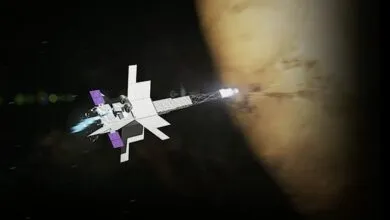
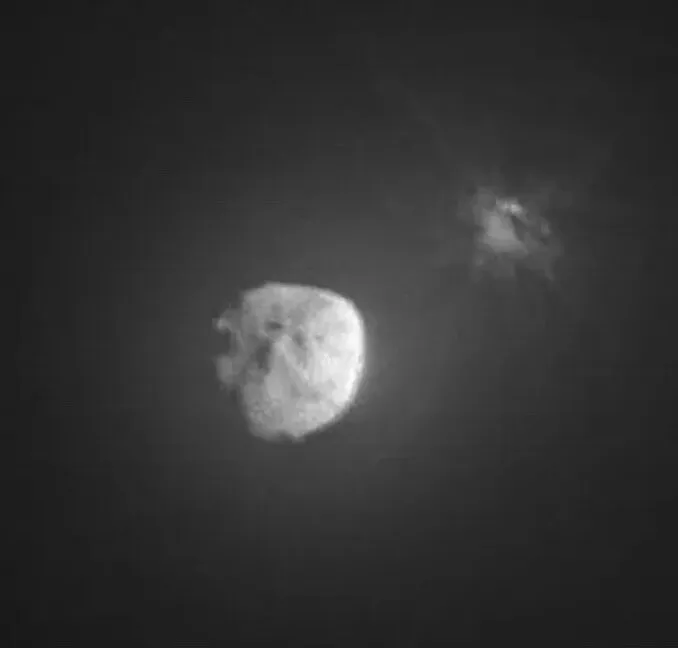
– NASA’s DART spacecraft successfully crashed into the asteroid moonlet Dimorphos on September 26, 2022, to test planetary defense.
– The impact shortened Dimorphos’s orbit around its parent asteroid, Didymos, by 33 minutes, proving the kinetic impact method works.
– Long-term data shows the collision also altered the trajectory of the entire Didymos binary system around the Sun.
– Measuring this small orbital shift required months or years of continuous observation due to its minuscule scale.
– Researchers used stellar occultation, timing when the asteroids blocked distant stars, to precisely measure the system’s new position.
The groundbreaking Double Asteroid Redirection Test (DART) mission achieved a monumental success beyond its primary goal, fundamentally altering our understanding of planetary defense. When NASA’s spacecraft intentionally collided with the asteroid moonlet Dimorphos in 2022, the immediate and celebrated result was a significant shortening of its orbit around the larger asteroid Didymos. However, new long-term analysis reveals the impact’s influence was far more profound, demonstrating that the kinetic energy from the collision actually nudged the entire binary asteroid system onto a slightly different path around the Sun. This finding confirms that such a defense strategy can affect the trajectory of an entire celestial body, not just a component part, providing crucial data for protecting Earth from future asteroid threats.
Determining this subtle shift required extraordinary precision. The change to the system’s solar orbit was incredibly small, a faint deviation that only became detectable after many months of meticulous observation. A research team led by Rahil Makadia from the University of Illinois Urbana-Champaign spearheaded the effort to measure this minute change. They faced the immense challenge of tracking the positional shift of a 780-meter-wide asteroid and its moon from a distance of millions of miles.
To accomplish this, the scientists primarily depended on a sophisticated method known as stellar occultation. This technique involves observing the precise moment an asteroid passes in front of a distant star from our viewpoint on Earth, causing the star’s light to momentarily disappear. By coordinating and timing these brief occultations as they are observed from different locations across the planet, astronomers can calculate an asteroid’s position with remarkable accuracy. This global network of observations provided the detailed data necessary to detect the almost imperceptible trajectory change imparted by the DART impact.
(Source: Ars Technica)