The Witcher’s Perfect Role: A Tinder-Style Reigns Adventure
▼ Summary
– The article discusses “Reigns: The Witcher,” a new Tinder-like, binary-choice game from Nerial that adapts The Witcher universe into a simplified, accessible format.
– A key adaptation is that players control the bard Dandelion narrating Geralt’s tales, which creatively explains the game’s death-and-restart loop and allows for humorous, non-canonical stories.
– The game is designed as both a fun, experimental “fanfiction simulator” for existing fans and an approachable entry point for newcomers intimidated by the franchise’s sprawling lore.
– It introduces a combat system that fits the Reigns formula by translating battles into the same left/right swipe mechanics used for narrative choices.
– Developers highlight that The Witcher’s world of morally gray, binary choices and dark humor makes it an ideal fit for the Reigns game structure.
The Reigns series of Tinder-style narrative games has found a surprisingly perfect match in The Witcher universe. This new adaptation transforms the sprawling fantasy saga into a streamlined, card-based adventure where every choice is a simple swipe left or right. For the developers at Nerial, this approachable format is an ideal gateway into complex worlds, allowing players to engage with rich lore through immediate, impactful decisions without the commitment of a full-scale role-playing game.
Players navigate the story by responding to a series of cards, each presenting a binary choice for the protagonist. An elf might beg for protection, a monster might demand a toll, and your only options are to accept or refuse, dealing with the cascading consequences. The core loop involves making these swift decisions to advance a narrative thread until the character meets an untimely end, which can happen in surprisingly creative ways.
This installment operates on two distinct levels. For dedicated fans of the books, games, or show, it offers a playful, experimental sandbox. It functions as a meta-commentary on the universe, akin to a fanfiction simulator, where players can explore “what if” scenarios without the constraints of canon. For newcomers, it serves as a low-stakes introduction to the tone and morally ambiguous themes that define the setting, all without the intimidating depth of a traditional RPG.
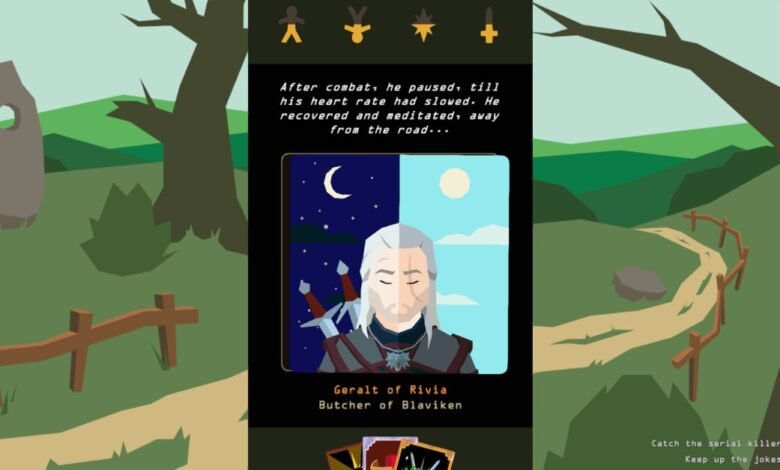
Adapting the formula required clever adjustments. A central pillar of Reigns is the cycle of death and succession, which clashed with playing an immortal character like Geralt of Rivia. The solution was a narrative twist: you are not actually controlling the witcher. Instead, you step into the boots of his bard companion, Dandelion, who is composing, and perhaps embellishing, tales of Geralt’s adventures. This creative liberty freed the team from strict lore adherence, leading to delightfully absurd and often hilarious demise scenarios that fit the bard’s tall-tale aesthetic.
This framing device proved invaluable. It provides a logical explanation for the game’s repetitive loop, as each failed story is simply a bad song ending. More importantly, it introduces a unique tension. While you are making choices for Geralt with the goal of survival, you are also, as Dandelion, trying to craft an entertaining narrative. This duality encourages experimentation, rewarding players who make seemingly illogical choices with unexpected story branches and discoveries, even after an early failure.
Another significant addition is the inclusion of combat. A Witcher experience would feel incomplete without monster slaying, but integrating battles threatened to overcomplicate the game’s elegant simplicity. The developers implemented a rhythmic, board-based system where players swipe to move Geralt side-to-side, attacking foes or dodging their strikes. Crucially, the control scheme remains identical; whether navigating a political dilemma or a fight with a striga, every action still boils down to that fundamental left or right swipe.
Beyond these mechanical tweaks, the world of The Witcher is a natural fit for the Reigns structure. Its signature blend of dark humor and grim realities, populated by factions with clashing agendas, provides fertile ground for compelling choices. Most fitting of all is the protagonist himself. Geralt is perpetually faced with morally ambiguous, no-win scenarios, a perfect translation for a game built entirely on binary decisions within a universe where there are rarely clear-cut right answers.
(Source: The Verge)